
Hong Kong is a Special Administrative Region of China, not a country, and its main route for founders — the one this guide calls the Hong Kong startup visa — sits inside the territory’s General Employment Policy rather than standing alone as a dedicated scheme. Under the current rules, an entrepreneur applies through Investment as Entrepreneurs, submits everything online, and can expect a decision in about four weeks rather than the several months often quoted elsewhere. This guide sets out who qualifies for the Hong Kong startup visa, what it costs, how long it takes, and when a different route — the Top Talent Pass Scheme or the New Capital Investment Entrant Scheme — will get a founder to Hong Kong faster.
H-1B to green card: key takeaways
- Hong Kong is a Special Administrative Region of China, not a country — and it runs no scheme officially named a “startup visa.” Founders apply under Investment as Entrepreneurs, part of the General Employment Policy (GEP).
- Postal applications were discontinued; every application now goes through the online portal at gov.hk.
- Processing normally takes about 4 weeks, not the 3–5 months once reported.
- Stay follows a 3+3+2 pattern: an initial 3-year grant, a 3-year first extension, then 2-year extensions after that.
- Fees are HK$600 (application) plus HK$1,300 (visa issuance for stays over 180 days) per applicant or dependant.
- Most founders who qualify by income or an elite university degree reach Hong Kong faster through the Top Talent Pass Scheme; those with HK$30 million to deploy can skip the business plan entirely under the New Capital Investment Entrant Scheme.
- Continuous residence of 7 years remains the path to the Right of Abode.
Table of Contents
What Is the Hong Kong Startup Visa?
What’s commonly called the Hong Kong startup visa is not a named visa category at all. It is the Immigration Department’s “Investment as Entrepreneurs” stream, administered under the General Employment Policy (GEP) — the same broad framework that covers skilled professional hires. The Immigration Department assesses each application on three grounds: character and security, the applicant’s education or relevant experience, and — most heavily — the economic contribution the proposed business would make to Hong Kong, judged on the business plan, projected turnover, financial resources, job creation, and any new technology or skills the venture would bring in.
There is no fixed minimum investment. What matters is whether the Immigration Department is satisfied the applicant has enough capital to get the business running and whether the venture is judged to be a genuine benefit to the local economy. Applicants entering through a recognised local programme — StartmeupHK, Cyberport Incubation, Incu-App/Bio/Tech, the Hong Kong Science and Technology Parks’ incubators, the Enterprise Support Scheme, or the Design Incubation Programme — tend to be viewed more favourably, particularly if they are a proprietor, partner, or key researcher in the business.
For founders comparing options across other countries, our startup visa guides by country cover which schemes remain open in 2026 and which have closed. Founders weighing a European base against Hong Kong most often shortlist Denmark, where the Startup Denmark visa also turns on a business plan rather than a capital minimum but admits only 75 people a year.
Hong Kong Startup Visa Eligibility
To qualify under Investment as Entrepreneurs, an applicant must meet all of the following:
- No security objection and no known record of serious crime.
- Normally a first degree in a relevant field — though good technical qualifications, proven professional ability, or relevant experience can substitute in appropriate cases.
- A business plan that demonstrates substantial economic benefit to Hong Kong, covering the business’s turnover projections, the applicant’s own financial resources, the capital being invested, the jobs the business will create locally, and any technology or expertise it introduces.
- The business is registered in Hong Kong, with supporting documentation from a sponsor — either a local individual or a Hong Kong-registered company — who backs the application.
- Where relevant, backing from a recognised funding institution or a government-backed incubator programme, which strengthens the economic-contribution case.
None of this requires the applicant to already hold Hong Kong residency. It does require a business that can be shown, on paper, to be viable and beneficial — which is the part of the Hong Kong startup visa process most applications fall down on, since a thin or generic business plan gives the Immigration Department nothing concrete to assess.
Hong Kong Startup Visa vs Top Talent Pass and New CIES
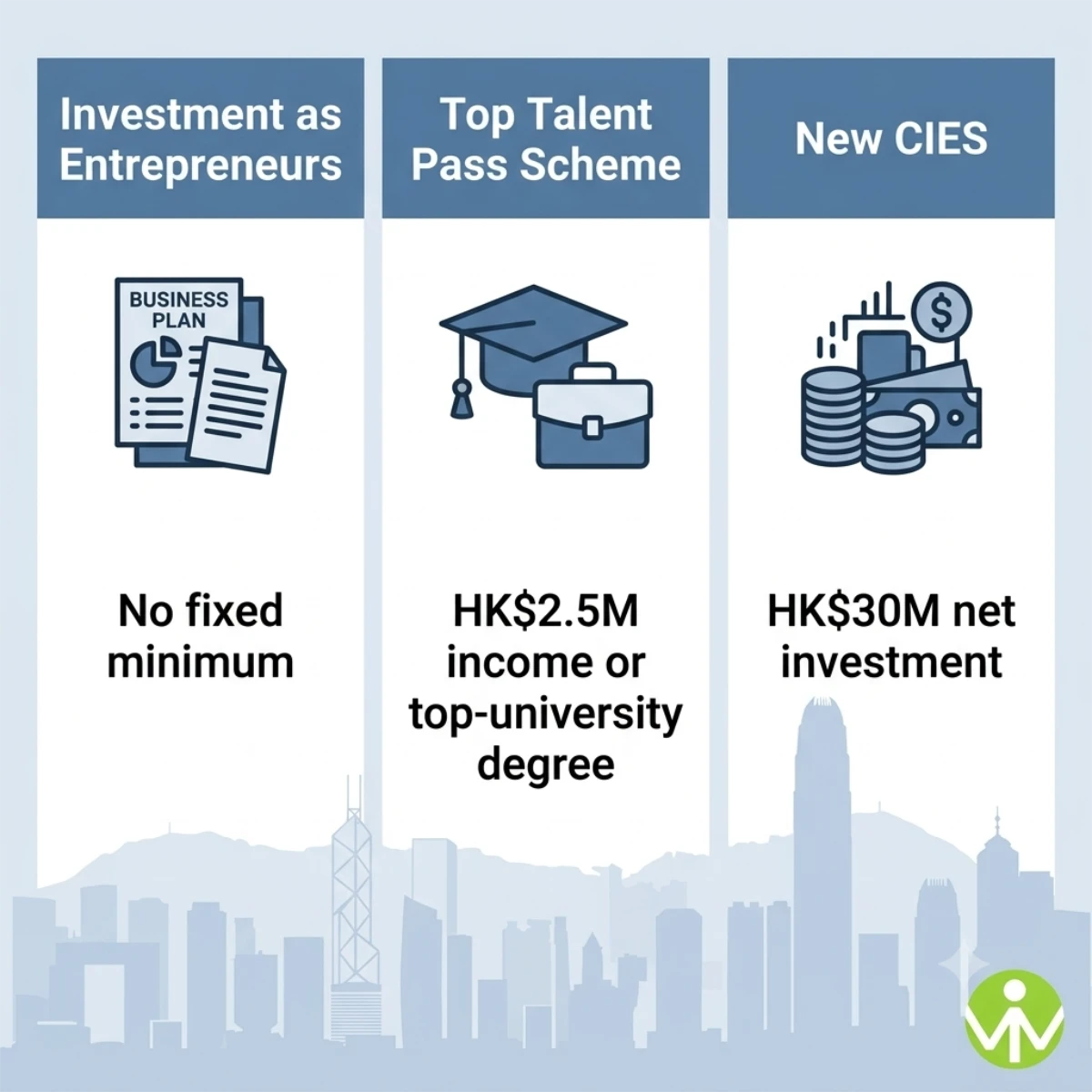
Table 1 — Hong Kong Startup Visa vs Top Talent Pass Scheme vs New CIES
| Feature | Investment as Entrepreneurs (GEP) | Top Talent Pass Scheme (TTPS) | New CIES |
|---|---|---|---|
| Basis of qualification | A viable, fundable Hong Kong business plan | Income of HK$2.5M+/year (Cat A) or a qualifying university degree (Cat B/C) | HK$30 million net investment |
| Business plan required? | Yes — the core of the application | No | No |
| Local sponsor required? | Yes — individual or company | No | No |
| Minimum capital | No fixed minimum; must cover running the business | No minimum capital requirement | HK$30 million net (HK$27M assets + HK$3M CIES portfolio) |
| Initial stay | Up to 3 years | 3 years (Cat A) / 2 years (Cat B & C) | Not employment-conditioned |
| Application + issuance fee | HK$600 + HK$1,300 | HK$600 + HK$1,300 | Not separately published |
| Job/business mobility | Tied to the approved business | Unrestricted — can change employment or business freely | Not employment-conditioned |
| Best fit | Founders whose strongest case is the business itself | Most founders who clear the income or degree bar — usually fastest | Investors who don’t plan to run a business day to day |
| Figures verified against immd.gov.hk and newcies.gov.hk, 31 August 2026. New CIES’s own visa/entry-permit fee is not separately published by the Immigration Department — confirm directly before budgeting. | |||
Not every founder needs to build a case around a business plan and a local sponsor. Two other Hong Kong schemes — both introduced after this page was last written — now account for a large share of the territory’s founder and investor inflow, and either can be faster than the entrepreneur route for the right applicant.
The Top Talent Pass Scheme (TTPS) needs no business plan and no local sponsor at all. Category A covers applicants with an annual income of HK$2.5 million or more in the preceding year, including salary, allowances, and business profits. Categories B and C cover graduates of a list of top-ranked universities — with Category C, for recent graduates with under three years’ experience, capped at 10,000 applicants a year on a first-come, first-served basis.
A founder who already clears the income bar, or holds a qualifying degree, will generally find TTPS the fastest way into Hong Kong: there is nothing to prove about the business itself before arrival, and TTPS holders can change or start a business without seeking prior Immigration Department approval — a freedom the entrepreneur stream does not offer. This is why most founders who reach this page will be better served by TTPS than by the Hong Kong startup visa route that this article otherwise describes.
The New Capital Investment Entrant Scheme (New CIES) sits at the opposite end from both: it asks for no business plan and no employment condition, only capital — a minimum of HK$30 million net (about US$3.85 million), split between HK$27 million in permissible financial or real-estate assets and a mandatory HK$3 million placed in the CIES Investment Portfolio managed by the Hong Kong Investment Corporation. New CIES suits an investor who wants Hong Kong residency without running a company day-to-day, which is a very different profile from the founder this article is otherwise written for.
In short: choose Investment as Entrepreneurs if a real, fundable business plan is the strongest asset and neither the TTPS income/education bar nor the New CIES capital threshold is met. Choose TTPS first if either bar is cleared. Choose New CIES only if deploying HK$30 million is the plan regardless of whether a business is ever operated.
Documents You’ll Need
Hong Kong startup visa applications are built from three sets of documents.
From the applicant: travel document and passport details, academic qualifications and evidence of relevant work experience, a detailed business plan covering at least three years of projected activity, financial documentation (bank statements, audited accounts, or profit-and-loss statements as applicable), company registration and any business licences, evidence of business premises or a tenancy agreement, and employment contracts if any staff have already been engaged.
From the sponsor: a Business Registration Certificate if the sponsor is a company, or identity documents if the sponsor is an individual.
For any dependants included in the application: travel documents and proof of the family relationship (marriage or birth certificates).
All documents are uploaded as scanned JPEG, PDF, GIF, PNG, or TIF files, each capped at 5MB, through the online application system.
Hong Kong Startup Visa Fees
Table 2 — Hong Kong Startup Visa Fees (2026)
| Fee | Amount | Applies To |
|---|---|---|
| Application fee | HK$600 | Every applicant and dependant, non-refundable |
| Visa issuance fee (stay over 180 days) | HK$1,300 | Standard 3-year initial grant |
| Visa issuance fee (stay 180 days or less) | HK$600 | Short-validity grants only |
| Total, standard 3-year grant | HK$1,900 (~US$245) | Per applicant or dependant |
| Source: Immigration Department fee schedule for Specified Schemes, immd.gov.hk — verified 31 August 2026. Applies equally to Investment as Entrepreneurs and Top Talent Pass Scheme applications. | ||
The Hong Kong startup visa comes with two separate charges, both set out in the Immigration Department’s fee schedule for Specified Schemes, and both apply per person — so a principal applicant bringing a spouse and one child pays the fee three times over.
- Application fee: HK$600, non-refundable regardless of outcome.
- Visa issuance fee: HK$1,300 where the visa’s validity period exceeds 180 days (which applies to the standard 3-year initial grant), or HK$600 where it does not.
For a standard 3-year grant, that’s HK$1,900 (around US$245) per applicant or dependant. The fee is paid during the online application itself, and the Immigration Department is explicit that it is kept whether the application succeeds or not. Both the Investment as Entrepreneurs stream and the Top Talent Pass Scheme sit in the same Specified Schemes fee table, so the same HK$600 + HK$1,300 structure applies to a TTPS application as well.
How to Apply for the Hong Kong Startup Visa
Applications for the Hong Kong startup visa are no longer accepted by post, and the paper form linked from this page is no longer the current channel. Every Investment as an Entrepreneur application now goes through the Immigration Department’s online application system for entry as an investor, where the applicant uploads all supporting documents and pays the application fee as part of the submission.
Once a decision is made, an approved applicant receives a visa/entry permit label, collected in person at an Immigration Department office or through an authorised representative, and affixed to a blank page in the applicant’s passport. An applicant whose case is refused can lodge an appeal directly with the Immigration Department.
Hong Kong Startup Visa Processing Time and Stay Pattern
The Immigration Department states that a complete application — every document submitted and the fee paid — “normally takes four weeks” to process. That is a fraction of the 3-to-5-month timeline that was once commonly quoted for this route, and it’s worth building a buffer into any relocation plan even so, since “normally” leaves room for cases that need further information.
Once approved, the Hong Kong startup visa follows a 3+3+2 pattern: an initial stay of up to 36 months, a first extension of 3 years, and 2-year extensions thereafter, each granted on an employment condition. Extension applications should be submitted no earlier than 3 months before the current permit expires, with at least 6 weeks’ notice recommended; extensions are typically processed within 2 to 3 weeks.
An applicant who remains ordinarily resident in Hong Kong for a continuous period of at least 7 years becomes eligible to apply for permanent residency — the Right of Abode.
Bringing Family on the Hong Kong Startup Visa
A principal applicant can bring a spouse and unmarried dependent children under 18 to Hong Kong on dependant visas once the main application is approved. Each dependant’s visa validity is tied to the principal’s, and each dependant pays the same HK$600 application fee plus the applicable visa issuance fee.
Founders who would rather pursue a non-business route into Hong Kong — for instance, BN(O) status rather than an entrepreneur visa — may find our guide to the BN(O) passport pathway more relevant than anything on this page.
Hong Kong Startup Visa FAQ
Is there an official “Hong Kong startup visa”?
No. The Immigration Department does not operate a scheme with that name. What this guide and most other sources call the Hong Kong startup visa is the Investment as Entrepreneurs stream of the General Employment Policy, and the terminology is used here for the same reason readers search for it — not because it appears on any official form.
How long does the Hong Kong startup visa take to process?
The Immigration Department states that it normally takes about four weeks once a complete application and the required fee have been submitted. Incomplete applications, or ones requiring further evidence, take longer.
How much does the Hong Kong startup visa cost?
HK$600 for the application plus HK$1,300 for visa issuance where the grant exceeds 180 days — HK$1,900 in total per applicant or dependant, non-refundable regardless of the outcome.
Is there a minimum investment amount?
No fixed minimum applies to Investment as Entrepreneurs. The Immigration Department instead assesses whether the capital available is sufficient to run the proposed business and whether the venture would meaningfully benefit Hong Kong’s economy.
What is the stay pattern for the Hong Kong startup visa?
An initial grant of up to 3 years, a first extension of 3 years, and 2-year extensions after that — commonly described as the 3+3+2 pattern.
Should I apply for the Hong Kong startup visa or the Top Talent Pass Scheme?
If an applicant already meets the Top Talent Pass Scheme’s income threshold (HK$2.5 million or more in the prior year) or holds a qualifying degree from a listed university, TTPS is usually faster and asks for no business plan or local sponsor. The entrepreneur route remains the better fit for founders whose strongest case is the business itself rather than income or academic credentials.