
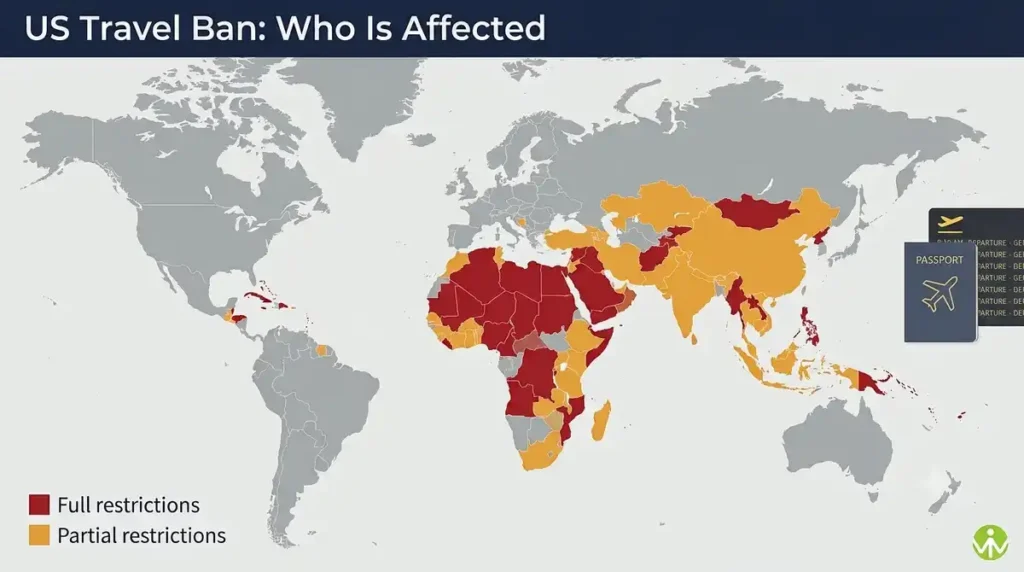
The US travel ban is a presidential proclamation that stops or limits US visas for nationals of 39 countries, along with anyone travelling on Palestinian Authority documents. The current version, Proclamation 10998, took effect on 1 January 2026 and replaced a shorter list from June 2025. It applies to people outside the United States who need a visa. It does not cancel green cards, and visas issued before it took effect were not revoked.
This guide sets out the current US travel ban country list, which visas each tier blocks, who is exempt, what the courts have decided and how the policy has changed since 2017. It is accurate as of 5 October 2026. The list can change at short notice, so check the State Department’s current US travel ban guidance before you book travel or file an application.
Key Takeaways
- The US travel ban now covers 39 countries plus anyone travelling on Palestinian Authority documents, under Proclamation 10998, in force since 1 January 2026.
- Nineteen countries face full restrictions: no immigrant or nonimmigrant visas unless an exemption or exception applies.
- Nineteen more face partial restrictions on visitor, student, exchange and immigrant visas. Turkmenistan’s restriction covers immigrant visas only.
- Green card holders, dual nationals using a passport from a country not on the list, diplomats and athletes at major sporting events are exempt.
- Since January 2026 there is no blanket exemption for immediate relatives of US citizens, adopted children or Afghan special immigrant visa holders.
- A federal court blocked the USCIS processing hold on applicants from these countries on 24 August 2026. The entry restrictions themselves remain in force.
Table of Contents
What the US travel ban is and where it comes from
The US travel ban rests on section 212(f) of the Immigration and Nationality Act, which lets the President suspend the entry of any class of foreign nationals whose entry he finds would be detrimental to the interests of the United States. In Trump v. Hawaii (2018) the Supreme Court upheld an earlier version by five votes to four, ruling that the President had acted within that authority. That decision is the main reason the current restrictions have survived legal challenge.
The present round began with an executive order in January 2025 that told agencies to identify countries whose identity documents, vetting and information-sharing fell short. Proclamation 10949, signed on 4 June 2025, restricted 19 countries from 9 June 2025. The text of Proclamation 10998, signed on 16 December 2025, expanded the US travel ban to 39 countries. The reasons given are country-specific: unreliable passports and civil records, poor co-operation on taking back nationals, high visa overstay rates and limited sharing of security information.
Every 180 days the Secretary of State must report on whether each restriction should continue, end, change or be extended. That review is how the June 2025 list grew into the current one, and it is the mechanism to watch for future changes.
US travel ban country list: full restrictions
Nineteen countries are under full restrictions. Their nationals cannot be issued immigrant visas, which lead to permanent residence, or nonimmigrant visas for visits, study, work and other temporary stays, unless an exemption or a case-by-case exception applies. The same full restriction covers anyone travelling on a document issued or endorsed by the Palestinian Authority.
Table 1: US travel ban country list: full restrictions
| Country or document | Region | On the list since |
|---|---|---|
| Afghanistan | Asia | June 2025 |
| Burkina Faso | Africa | January 2026 |
| Burma (Myanmar) | Asia | June 2025 |
| Chad | Africa | June 2025 |
| Republic of the Congo | Africa | June 2025 |
| Equatorial Guinea | Africa | June 2025 |
| Eritrea | Africa | June 2025 |
| Haiti | Caribbean | June 2025 |
| Iran | Middle East | June 2025 |
| Laos | Asia | Partial from June 2025; full from January 2026 |
| Libya | Africa | June 2025 |
| Mali | Africa | January 2026 |
| Niger | Africa | January 2026 |
| Sierra Leone | Africa | Partial from June 2025; full from January 2026 |
| Somalia | Africa | June 2025 |
| South Sudan | Africa | January 2026 |
| Sudan | Africa | June 2025 |
| Syria | Middle East | January 2026 |
| Yemen | Middle East | June 2025 |
| Palestinian Authority travel documents | Middle East | January 2026 |
| Source: Proclamation 10998 and US Department of State guidance (page last updated 2 February 2026). Checked 5 October 2026. | ||
Partial restrictions under the US travel ban
A further 19 countries are under partial restrictions. For their nationals, the US travel ban suspends immigrant visas and four nonimmigrant categories: B-1/B-2 visitor visas, F and M student visas, and J exchange visitor visas. Other temporary visas, including most work visas, can still be issued, but consular officers are instructed to shorten their validity where the law allows.
Table 2: US travel ban country list: partial restrictions
| Country | Region | On the list since |
|---|---|---|
| Angola | Africa | January 2026 |
| Antigua and Barbuda | Caribbean | January 2026 |
| Benin | Africa | January 2026 |
| Burundi | Africa | June 2025 |
| Côte d’Ivoire | Africa | January 2026 |
| Cuba | Caribbean | June 2025 |
| Dominica | Caribbean | January 2026 |
| Gabon | Africa | January 2026 |
| The Gambia | Africa | January 2026 |
| Malawi | Africa | January 2026 |
| Mauritania | Africa | January 2026 |
| Nigeria | Africa | January 2026 |
| Senegal | Africa | January 2026 |
| Tanzania | Africa | January 2026 |
| Togo | Africa | June 2025 |
| Tonga | Pacific | January 2026 |
| Venezuela | South America | June 2025 |
| Zambia | Africa | January 2026 |
| Zimbabwe | Africa | January 2026 |
| Turkmenistan (immigrant visas only) | Asia | June 2025; narrowed to immigrant visas from January 2026 |
| Source: Proclamation 10998 and US Department of State guidance (page last updated 2 February 2026). Checked 5 October 2026. | ||
Turkmenistan is a special case. It was on the June 2025 partial list, but Proclamation 10998 lifted its restrictions on visitor, student and exchange visas, leaving only immigrant visas suspended. That is why some sources count 39 countries and others 40. This guide counts 19 full, 19 partial and Turkmenistan, which makes 39.
Antigua and Barbuda and Dominica are notable additions, because the proclamation cites their citizenship by investment programmes, which let people buy a passport without living in the country, as a vetting concern. Holders of those passports who also have another nationality are covered by the dual-national exemption described below.
Which visas the US travel ban affects
The two tiers work very differently in practice. A national of a partial-restriction country who has been admitted to a US university cannot get an F-1 student visa, but the same person with an approved H-1B petition can still apply for a work visa. Under a full restriction, both applications would be refused. The K-1 fiancé(e) visa follows the same pattern as the H-1B: it is suspended for full-restriction nationals but can still be issued to partial-restriction nationals. The table below shows the position for each main visa type.
Table 3: Which visas the US travel ban suspends
| Visa type | Full-restriction countries | Partial-restriction countries | Turkmenistan |
|---|---|---|---|
| Immigrant visas (family, employment, diversity) | Suspended | Suspended | Suspended |
| B-1/B-2 visitor visas | Suspended | Suspended | Not suspended |
| F-1 and M-1 student visas | Suspended | Suspended | Not suspended |
| J-1 exchange visitor visas | Suspended | Suspended | Not suspended |
| Other nonimmigrant visas (for example H-1B, L-1, O-1, E-2) | Suspended | Can be issued; validity may be shortened | Not suspended |
| Diplomatic and official visas (A, C-2, C-3, G, NATO) | Exempt | Exempt | Exempt |
| Source: Proclamation 10998, sections 2 to 6. Exemptions and case-by-case exceptions can apply in every row. Checked 5 October 2026. | |||
Applicants from listed countries can still submit visa forms and attend interviews. A refusal under the US travel ban is recorded under section 212(f), and the consular officer then considers whether an exemption or exception applies. Visitors planning a short trip should read our US tourist visa guide alongside this list, since the travel ban overrides the normal B-1 business visa and B-2 rules.
US travel ban exemptions
The proclamation lists categories of people who are outside the US travel ban altogether:
- Lawful permanent residents (green card holders).
- Dual nationals travelling on the passport of a country that is not on the list. Our guide to US dual citizenship explains how multiple nationality works for US purposes.
- Holders of diplomatic and official visas, including A-1, A-2, C-2, C-3, G-1 to G-4 and NATO visas.
- Athletes, coaches, support staff and their immediate relatives travelling for the World Cup, the Olympics or another major sporting event.
- Special immigrant visas for people who have worked for the US government.
- Immigrant visas for members of ethnic and religious minorities facing persecution in Iran.
The proclamation also applies only to people who were outside the United States and did not hold a valid visa when it took effect. Visas issued before then have not been revoked under it.
Exemptions removed in December 2025
Proclamation 10998 removed three blanket exemptions that the June 2025 version contained: immigrant visas for immediate relatives of US citizens (spouses, children and parents, with the relationship proven), immigrant visas for children being adopted, and Afghan special immigrant visas. These applicants are not barred outright, but they now need a case-by-case exception. The State Department says children being adopted by US citizens can qualify for an exception. Anyone pursuing a family-based green card from a listed country should factor this in before a consular interview.
National-interest exceptions
The Secretary of State and the Secretary of Homeland Security can grant exceptions case by case where an applicant’s travel would serve a US national interest. The Attorney General can do the same where travel would advance a critical Department of Justice interest, such as giving evidence in a criminal trial. There is no separate application form; the consular officer handling the visa decides whether to refer the case.
Green card holders, existing visas and pending USCIS cases
The US travel ban controls who can be issued a visa and admitted. It does not take away status that people already hold. Green card holders from listed countries remain exempt and can travel and return, and visas issued before the restrictions took effect remain valid until they expire. Our US green card guide covers how people keep and lose permanent residence.
The USCIS processing hold and the August 2026 court order
For people already in the United States, the bigger change came from USCIS rather than from the proclamation. On 2 December 2025, policy memorandum PM-602-0192 placed a hold on final decisions for nationals of the countries on the June 2025 list. On 1 January 2026, PM-602-0194 extended it to nationals of all 39 countries and holders of Palestinian Authority documents. The hold covered green card applications, naturalisation, asylum, work permits, travel documents, and many petitions, so it reached people with no plans to travel at all.
On 24 August 2026 the US District Court for the Northern District of California, in Red Eagle Law v. Edlow, enjoined both memoranda and certified a class of affected applicants. USCIS has said it will follow the court order while it considers further review, and it must decide these cases in the normal course. As of 5 October 2026 that order stands. Applicants on the US citizenship track whose naturalisation was held are among those covered.
Related measures that are not part of the US travel ban
Several other 2026 measures are often confused with the US travel ban. They have different legal bases, different country lists and different outcomes in court.
The 75-country immigrant visa pause
From 21 January 2026, the State Department paused immigrant visa issuance to nationals of 75 countries, citing public charge concerns. On 21 August 2026, the US District Court for the Southern District of New York set that pause aside in CLINIC v. Rubio, finding it exceeded the State Department’s authority. The government filed an appeal on 10 September 2026. The ruling does not lift the US travel ban: nationals of the 39 listed countries remain restricted under the proclamation.
The diversity visa pause
Diversity visa issuance was suspended on 18 December 2025 and resumed on 28 August 2026 after a court ruling. The resumption does not help green card lottery winners from travel-ban countries, because the proclamation suspends all immigrant visas, including diversity visas, for both tiers.
Visa bonds
Nationals of certain countries must post a bond before a B-1/B-2 visa is issued. The visa bond list overlaps with the travel ban list in places, but it is a separate measure with its own rules.
How the US travel ban has changed since 2017
Today’s restrictions are the third generation of the policy. The country lists published between 2017 and 2020 are no longer in force. For instance, Kyrgyzstan and North Korea appeared on earlier lists but are not covered by the current US travel ban.
Table 4: How the US travel ban has changed since 2017
| Date | Measure | What it did |
|---|---|---|
| 27 January 2017 | Executive Order 13769 | Suspended entry for 90 days for nationals of Iran, Iraq, Libya, Somalia, Sudan, Syria and Yemen; quickly blocked by the courts |
| 6 March 2017 | Executive Order 13780 | Replaced the first order and dropped Iraq, leaving six countries |
| 24 September 2017 | Proclamation 9645 | Indefinite, country-specific restrictions on Chad, Iran, Libya, North Korea, Somalia, Syria, Venezuela (certain officials) and Yemen |
| 10 April 2018 | Proclamation 9723 | Removed Chad |
| 26 June 2018 | Trump v. Hawaii | Supreme Court upheld Proclamation 9645 by five votes to four |
| 31 January 2020 | Proclamation 9983 | Added immigrant visa limits for Burma, Eritrea, Kyrgyzstan and Nigeria, and diversity visa limits for Sudan and Tanzania |
| 20 January 2021 | Proclamation 10141 | Revoked the 2017 to 2020 restrictions |
| 4 June 2025 | Proclamation 10949 | 12 countries under full and 7 under partial restrictions, from 9 June 2025 |
| 16 December 2025 | Proclamation 10998 | Expanded to 39 countries plus Palestinian Authority documents from 1 January 2026, and removed several exemptions |
| 24 August 2026 | Red Eagle Law v. Edlow | Court enjoined the USCIS processing holds tied to the travel ban list |
| Sources: Federal Register, Congressional Research Service and USCIS. Checked 5 October 2026. | ||
Court challenges and what to watch
Direct challenges to the proclamation face the Trump v. Hawaii precedent, so most 2026 litigation has targeted how agencies applied it: the USCIS holds, the 75-country pause, and the diversity visa freeze. Three developments will shape what the US travel ban looks like next:
- The next 180-day review, which can add countries, remove them or move them between tiers.
- The appeal in CLINIC v. Rubio, and any appeal in Red Eagle Law v. Edlow.
- How major-event exemptions are applied ahead of the 2028 Los Angeles Olympics.
If you are a national of a listed country, check the State Department page before applying, keep evidence of any exemption to hand, and consider independent legal advice before travelling while an application is pending. For every other route into the country, see our guide to the types of US visa.
US travel ban FAQ
How many countries are on the US travel ban list?
Thirty-nine countries, plus anyone travelling on Palestinian Authority documents. Nineteen are under full restrictions, 19 under partial restrictions, and Turkmenistan is restricted for immigrant visas only. Some sources count 40 because they list Turkmenistan separately.
Does the US travel ban apply to green card holders?
No. Lawful permanent residents are exempt and can travel and return on their green card. The ban applies to people who need a new visa to enter.
Can I get a US work visa if my country is under partial restrictions?
Usually, yes. Partial restrictions suspend immigrant visas and B, F, M and J visas. Other nonimmigrant visas, such as H-1B or L-1, can still be issued, although their validity may be shortened.
Does the US travel ban apply to dual nationals?
Not if you travel on the passport of a country that is not on the list. The exemption depends on the passport you use for the visa application and for entry.
Can the spouse of a US citizen from a listed country get a green card?
There is no longer a blanket exemption for immediate relatives applying from abroad, so a consular case needs a national-interest exception. A spouse who is already in the United States and eligible to adjust status applies to USCIS instead, and the August 2026 court order requires USCIS to process those cases normally.
Is the 2017 Trump travel ban still in force?
No. The 2017 to 2020 restrictions were revoked in January 2021. The current US travel ban comes from new proclamations issued in June and December 2025, with a different country list.
How often is the US travel ban list reviewed?
The Secretary of State must report to the President within 180 days of the December 2025 proclamation and every 180 days after that, recommending whether each restriction should continue, end or change.