
The K-1 visa lets the foreign fiancé(e) of a US citizen travel to the United States to marry, then apply for a green card without leaving the country. It is a nonimmigrant visa with an immigrant purpose: the holder has 90 days after entry to marry the citizen who filed the petition, and the marriage opens the route to permanent residence.
The route has three government stages: a petition to US Citizenship and Immigration Services (USCIS), a visa interview at a US embassy or consulate, and a green card application after the wedding. This guide covers K-1 visa requirements, current fees, typical timelines, the K-2 visa for children, and the screening rules added in 2026, including the public-profile instruction that has applied to K-1, K-2, and K-3 applicants since 30 March 2026. For other routes, see our overview of the full range of US visa types.
Key Takeaways
- The K-1 visa is for the foreign fiancé(e) of a US citizen, and the couple must marry within 90 days of entry.
- Core government fees total $2,380: $675 for Form I-129F, $265 for the visa application, and $1,440 for the green card application.
- USCIS takes about 10 to 14 months to decide the petition, and filing to arrival usually runs 12 to 18 months.
- Since 30 March 2026, K-1, K-2, and K-3 applicants must set their social media accounts to public for consular review.
- Unmarried children under 21 can come on K-2 visas, travelling with the parent or within one year of the K-1 visa’s issue.
- A marriage less than two years old when the green card is approved leads to a two-year conditional card.
Table of Contents
What the K-1 visa is
A K-1 visa is a single-entry visa with one purpose: to marry a specific US citizen inside the United States. The State Department issues it after USCIS approves the citizen’s petition, and it is valid for up to six months from issue. The holder enters once, marries the petitioner within 90 days, and then applies to USCIS for lawful permanent residence.
The K-1 visa cannot be extended, and the holder cannot change to another nonimmigrant status. A K-1 entrant who marries someone other than the petitioner has no route to a green card through the K-1. Only US citizens can file for a fiancé(e); lawful permanent residents must marry first and use a spouse petition.
K-1 visa requirements
Who can sponsor a fiancé(e)
The petitioner must be a US citizen. Both partners must be legally free to marry when the petition is filed and must stay free until the wedding, so any earlier marriage must already have ended by divorce, annulment, or death. The marriage must also be legal in the US state where it will take place.
The International Marriage Broker Regulation Act (IMBRA) adds limits for repeat petitioners. A citizen who has filed two or more fiancé(e) petitions before, or had one approved in the previous two years, needs a waiver from USCIS, and certain criminal convictions must be disclosed. The State Department passes any criminal background information USCIS found on the petitioner to the fiancé(e).
The in-person meeting rule
The couple must have met in person at least once in the two years before the petition was filed. USCIS can waive this when a meeting would cause extreme hardship to the petitioner, or when meeting before marriage would break long-established customs of the fiancé(e)’s culture. Typical evidence includes photographs together, travel records, and messages, along with a signed statement from each partner confirming the intent to marry within 90 days of arrival.
Financial support: Form I-134 first, Form I-864 later
K-1 visa applicants must show they are not likely to become a public charge. At the interview, the consular officer may ask for Form I-134, Declaration of Financial Support, from the petitioner. The benchmark is 100% of the federal poverty guidelines, which in 2026 is $21,640 a year for a household of two in the 48 contiguous states and Washington, DC.
After the wedding, the green card application needs Form I-864, Affidavit of Support. It is legally binding and has a higher floor of 125%, or $27,050 for a household of two. Our page on US green card eligibility explains how that income test is counted. Since late 2025, State Department guidance has told officers to give more weight to health, age, and likely medical costs in this assessment, in nonimmigrant cases as well as immigrant ones.
How to apply for a K-1 visa, step by step
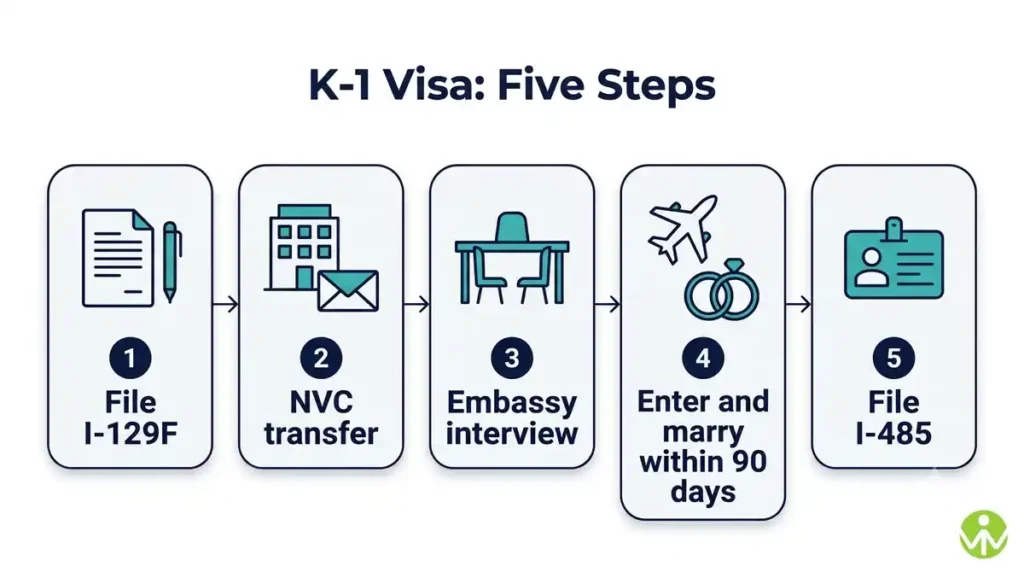
Step 1: File Form I-129F with USCIS
The US citizen files Form I-129F, Petition for Alien Fiancé(e), on paper with USCIS, together with proof of citizenship, evidence of the in-person meeting, both intent-to-marry statements, and the $675 fee. List every unmarried child of the fiancé(e) under 21 on the form, because a child left off the petition cannot get a K-2 visa.
Step 2: Approval and transfer to the National Visa Center
Once USCIS approves the petition, it sends the case to the State Department’s National Visa Center (NVC), which assigns a case number and forwards the file to the embassy or consulate where the fiancé(e) lives. The approval is valid for four months, and the consular officer can revalidate it if processing runs past that date.
Step 3: DS-160, medical exam, and interview
The fiancé(e) completes the online DS-160 form, pays the $265 K visa application fee, and books a medical exam with an embassy-approved panel physician. Gather the civil documents next: a valid passport, a birth certificate, police certificates from every country lived in for six months or more since age 16, and divorce or death certificates for any earlier marriages. The State Department’s K-1 visa page lists the full interview checklist, and interviews normally take place in the country where the fiancé(e) lives.
Vaccinations are not required for the K-1 visa itself, but they are required when adjusting status after the wedding, so many applicants complete them at the medical exam.
Step 4: Entry and the 90-day clock
A K-1 visa allows one entry during its validity. US Customs and Border Protection decides admission at the port of entry, and the 90 days to marry start on the day of admission.
K-1 visa cost
Three government fees are unavoidable: the I-129F petition, the visa application, and the I-485 green card application after the wedding. Together they come to $2,380, before medical exams, translations, police certificates, travel, and the marriage licence. Each K-2 child pays a separate $265 visa fee and, later, a separate I-485 fee: $950 for a child under 14 filing with a parent, otherwise $1,440.
Table 1: K-1 visa cost by stage
| Fee | Amount (USD) | Paid to | When |
|---|---|---|---|
| Form I-129F petition | 675 | USCIS | At filing, by the US citizen |
| K visa application (DS-160), per applicant | 265 | State Department | Before the interview |
| Medical exam | Varies by country | Panel physician | Before the interview |
| Form I-485, age 14 or older | 1,440 | USCIS | After the wedding |
| Form I-485, under 14 filing with a parent | 950 | USCIS | After the wedding |
| Form I-765 work permit, with pending I-485 | 260 | USCIS | Optional, with the I-485 |
| Form I-131 advance parole | 630 | USCIS | Optional, with the I-485 |
| Form I-751 to remove conditions | 750 | USCIS | In the 90 days before the conditional card expires |
| Source: 8 CFR 106.2 for USCIS fees; State Department K visa fee of $265. Online filing, where available, cuts most USCIS fees by $50. The $250 Visa Integrity Fee is not included. Checked 14 November 2026. | |||
Work and travel permits are optional. Filed with the I-485, Form I-765 for an Employment Authorization Document costs $260, and Form I-131 for advance parole costs $630. A K-1 entrant can apply for a work permit before the wedding, but the standalone fee is $520 and the card covers only the 90-day stay, so most couples wait and file everything together. The USCIS amounts are set in 8 CFR 106.2.
A $250 Visa Integrity Fee, created by legislation in July 2025, is due on most nonimmigrant visa issuances, including K visas. The State Department fee schedule did not list it as of November 2026, and reports differ on whether embassies collect it, so check with the embassy before the interview.
K-1 visa processing time
USCIS publishes I-129F processing times in its online tool, and recent figures show 80% of petitions decided within about 10 to 14 months. After approval, the NVC transfer and the embassy stage usually add another two to four months, depending on the post’s interview backlog. From filing to arrival, most couples should plan for 12 to 18 months.
Table 2: K-1 visa processing time by stage
| Stage | Typical time | What happens |
|---|---|---|
| I-129F decision | 10 to 14 months | USCIS reviews the petition and may issue a Request for Evidence |
| NVC transfer | 2 to 6 weeks | NVC creates the case and sends it to the embassy |
| Embassy stage | 1 to 3 months | DS-160, medical exam, interview, and visa printing |
| Entry to wedding | Up to 90 days | The wedding must take place within 90 days of admission |
| I-485 decision | 6 to 12 months | USCIS decides the green card application |
| Estimates based on recent USCIS processing data; times vary by service centre and embassy. Checked 14 November 2026. | ||
USCIS does not offer premium processing for the I-129F. Expedite requests are possible on humanitarian grounds, but USCIS grants them at its discretion. After the wedding, the I-485 adds several more months, and the work permit filed alongside it usually arrives before the green card.
Social media vetting and other K-1 visa screening in 2026
Since 30 March 2026, the State Department has required K-1, K-2, and K-3 applicants to set their social media accounts to public so consular officers can review their online presence. The same instruction already applied to student and exchange visitors from June 2025 and to H-1B workers and their dependants from December 2025. Our guide to US visa social media vetting explains what the review covers and how to prepare for it.
Nationality matters too. Under Proclamation 10998, nationals of the 19 full-restriction countries generally cannot get any nonimmigrant visa, so the K-1 visa is suspended for them unless an exemption or a national-interest exception applies. For the 19 partial-restriction countries, the suspension covers immigrant visas and B, F, M, and J visas. The K-1 visa is not on that list, so it can still be issued, although officers may shorten its validity. The US travel ban page lists both groups of countries.
The separate pause on immigrant visas for nationals of 75 countries, which began on 21 January 2026, never covered the K-1 visa, because the K-1 is a nonimmigrant visa. A federal court set that pause aside on 21 August 2026, and the government’s appeal is pending.
K-2 visa for children, and the K-3
Unmarried children under 21 of the fiancé(e) can get K-2 visas if the petitioner named them on the I-129F. Each child files a separate DS-160, pays the visa fee, and has a medical exam. A K-2 child can travel with the parent or follow within one year of the K-1 visa’s issue, but cannot enter before the parent. After that year, the child needs a separate immigrant petition.
K-2 children apply for their own green cards on the strength of the parent’s case, each with a separate I-485. File promptly after the wedding, because a child who turns 21 before USCIS decides the case can lose K-2 eligibility.
The K-3 visa for spouses
The K-3 visa uses the same I-129F form for a foreign spouse who is already married to a US citizen and has a Form I-130 pending. It is rarely used now: when USCIS approves the I-130 first, the NVC closes the K-3 case and processes an immigrant visa instead. Couples who are already married normally apply for a spouse visa directly.
After arrival: the wedding and the K-1 visa green card step
The wedding must take place within 90 days of entry, and the K-1 holder can then adjust status only through marriage to the petitioner. File Form I-485 with Form I-864, the medical exam record, and vaccination evidence. Our US green card guide explains what permanent residence covers and how it differs from a visa.
If the marriage is less than two years old when USCIS approves the I-485, the green card is conditional and valid for two years. In the 90 days before it expires, the couple files Form I-751 jointly, at a cost of $750, to show the marriage is genuine and receive a 10-year card. Time on the conditional card counts towards US citizenship, which spouses of US citizens can apply for after three years as permanent residents.
Leaving the United States while the I-485 is pending, without advance parole, is generally treated as abandoning the application. A K-1 holder who has not married within 90 days falls out of status, so take legal advice before the deadline passes.
K-1 visa or a spouse visa?
Couples who can marry abroad can marry first and apply for a CR-1 or IR-1 spouse visa through a family-based green card petition. The spouse then enters the United States as a permanent resident, with no adjustment step and no work permit to wait for. The K-1 visa suits couples who want to marry in the United States, but it costs more in total because the green card application is paid after arrival.
A spouse visa costs about $1,355 in government fees: $675 for Form I-130, $325 for the immigrant visa application, $120 for the affidavit of support review, and the $235 USCIS Immigrant Fee.
Table 3: K-1 visa compared with a CR-1 or IR-1 spouse visa
| Feature | K-1 visa | CR-1 or IR-1 spouse visa |
|---|---|---|
| Where the wedding happens | In the US, within 90 days of entry | Before the petition, anywhere |
| USCIS petition | Form I-129F, $675 | Form I-130, $675 |
| Status on arrival | Nonimmigrant; must adjust status | Permanent resident on entry |
| Work on arrival | Only with a work permit | Yes, as a permanent resident |
| Core government fees | $2,380 | About $1,355 |
| Typical USCIS petition time | About 10 to 14 months | About 13 months (median) |
| Covered by the 75-country pause | No (nonimmigrant visa) | Yes, until a court set it aside in August 2026 |
| Fees from 8 CFR 106.2 and the State Department fee schedule. Petition times are recent USCIS estimates and vary. Checked 14 November 2026. | ||
K-1 visa FAQ
How long does a K-1 visa take?
USCIS currently takes about 10 to 14 months to decide the I-129F, and the embassy stage adds two to four months. Most couples plan for 12 to 18 months from filing to arrival.
How much does a K-1 visa cost in total?
Required government fees come to $2,380 for one applicant: $675 for the petition, $265 for the visa application, and $1,440 for the green card application. Medical exams, documents, and travel come on top.
Can a K-1 visa holder work in the United States?
Not until USCIS issues a work permit. A K-1 holder can apply on arrival, but most couples wait and file Form I-765 with the I-485 after the wedding, when the fee drops to $260.
What happens if we do not marry within 90 days?
The K-1 holder falls out of status and cannot extend the 90 days or switch to another visa. If the couple marries the same petitioner late, USCIS may still allow a green card application based on Form I-130, but take advice before relying on that.
Can a green card holder sponsor a fiancé(e)?
No. Only US citizens can file Form I-129F. Permanent residents must marry first and file Form I-130 for a spouse, which is subject to annual limits.
Do K-1 visa applicants need public social media accounts?
Yes. Since 30 March 2026, K-1, K-2, and K-3 applicants must set their social media accounts to public before the interview so consular officers can review them.