
The Spain entrepreneur visa lets non-EU founders live in Spain while they start, develop, or run an innovative business, with no minimum investment and no job-creation target. The route comes from Law 14/2013, the law supporting entrepreneurs and their internationalisation, and Spain rebuilt it through the Startups Law (Law 28/2022), in force since 23 December 2022. The next step is a favourable report from ENISA, and the Unidad de Grandes Empresas y Colectivos Estratégicos (UGE) decides on the application.
This guide covers who qualifies for the Spain entrepreneur visa, what ENISA assesses, how much money you need in 2026, what it costs, and how to apply from abroad or within Spain. For the other work, study, and residence routes, see our guide to the types of Spain visa.
Key Takeaways
- The Spain entrepreneur visa is for non-EU founders who want to start, develop, or run an innovative business in Spain.
- A favourable report from ENISA, the state innovation company, is the deciding step. There is no minimum investment and no job-creation target.
- Applicants show funds of 200% of the Spanish minimum wage (SMI) a month, plus 75% for the first family member and 25% for each additional one.
- The residence authorisation lasts three years and renews for two-year periods. From abroad, the consular visa is valid for one year.
- The Unidad de Grandes Empresas y Colectivos Estratégicos (UGE) must decide within 20 days, or the application counts as approved.
- After five years of residence, entrepreneurs can apply for long-term residence.
Table of Contents
What the Spain entrepreneur visa is
The Spain entrepreneur visa covers two related permissions. Founders outside Spain receive a residence visa from a Spanish consulate, and founders already in Spain legally receive a residence authorisation for entrepreneurial activity directly from the UGE. Both rest on the same legal test and the same ENISA report.
Under Article 69 of Law 14/2013, the residence authorisation is valid throughout Spain for three years. The residence visa issued to applicants from abroad is valid for one year, and its holder can live in Spain without a foreigner identity card (TIE) during that year. The route is closed to EU, EEA, and Swiss citizens, who already have free movement.
Interest in the route has grown since Spain closed its investor residence route to new applicants on 3 April 2025. Unlike the old golden visa, the Spain entrepreneur visa asks for an active business rather than a passive investment; our overview of golden visa programmes by country lists the investor schemes still open elsewhere in Europe.
Table 1: Spain entrepreneur visa vs. in-Spain residence authorisation
| Feature | Entrepreneur visa (applying from abroad) | Residence authorisation (applying in Spain) |
|---|---|---|
| Who applies | Founders living outside Spain | Founders legally in Spain on a stay, visa, or residence permit |
| Where to file | UGE online, then the Spanish consulate for the visa | UGE online |
| Assessment | Favourable ENISA report | Favourable ENISA report |
| Decision deadline | UGE: 20 days; consulate: 10 working days | UGE: 20 days |
| Validity | Visa: one year; authorisation: three years | Three years |
| Identity card | Not needed while the visa is valid | TIE required if valid for more than six months |
| Renewal | Two-year periods | Two-year periods |
| Source: Law 14/2013, Articles 69, 70, 75, and 76 (consolidated text, BOE). Checked 17 November 2026. | ||
Who qualifies for the Spain entrepreneur visa
Article 62 of Law 14/2013 sets the general requirements, and Article 70 adds the entrepreneur test. To qualify, applicants must:
- Be at least 18 years old and not be in Spain irregularly.
- Have no criminal record in Spain or in the countries where they lived in the last two years, and sign a sworn statement covering the last five years.
- Not be a person to whom entry is refused in countries that have an agreement with Spain.
- Hold public health insurance or private health insurance from an insurer authorised in Spain. Travel insurance doesn’t count.
- Show enough money for themselves and their family for the whole stay, and pay the processing fee.
- Plan an activity that is innovative and/or of special economic interest to Spain, backed by a favourable ENISA report.
The “innovative and/or” test
The 2013 wording required an activity that was innovative and of special economic interest to Spain. The Startups Law changed this to innovative and/or of special economic interest, so a project now needs to meet just one criterion. The UGE states that the Spain entrepreneur visa has no minimum investment or job-creation requirements.
The ENISA report for a Spain entrepreneur visa
ENISA (Empresa Nacional de Innovación) is a state-owned company that finances and supports innovative businesses. Applicants start by completing the residence-for-entrepreneurs form on the ENISA website. When the application reaches the UGE, the UGE requests ENISA’s report on its own initiative, and ENISA must issue it within 10 working days.
Article 70.2 of Law 14/2013 lists three things ENISA weighs:
- Your profile and involvement: your professional background and your role in the project. When a company has several partners, ENISA assesses each partner, including those who do not need a visa.
- The business plan: a description of the project and its product or service, and its financing, including the investment it needs and possible funding sources.
- Value for Spain: what the business adds to the Spanish economy, such as innovation or investment opportunities.
What the business plan should cover
Spain’s official investment portal asks for a business plan describing the product or service, a market analysis, the financing, and the expected economic contribution, together with your CV. Keep figures realistic and verifiable, because ENISA judges whether the project can actually grow from Spain.
ENISA report vs. startup certification
ENISA also certifies companies as “empresas emergentes” under the Startups Law, which unlocks tax benefits such as a 15% corporate tax rate. That certification is a separate process. It doesn’t replace the report for the Spain entrepreneur visa, and the visa doesn’t require it.
How much money you need for a Spain entrepreneur visa
Directorate-General for Migration Instruction 1/2023 links the funds requirement to the Spanish minimum wage (salario mínimo interprofesional, SMI), not to the IPREM index used before 2023. Applicants show 200% of the SMI a month. A family of two adds at least 75% of the SMI, and each further family member adds 25%.
Royal Decree 126/2026 sets the 2026 SMI at €1,221 a month, paid in 14 instalments. On that basis, a single applicant needs €2,442 a month. Some advisers prorate the 14 payments over 12 months, which gives €2,849 a month. Ask the consulate or the UGE which basis it applies before you prepare bank evidence.
Table 2: Spain entrepreneur visa funds by household size, 2026
| Household member | Share of SMI | Monthly amount (€1,221 SMI) | Monthly amount (SMI prorated over 12 months) |
|---|---|---|---|
| Main applicant | 200% | €2,442.00 | €2,849.00 |
| First family member | 75% | €915.75 | €1,068.38 |
| Each additional family member | 25% | €305.25 | €356.13 |
| Example: applicant, partner, and two children | 325% | €3,968.25 | €4,629.63 |
| Source: Instruction DGM 1/2023; SMI from Royal Decree 126/2026 (€1,221 a month in 14 payments). Figures as of 17 November 2026. Confirm the basis with the consulate or UGE. | |||
Any legally accepted evidence works, such as bank statements, investment income, or a work contract, and the UGE assesses each case individually. The old figure of €2,316.08 a month, based on the 2022 IPREM, no longer applies.
Documents for a Spain entrepreneur visa application
The UGE and the official investment portal list these documents for an initial application:
- A full copy of a valid passport or travel document for you and each family member.
- The signed application form (the Ministry’s MIT form) and proof of fee payment.
- Proof of funds for the household for the period of residence.
- Health insurance certificate from an insurer authorised in Spain.
- A criminal record certificate, where required. Applicants already in Spain on a short stay of six months or less, or on a student stay, must include it.
- The business plan and your CV.
- Proof of registration as self-employed (RETA) and of the Economic Activities Tax (IAE), if the business has already started.
Translate every foreign document into Spanish, and legalise foreign public documents with an apostille or through diplomatic channels.
How to apply for the Spain entrepreneur visa
The process runs online through the UGE, whether you apply from abroad or within Spain. You or your legal representative must file the authorisation application electronically.
Applying for the Spain entrepreneur visa from outside Spain
Since the Startups Law, founders abroad file a single application that starts the authorisation and the visa one after the other. Once the UGE grants the authorisation, request the residence visa at the Spanish consulate that covers your place of residence. Article 75.5 gives the consulate 10 working days to decide and notify.
Applying from within Spain
Founders in Spain on a legal stay or residence apply directly to the UGE. Filing the application extends your current stay or residence status until the UGE decides. If the authorisation lasts more than six months, apply for a TIE at a police station after approval.
Step-by-step application process
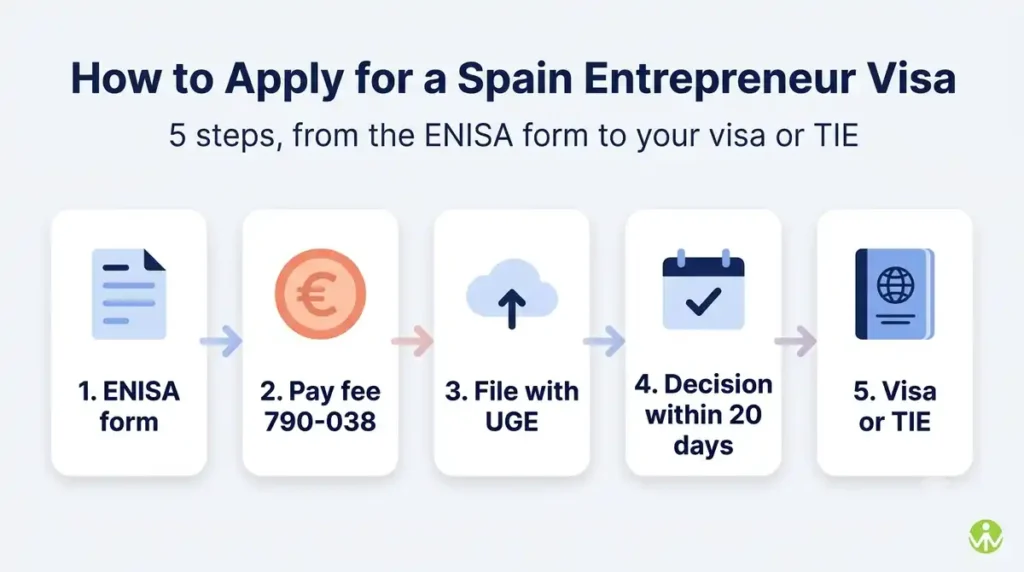
- Request the ENISA report. Sign in on the ENISA website and complete the residence-for-entrepreneurs form. ENISA notifies the UGE.
- Pay the fee. Pay fee code 038 on Model 790, point 7, and keep the 22-character NRC reference the payment generates.
- File with the UGE. Sign in to the UGE electronic office with a digital certificate or Cl@ve, complete the applicant details, upload your documents (24 MB maximum), and sign.
- Wait for the decision. The UGE must decide within 20 days of electronic filing. If it doesn’t, the authorisation counts as granted by administrative silence.
- Collect the visa or apply for the TIE. Applicants abroad request the visa at the consulate; applicants in Spain apply for the TIE.
The UGE entrepreneurs page links to the current application instructions and forms.
Spain entrepreneur visa fees
Order ESS/1571/2014 sets the UGE fee at €70.40 for an initial residence authorisation and €75.60 for a renewal. Spanish consulates charge their own national visa fee, which varies by nationality, and the TIE carries a separate police fee. Budget for translations, apostilles, health insurance, and any professional help with the business plan.
Permit length, renewal, and family members
The Spain entrepreneur visa authorisation lasts three years. You can then renew it for two years at a time, as long as the conditions that justified it still apply; the UGE checks that the business is active and that you still meet the general requirements. File renewals online. Filing extends your authorisation until the decision, and the law still accepts a renewal filed within 90 days after expiry, although a late filing can lead to a penalty.
Family members can apply with you or later. Under Article 62.4, these relatives qualify:
- A spouse or unmarried partner.
- Children under 18, and adult children who depend on you financially and haven’t formed their own family.
- Dependent parents.
When family members apply at the same time as you, the UGE decides all the applications together. Each relative must show health insurance and counts toward the household funds calculation above.
From entrepreneur residence to long-term residence and citizenship
Article 69 provides that an entrepreneur can obtain long-term residence after five years. Spanish nationality normally needs 10 years of legal residence, reduced to two years for nationals of Ibero-American countries, Andorra, the Philippines, Equatorial Guinea, and Portugal. Spain generally expects new citizens to renounce their previous nationality unless a treaty applies; our list of countries that allow dual citizenship explains how this works.
Spain entrepreneur visa vs. other routes
The Spain entrepreneur visa suits founders who will build and manage the business in Spain. Other routes may fit better:
- Remote workers employed by, or contracting with, companies outside Spain can use the digital nomad route, which our digital nomad visa guide compares across countries.
- Graduates of Spanish universities can apply for a 24-month permit to look for work or start a business, described in our Spain student visa guide.
- Founders comparing countries can weigh Portugal’s D2 visa and other schemes in our startup visa by country comparison.
FAQ: Spain entrepreneur visa
Is there a minimum investment for the Spain entrepreneur visa?
No. The UGE states that there are no minimum investment or job-creation requirements. You must still show personal funds of 200% of the SMI a month and a business plan with realistic financing.
How long does the Spain entrepreneur visa process take?
ENISA has 10 working days to issue its report, and the UGE must decide within 20 days of electronic filing. Applicants abroad then wait up to 10 working days for the consular visa. Allow extra time to prepare documents and translations.
How much money do I need for a Spain entrepreneur visa in 2026?
A single applicant needs 200% of the SMI a month: €2,442 on the €1,221 monthly SMI, or €2,849 if the 14 payments are spread over 12 months. Add 75% of the SMI for the first family member and 25% for each additional one.
Can my family come with me on a Spain entrepreneur visa?
Yes. A spouse or partner, children under 18, financially dependent adult children, and dependent parents can apply with you or later. The UGE decides applications filed together at the same time.
Do I need ENISA startup certification to apply?
No. The ENISA report for the residence application and the ENISA certification of an emerging company are separate processes. The visa needs only the favourable report.
Can I apply from Spain while visiting as a tourist?
Yes, if your stay is legal. Law 14/2013 allows holders of a stay authorisation or visa to apply to the UGE, and the application extends your status until the decision. You must include a criminal record certificate.
Does the Spain entrepreneur visa lead to permanent residence?
Yes. After the three-year authorisation and a two-year renewal, entrepreneurs can apply for long-term residence at five years. Spanish nationality usually requires 10 years of legal residence.