
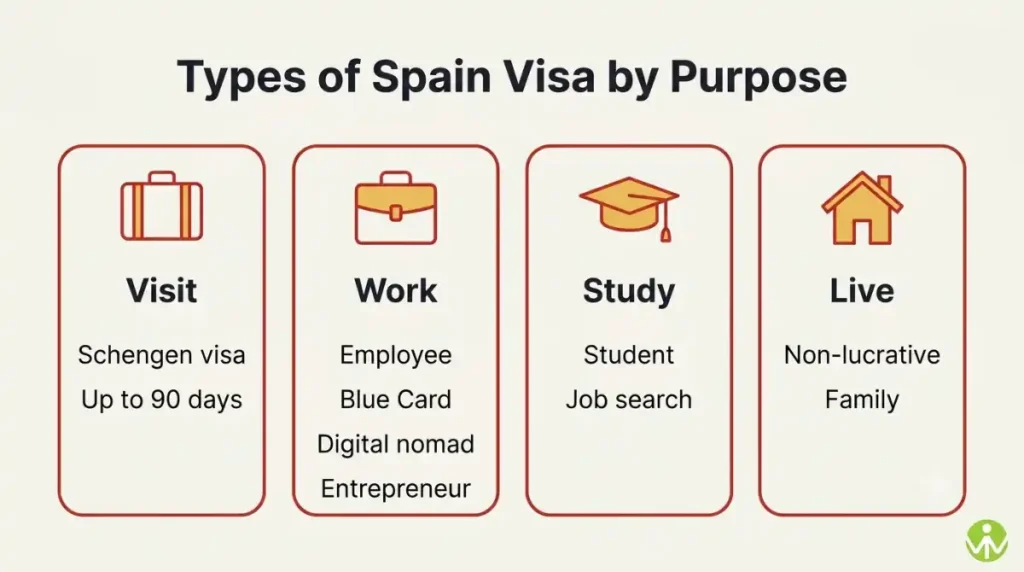
Spain visas fall into two broad groups: short-stay Schengen visas for trips of up to 90 days, and national long-stay visas for anyone planning to work, study, or live in Spain longer. Which one applies depends on your nationality, the purpose of the trip, and how long you plan to stay.
Spain rewrote much of its immigration rulebook in 2025. A new Immigration Regulation, approved by Royal Decree 1155/2024, took effect on 20 May 2025. It extended the job-search visa to 12 months, allowed students to work up to 30 hours a week, and set most first-time residence permits at one year, with four-year renewals. A separate law closed the investor golden visa to new applicants on 3 April 2025.
This guide explains which Spain visas remain open, what each requires, and what the main ones cost. Several thresholds are tied to indexes that change every year, so check the official information sheet for your route before you apply.
Key Takeaways
- The types of Spain visas split into short-stay Schengen visas, for up to 90 days in any 180 days, and national long-stay visas for work, study, or residence.
- Schengen and national visas both cost €90 for adults; children aged 6 to 11 pay €45 for a Schengen visa.
- In 2026, the digital nomad visa needs about €2,849 a month in income, and the non-lucrative visa needs €28,800 a year.
- Spain closed its golden visa to new applicants on 3 April 2025.
- Most first-time permits now last one year and renew for four; long-term residence is open after five years.
- Spanish citizenship usually takes 10 years of residence, or two years for Ibero-American nationals.
Types of Spain visa at a glance
The table below summarises the main types of Spain visas and permits, grouped by purpose. Spain issues three visa categories: airport transit (type A), short stay (type C), and national long stay (type D). Most long-stay routes also need a residence authorisation, which the visa unlocks or which you request after arrival.
Table 1: Types of Spain visa at a glance
| Route | Visa category | Typical length | Work allowed |
|---|---|---|---|
| Schengen short-stay visa | Type C | Up to 90 days in any 180 | No |
| Airport transit visa | Type A | Transit only | No |
| Employee work visa | Type D | 1 year, then 4-year renewal | Yes |
| Highly qualified professional or EU Blue Card | Type D | Up to 3 years | Yes |
| Digital nomad (international teleworker) | Type D or permit in Spain | 1-year visa or 3-year permit | Yes, remote work |
| Entrepreneur | Type D or permit in Spain | Varies by route | Yes, own business |
| Student | Type D | Length of the course | Up to 30 hours a week |
| Job search | Type D | 12 months | Yes, once hired and authorised |
| Non-lucrative | Type D | 1 year, then 2-year renewals | No |
| Family reunification | Type D | Linked to the sponsor’s permit | Yes |
| Source: Royal Decree 1155/2024, Law 14/2013, and Ministry of Inclusion information sheets, checked November 2026. | |||
Short-stay types of Spain visa
Short-stay Spain visa types cover tourism, business trips, family visits, and short courses. Citizens of visa-exempt countries, such as the UK, the US, Canada, Australia, and Japan, need no visa for these trips; most other nationals apply for a Schengen visa.
Schengen visa (type C)
A Schengen visa issued by Spain allows stays of up to 90 days in any 180-day period across all 29 Schengen countries. Apply at the Spanish consulate or its visa centre in your country of residence if Spain is your main destination. The fee is €90, €45 for children aged 6 to 11, and nothing for children under six. Our guide to the Spain tourist visa covers the documents, and the Schengen visa guide explains how the 90/180 rule works.
Airport transit visa (type A)
Nationals of some countries need an airport transit visa even to change planes at a Spanish airport without leaving the international zone. It costs the same €90. Check the consulate’s list before booking a connection through Madrid or Barcelona.
EES and ETIAS
Since 10 April 2026, the EU’s Entry/Exit System (EES) has recorded non-EU visitors’ fingerprints and facial images at the border instead of stamping passports. ETIAS, the online travel authorisation planned for visa-exempt visitors, is not yet running, and the EU has not announced a start date. Our ETIAS guide tracks the latest position.
Types of Spain visa for work
Work-based Spain visas run through two systems. The general Immigration Regulation covers ordinary employment and self-employment, while Law 14/2013 runs a faster track for highly qualified staff, intra-company transferees, researchers, entrepreneurs, and remote workers. Applications under Law 14/2013 go to the Large Companies and Strategic Groups Unit (UGE-CE), which has a 20-working-day decision target.
Employee work visa
An employer in Spain applies for the work and residence authorisation first. In most cases, the job must pass a labour market test, unless it appears on the shortage occupations list. Once the authorisation is approved, the worker applies for the visa at the consulate and enters Spain within its validity. The first permit lasts one year and can be renewed for four years.
Highly qualified professional permit and EU Blue Card
Both routes need a job offer at a minimum salary. After a June 2026 update, the threshold is reportedly €41,356.36 a year; the EU Blue Card also has a reduced threshold of €33,085.09 for recent graduates and shortage roles. Neither route requires a labour market test. The Blue Card also gives you the right to move to another EU country after 12 months, as our EU Blue Card guide explains.
Self-employment and seasonal work
The self-employment visa suits freelancers and small-business owners whose plans do not meet the innovation test for the entrepreneur route. It requires a viable business plan and the funds to carry it out. The 2025 regulation also created a dedicated authorisation for seasonal work, often filled through collective hiring in the worker’s home country.
Digital nomad visa
The digital nomad visa, officially the international teleworker visa, lets non-EU nationals live in Spain while working remotely for employers or clients outside the country. Freelancers may earn up to 20% of their income from Spanish clients. Applicants need a degree or three years of relevant experience, and a working relationship with their employer or clients of at least three months.
The income test is 200% of Spain’s minimum wage. For 2026, that is about €2,849 a month for the main applicant, plus 75% of the minimum wage for the first family member and 25% for each additional one. A consulate issues a visa for up to one year; applying from inside Spain through the UGE-CE gives a residence permit of up to three years, renewable for two years. Our digital nomad visa guide compares Spain with other countries.
Entrepreneur visa
Spain rebuilt this route under the 2022 Startups Law. The deciding step is a favourable report from ENISA, a state-owned company that supports innovative businesses, confirming that the project is innovative and of economic interest to Spain. There is no fixed minimum investment. Our Spanish entrepreneur visa guide covers the application, and the startup visa comparison sets Spain against other European schemes.
Intra-company transfer and research permits
Law 14/2013 also covers staff moved to a Spanish branch of their employer and researchers hired by universities or research centres. Since 2026, doctoral students in certain programmes apply under the research permit rather than as students.
Types of Spain visa for study and job search
Two types of Spain visa serve people who come to learn or to look for a job: the student visa and the job-search visa.
Student visa
Students admitted to a full-time course, exchange, or unpaid internship lasting more than 90 days need a long-stay study visa. Applicants must show funds equal to 100% of IPREM, or €600 a month in 2026, along with health insurance and proof of admission. Since May 2025, students can work up to 30 hours a week, provided the job fits around their studies. The authorisation lasts for the course, and family members can join. Our Spain student visa guide lists the documents.
Job-search visa
The job-search visa now gives 12 months of legal residence to look for work. It is open to children and grandchildren of Spanish nationals by origin, and to professionals in occupations and regions where Spain sets annual quotas. Graduates who finish a degree in Spain can also extend their stay to look for work.
Types of Spain visa for living without working
Since the golden visa closed, the non-lucrative visa is the main option for people who do not plan to work.
Non-lucrative visa
The non-lucrative visa suits retirees and people with savings or passive income. The main applicant must show 400% of IPREM, or €28,800 a year in 2026, plus €7,200 for each family member, along with private health insurance. Working in Spain is not allowed. The first permit lasts one year and renews for two-year periods.
What happened to the golden visa?
Spain abolished its investor residence route through Organic Law 1/2025 and stopped accepting new applications on 3 April 2025. Already granted permits remain valid and can still be renewed. For investors, the closest remaining types of Spain visa are the entrepreneur route and, for those who do not need to work, the non-lucrative visa. Our golden visa comparison lists the programmes still open elsewhere, including Portugal’s routes.
Family types of Spain visa
Family types of Spain visa let foreign residents and Spanish citizens bring relatives to live with them.
Family reunification
Non-EU residents can bring a spouse or partner aged 18 or over, children, and, in some cases, dependent parents. The sponsor needs a renewable residence permit, suitable housing, and enough income. After holding a reunification permit for at least one year, a spouse or partner who meets the extra conditions can apply for an independent residence and work permit.
Relatives of Spanish citizens
A separate permit now covers non-EU relatives of Spanish citizens who have not used EU free movement rights. It is valid for five years and allows work.
From visa to residence: permits after arrival
Most long-stay types of Spain visa are only the first step. Within one month of arrival, holders must request a foreigner identity card (TIE) at an immigration office or police station.
Long-term residence
After five years of continuous legal residence, non-EU nationals can apply for long-term residence, which removes the need to renew a specific permit and allows work in any job.
Arraigo: residence through ties to Spain
The 2025 regulation also reshaped arraigo, the permits for people already living in Spain without status. The main versions now require two years of presence instead of three and cover employment, training, family, and social ties. A one-off regularisation for people in Spain before 1 January 2026 closed to applications on 30 June 2026.
Spanish citizenship after residence
Residence-based Spanish visas can eventually lead to citizenship. Spanish nationality by residence normally requires 10 years of legal, continuous residence, but the period is shorter for some groups.
Table 3: Residence needed for Spanish citizenship
| Residence period | Who it applies to |
|---|---|
| 10 years | Most applicants |
| 5 years | Recognised refugees |
| 2 years | Nationals of Ibero-American countries, Andorra, the Philippines, Equatorial Guinea, and Portugal, and people of Sephardic origin |
| 1 year | People born in Spain, spouses of Spanish citizens, and some other cases |
| Source: Article 22 of the Spanish Civil Code. | |
Applicants usually pass two tests run by the Instituto Cervantes: the CCSE civic knowledge exam and the DELE A2 Spanish language exam, unless exempt. Nationals of the countries on Spain’s treaty list can keep their original nationality; most other applicants must declare that they renounce it, as our dual citizenship guide explains.
Spain visa fees
Fees for all three visa categories are set by Orden AUC/891/2024. The table lists the standard amounts across visa types; convert them to your currency before you pay at the consulate or visa centre.
Table 2: Spain visa fees
| Visa | Fee | Notes |
|---|---|---|
| Schengen visa (type C), age 12 and over | €90 | Non-refundable if refused |
| Schengen visa, children aged 6 to 11 | €45 | Non-refundable if refused |
| Schengen visa, children under 6 | Free | — |
| Airport transit visa (type A) | €90 | Only for nationalities on the transit list |
| National long-stay visa (type D) | €90 | Some nationalities pay a different reciprocity fee |
| Source: Orden AUC/891/2024. Visa centres add a service charge, and residence authorisations and the TIE card carry separate fees. | ||
How to choose between the types of Spain visa
Start with purpose and length, because Spain visa types are organised around both. For a holiday or business trip under 90 days, you need either nothing or a Schengen visa. For a job with a Spanish employer, look at the employee route or, for senior roles, the highly qualified permit or Blue Card. Remote workers paid from abroad usually qualify for the digital nomad visa, and people living on savings or pensions usually qualify for the non-lucrative visa.
Money is often the deciding factor between the long-stay types of Spain visa, so compare the thresholds below with your own income or savings. The official information sheets from Spain’s Ministry of Inclusion, Social Security and Migration list the documents for every route.
Table 4: Financial thresholds for the main types of Spain visa, 2026
| Route | 2026 requirement | Basis |
|---|---|---|
| Digital nomad | About €2,849 a month | 200% of the minimum wage |
| Non-lucrative | €28,800 a year, plus €7,200 per family member | 400% of IPREM |
| Student | €600 a month | 100% of IPREM |
| Highly qualified professional or EU Blue Card | €41,356.36 a year (Blue Card reduced rate: €33,085.09) | Average-salary benchmark |
| Figures for 2026. Published thresholds differ between sources; confirm the current amount with the consulate or the UGE-CE before applying. | ||
FAQ: types of Spain visa
How many types of Spain visa are there?
Spain issues three visa categories: airport transit (type A), short stay (type C), and national long stay (type D). Within the national category, there are more than a dozen types of Spain visas, including work, study, digital nomad, non-lucrative, job-search, and family reunification visas.
Does Spain still have a golden visa?
No. Spain stopped accepting new golden visa applications on 3 April 2025. Existing holders keep their permits and can renew them.
How much income do I need for the Spain digital nomad visa?
In 2026, the main applicant needs about €2,849 a month, which is 200% of Spain’s minimum wage. Each family member adds to the amount.
Can I work in Spain on a student visa?
Yes. Since May 2025, students can work up to 30 hours a week if the job fits around their studies.
Which types of Spain visas lead to permanent residence?
Routes that grant legal residence, such as work, digital nomad, non-lucrative, and family permits, count toward long-term residence after five years. Short-stay Schengen visas do not.
How long does it take to get Spanish citizenship?
Usually 10 years of legal residence, or 2 years for nationals of Ibero-American countries, Andorra, the Philippines, Equatorial Guinea, and Portugal. Processing the nationality application itself takes additional time.
Do I need ETIAS to visit Spain?
Not yet. ETIAS has no confirmed start date, so visa-exempt visitors currently enter Spain with a valid passport alone.