
The EU Blue Card is a combined work and residence permit for non-EU nationals who take up highly qualified jobs in the European Union. Twenty-five EU countries issue it under one set of common rules, while each sets its own salary threshold, fees and application process.
This guide covers who qualifies, how salary thresholds work, how to apply, and the rights the card brings, from family reunification to moving between countries and settling permanently, with Germany as a worked example. The rules come from Directive (EU) 2021/1883, which replaced the original 2009 scheme from 18 November 2023.
Key Takeaways
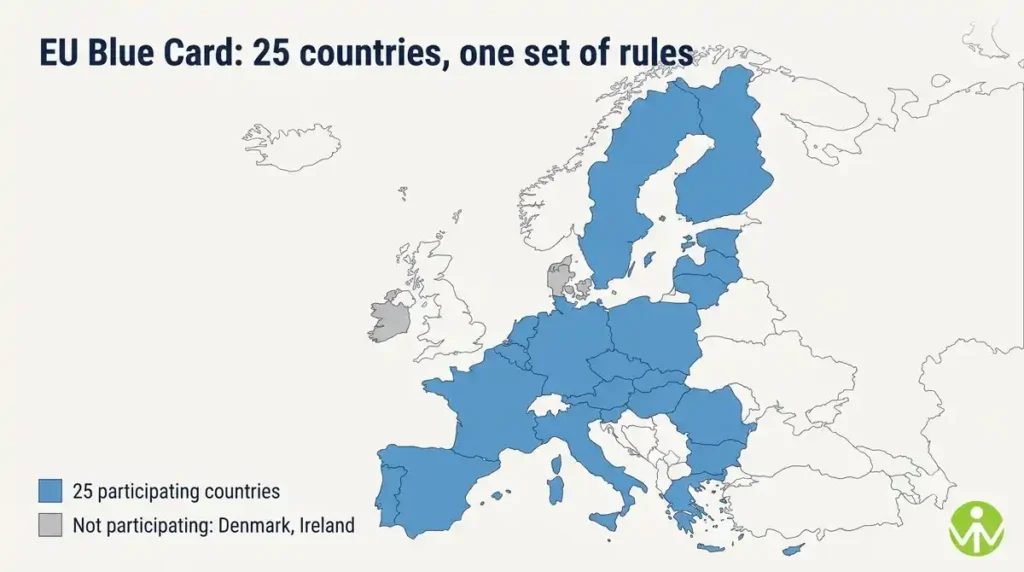
- The EU Blue Card is a work and residence permit for highly qualified non-EU workers, issued by 25 EU countries. Denmark and Ireland do not take part.
- You need a job offer of at least six months, a degree from a programme of at least three years (or, for some IT roles, three years of experience) and a salary above the national threshold.
- Each country sets its salary threshold at 1.0 to 1.6 times its average gross salary. Germany’s 2026 figures are €50,700 and, for shortage occupations and recent graduates, €45,934.20.
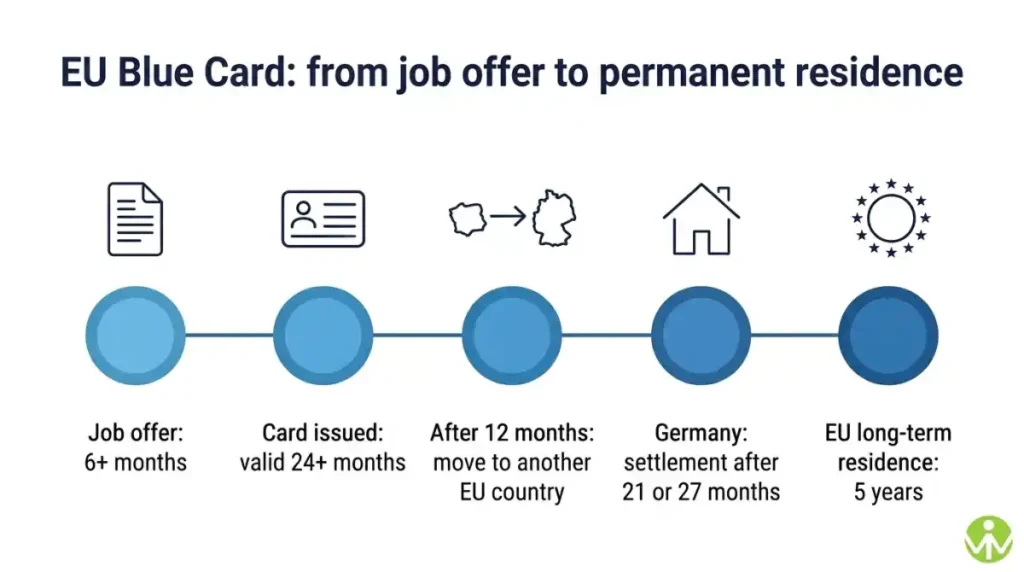
- The card is valid for at least 24 months, or for the contract length plus three months if that is shorter.
- Family members can join without a waiting period, and after 12 months you can move to work in another EU country.
- In Germany, holders can apply for a settlement permit after 21 months with B1 German or 27 months with A1 German.
What is the EU Blue Card?
The EU Blue Card is a residence permit that lets a non-EU national live and work in the EU country that issued it. It is for highly qualified employment: paid work as an employee in a role that normally needs a degree. It is not a route for students, seasonal workers, intra-corporate transferees, researchers under the separate research scheme, or the self-employed, each of whom has their own permit.
Directive (EU) 2021/1883 sets minimum standards, such as how the salary threshold is calculated and how long a decision may take, and leaves countries to decide details such as fees. Although it is often compared to a US green card, it is a temporary permit. It can lead to permanent residence but does not grant it.
Which countries issue the EU Blue Card?
Twenty-five EU member states issue it: Austria, Belgium, Bulgaria, Croatia, Cyprus, the Czech Republic, Estonia, Finland, France, Germany, Greece, Hungary, Italy, Latvia, Lithuania, Luxembourg, Malta, the Netherlands, Poland, Portugal, Romania, Slovakia, Slovenia, Spain and Sweden.
Denmark and Ireland are not bound by the directive and issue their own national permits instead; for example, founders looking at Denmark can use the Startup Denmark visa. Norway, Iceland, Liechtenstein and Switzerland are outside the EU and do not issue the card. Participating countries may also keep national permits for highly qualified workers, but those do not carry EU-wide mobility rights.
EU Blue Card rules at a glance
The table sets out the common rules. National law can be more generous on some points, so check the rules of the country where you will work.
Table 1: EU Blue Card rules at a glance
| Rule | What the directive sets |
|---|---|
| Who it is for | Non-EU nationals taking up highly qualified employment as employees |
| Job offer | Work contract or binding job offer of at least 6 months |
| Qualification | Higher education of at least 3 years (ISCED level 6 or above), or professional experience for listed IT roles |
| Salary threshold | Set nationally at 1.0 to 1.6 times the average gross annual salary |
| Lower threshold | At least 80% of the standard threshold for shortage occupations and recent graduates, never below 1.0 times the average salary |
| Decision time | Up to 90 days, or 30 days for recognised employers |
| Validity | At least 24 months, or contract length plus 3 months if shorter |
| Changing employer | May have to be reported and checked in the first 12 months; afterwards reporting only |
| Unemployment | Card kept unless unemployment exceeds 3 months in total (6 months after 2 years as a holder) |
| Family | No minimum residence period; family members may work |
| Business trips in other EU countries | Up to 90 days in any 180-day period |
| Moving to another EU country | After 12 months; apply within 1 month of arrival |
| Source: Directive (EU) 2021/1883, Articles 5, 8, 9, 11, 15, 17, 20 and 21. National rules can be more favourable. Checked 24 October 2026. | |
EU Blue Card requirements
Every applicant needs a valid travel document and health insurance, plus three things: a qualifying job offer, a recognised qualification and a salary above the national threshold. Regulated professions, such as medicine or law, also need the licence the host country requires of its own citizens.
A degree or professional skills
The standard route needs a higher education qualification from a programme of at least three years at ISCED 2011 level 6 or above, broadly a bachelor’s degree. A master’s degree is not required, and there is no general work-experience requirement. ICT managers and ICT professionals can qualify instead with three years of relevant experience in the last seven years, and countries may accept five years of degree-level experience in other occupations.
A job offer of at least six months
You need a work contract or binding job offer for highly qualified employment lasting at least six months; the 2009 rules required a year. Pay and conditions must match law, collective agreements or practice in the occupation. Some countries first check whether the vacancy could be filled locally, and countries may limit how many non-EU workers they admit.
EU Blue Card salary threshold
Each country sets its own threshold, after consulting employers and unions, at between 1.0 and 1.6 times its average gross annual salary. The old fixed rule of 1.5 times the average no longer applies, which is why the same offer can qualify in one country and fall short in another.
A lower threshold, of at least 80% of the standard figure but never below the national average salary, may apply to shortage occupations and to people who gained their qualification in the three years before applying. Italy sets its threshold at €36,278.51 a year, as our Italy work visa guide explains. Thresholds usually change every year, so confirm the current figure before you accept an offer.
EU Blue Card in Germany: 2026 figures
Germany issues the card under Section 18g of the Residence Act, and the Make it in Germany Blue Card page explains the requirements in English. The 2026 standard threshold is €50,700 gross a year, according to the Baden-Württemberg state service portal. A lower threshold of €45,934.20 applies to shortage occupations, recent graduates and IT specialists without a degree, and in those cases the Federal Employment Agency must approve the job.
The card runs for the contract length plus three months, up to four years. A job change in the first year must be reported to the local foreigners authority. The 2027 thresholds are due by 31 December 2026 and apply from 1 January 2027.
Table 2: EU Blue Card in Germany (2026)
| Item | Germany |
|---|---|
| Legal basis | Section 18g, Residence Act (AufenthG) |
| Standard salary threshold | €50,700 gross a year |
| Lower salary threshold | €45,934.20 gross a year (shortage occupations, recent graduates, IT specialists without a degree) |
| Federal Employment Agency approval | Needed only at the lower threshold |
| Minimum contract | 6 months |
| Validity | Contract length plus 3 months, maximum 4 years |
| Job change in the first year | Must be reported to the local foreigners authority |
| Settlement permit | After 21 months with B1 German, or 27 months with A1 German |
| National visa fee | €75 for adults |
| Sources: Make it in Germany and the Baden-Württemberg service portal, checked 24 October 2026. The 2027 thresholds are due by 31 December 2026. | |
For Germany’s other routes, including the skilled worker visa and the Opportunity Card, see our German work visa guide and the overview of the types of Germany visa.
How to apply for an EU Blue Card
The process is set nationally, and each country decides whether the worker, the employer or either of them applies. The usual sequence is:
- Secure a job offer of at least six months that meets the national salary threshold.
- Check whether your qualification needs recognition in the destination country, and obtain any licence your profession requires.
- Find out whether the application goes through the employer, an embassy or consulate, an online portal or the local immigration office.
- Apply for an entry visa if your nationality needs one; many countries issue a national visa first and the card after arrival.
- Submit the application with your documents and pay the fee.
- Collect the card and register your address where local rules require it.
Documents for an EU Blue Card application
Checklists differ by country, but most ask for:
- A valid passport.
- The signed contract or binding job offer, showing salary and duration.
- Degree certificates and any proof of recognition, or evidence of experience for IT roles.
- A licence for regulated professions.
- Proof of health insurance.
- Photographs and the application form.
- An address, where required; the employer’s address is accepted if you have not found housing yet.
Recognition of a foreign qualification is handled by the destination country, not your home country, although many recognition bodies accept applications from abroad.
Processing time and fees
Authorities must decide within 90 days of a complete application, or 30 days for recognised employers. These are maximum limits, and they exclude time spent on recognition or visas. Fees are national and may not exceed those for comparable national permits. In Germany the national visa costs €75 for adults, plus a local fee for the residence permit after arrival.
EU Blue Card validity, renewal and changing jobs
Each country sets a standard validity of at least 24 months. A shorter contract means a card for at least the contract length plus three months, and a passport that expires sooner can shorten it too. If the card expires while a renewal is pending, you keep your rights until the decision.
In the first 12 months a country may require you to report a change of employer and check the labour market, which can delay the move by up to 30 days. After that, you only report the change. Losing your job does not end the card unless unemployment exceeds three months in total, or six months once you have held it for two years, and you must report when unemployment starts and ends.
Family members of EU Blue Card holders
Your spouse and minor children can join you without any minimum period of residence. Applications made together are decided with the card; later ones within 90 days. Family permits last as long as the card, family members can take any job, and integration measures such as language courses may only be required after arrival. Germany, for instance, exempts spouses of Blue Card holders from the usual A1 German requirement, as our Germany dependent visa guide explains.
Moving to another EU country with an EU Blue Card
Mobility within the EU is what sets the card apart from national work permits.
Business trips
Holders can travel to other participating countries for meetings, conferences, negotiations, sales work or training for up to 90 days in any 180-day period, with no extra work permit. The limit mirrors the 90/180 rule in our Schengen visa guide, but the activity must relate to your job in the first country.
Moving to work in a second country
After 12 months as an EU Blue Card holder in the first country, you can move to a second participating country for a highly qualified job that meets its own salary threshold. You apply for a new card there within one month of arriving and can start work no later than 30 days after a complete application. No other authorisation can be required for the move.
From EU Blue Card to permanent residence
National rules decide permanent permits. In Germany, holders can apply for a settlement permit after 21 months with B1 German or 27 months with A1 German, not the 33 months quoted in older guides, as our guide to permanent residency in Germany explains.
EU long-term resident status generally needs five years of legal residence. Holders who have moved between countries can add up time in different member states if the last two years were spent as a Blue Card holder in the country where they apply. Absences under 12 consecutive months, and 18 months in total, do not break the period, and once granted the status survives absences from the EU of up to 24 months.
EU Blue Card vs national work permits
Most participating countries also issue national work permits, such as Germany’s skilled worker visa or Italy’s quota-based work visas, which may suit you if your salary or qualification falls short. The EU Blue Card usually brings stronger rights: easier family reunification, protection during short unemployment, business travel and the option to move country. National permits can also lead to permanent residence, on each country’s own timetable. Our guide on how to apply for a work visa explains the wider choice, and the types of Italy visa guide shows both routes side by side.
EU Blue Card FAQs
Which countries issue the EU Blue Card?
Twenty-five EU countries. Denmark and Ireland do not take part, and non-EU countries such as Norway and Switzerland do not issue it.
Do I need a master’s degree for an EU Blue Card?
No. A qualification from a programme of at least three years, broadly a bachelor’s degree, is enough. ICT managers and professionals can qualify with three years of relevant experience in the last seven.
What is the EU Blue Card salary threshold?
Each country sets it at 1.0 to 1.6 times its average gross salary, with a lower threshold for shortage occupations and recent graduates. Germany’s 2026 figures are €50,700 and €45,934.20.
How long is the card valid?
At least 24 months, or the contract length plus three months if that is shorter. Germany issues it for the contract plus three months, up to four years, and it can be renewed.
Can I move to another EU country with an EU Blue Card?
Yes. You can make business trips for up to 90 days in any 180, and after 12 months you can move to work in a second country, applying there within one month of arrival.
How soon can a holder get permanent residence?
It depends on the country. Germany allows a settlement permit after 21 months with B1 German or 27 months with A1. EU long-term resident status generally takes five years, and time in several EU countries can count.
Can my family join me?
Yes. Your spouse and minor children can join without a waiting period and can work in any job.