
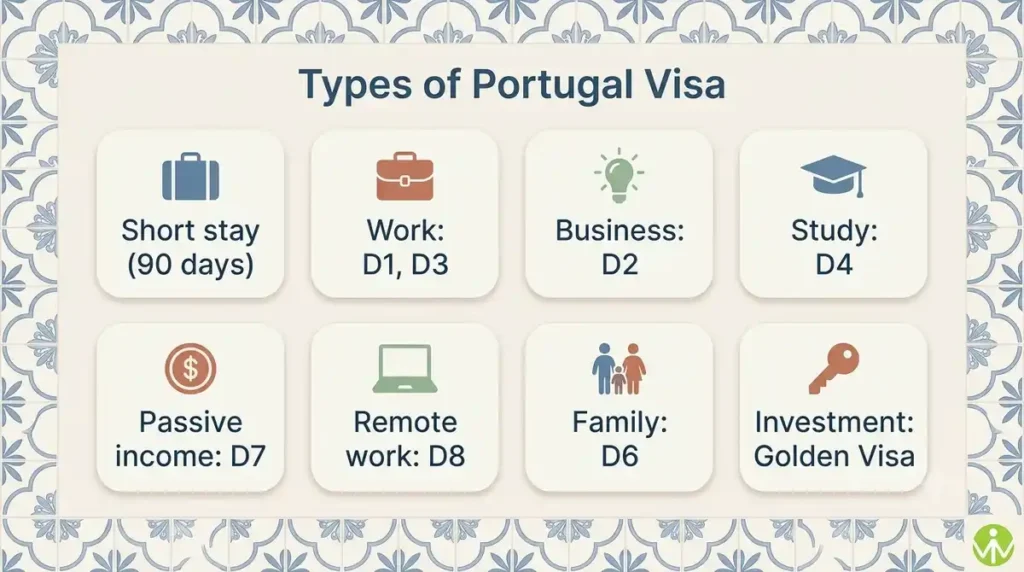
Portugal visas fall into two families: short-stay Schengen visas for visits of up to 90 days, and national visas for anyone planning to stay longer to work, study, retire, invest, or join family. Which one you need depends on your nationality, the purpose of your stay, and how long you intend to stay. This guide to the types of Portugal visa sets out every current route, what each one costs, the income each one asks for, and the rule changes of 2025 and 2026 that have made many older guides wrong.
Two of those changes matter more than any others. In October 2025, Portugal abolished its general job-seeker visa and tightened family reunification, and in May 2026, it doubled the residence period required for citizenship from five years to ten for most nationalities. Both affect which visa makes sense, not just how to apply.
Key Takeaways
- The types of Portugal visa divide into Schengen short-stay visas for up to 90 days and national visas: temporary stay visas for up to a year and residence visas that lead to an AIMA residence permit.
- A national visa costs €110 per applicant. A Schengen visa costs €90, or €45 at the reduced rate.
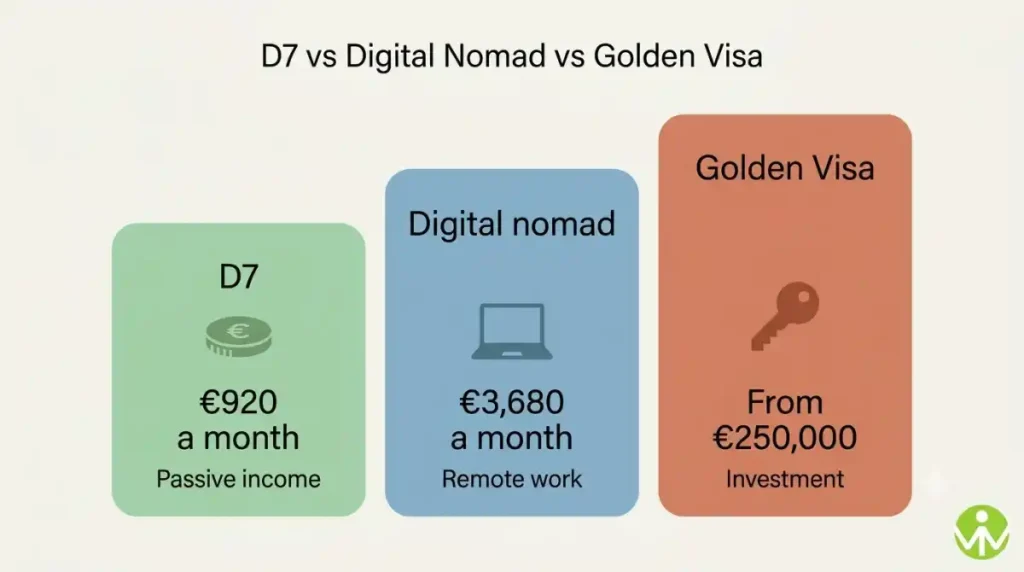
- The D7 asks for passive income of at least €920 a month in 2026. The digital nomad visa asks for €3,680, four times the minimum wage.
- The general job-seeker visa ended on 23 October 2025. Its skilled replacement exists in law but cannot yet be applied for.
- The Golden Visa is still open from €250,000, but property purchases no longer qualify.
- Since 19 May 2026, naturalisation takes 10 years of legal residence, or 7 for EU and CPLP nationals.
Table of Contents
How the types of Portugal visa fit together
Portugal’s system works in two stages for anyone who is moving there. A Portuguese embassy or consulate, part of the Ministry of Foreign Affairs, issues the visa that lets you enter. For a long stay, that visa is only the first step: a residence visa is valid for four months and two entries, and its purpose is to get you to Portugal so that you can collect a residence permit from AIMA, the Agency for Integration, Migration and Asylum, which replaced the former SEF in October 2023.
There are three layers. Schengen short-stay visas cover visits of up to 90 days. Temporary stay visas cover stays of more than 90 days and up to one year. Residence visas cover anyone who intends to live in Portugal for longer, and they are the only Portugal visa types that lead to a residence permit.
The letter codes, D1 to D9 for residence visas and E1 to E11 for temporary stay visas, are consular checklist labels rather than legal names, and consulates do not number them identically. For example, the digital nomad residence visa is widely called the D8 but appears as D9 on some consular checklists. When you apply, choose the visa by purpose, not by code.
Types of Portugal visas at a glance
Table 1: Types of Portugal visa at a glance
| Visa | Main purpose | Length of stay | Key requirement |
|---|---|---|---|
| Schengen short-stay (C) | Tourism, business, family visits, short courses | Up to 90 days in any 180 | Funds, travel insurance, return travel |
| Temporary stay visa | Medical treatment, seasonal work, short study, remote work | Over 90 days, up to 1 year | Evidence for the specific purpose |
| D1 work visa | Employment with a Portuguese employer | Residence | Contract or promise of contract |
| D2 entrepreneur visa | Self-employment, freelancing, new business | Residence | Service contract or business plan, funds |
| D3 highly qualified visa | Skilled jobs, teaching, research, EU Blue Card | Residence | Qualified job offer |
| D4 study and research visa | Higher education, research, internships, volunteering | Residence | Admission or hosting agreement |
| D6 family reunification visa | Joining a family member resident in Portugal | Residence | Sponsor’s residence, housing and means |
| D7 passive income visa | Pensions, rental income, dividends | Residence | At least €920 a month (2026) |
| Digital nomad visa (D8) | Remote work for employers or clients abroad | Temporary stay or residence | At least €3,680 a month (2026) |
| Golden Visa (ARI) | Qualifying investment | Residence permit | From €250,000 |
| Skilled job-seeker visa | Searching for qualified work | 120 days, plus 60 | Not yet open to applications |
| Income thresholds are pegged to the 2026 minimum wage of €920 a month and change every January. Sources: Portuguese Ministry of Foreign Affairs visa portal; Lei n.º 61/2025. Compiled 25 October 2026. | |||
Do you need a visa for Portugal?
Portugal is part of the Schengen area, so the common EU short-stay rules apply. Nationality and length of stay together decide which of the types of Portugal visa applies to you. Nationals of visa-exempt countries, including the United States, the United Kingdom, Canada, Australia, Brazil and Japan, can visit for up to 90 days in any 180-day period without a visa. Nationals of other countries need a Schengen visa before travelling; our Schengen visa guide explains who needs one and how the 90/180 rule works.
Since 10 April 2026, the Entry/Exit System has recorded the fingerprints and facial images of non-EU travellers at Schengen borders. ETIAS, the travel authorisation visa-exempt visitors will need, is not yet operational, and the EU has not announced a start date.
Visa exemption covers visits only. Anyone planning to work, study, or live in Portugal for more than 90 days needs a national visa issued before travel, regardless of nationality. Since October 2025, this also applies to nationals of the Portuguese-speaking CPLP countries, who previously could regularise their stay from inside Portugal.
Schengen visas: the short-stay types of Portugal visa
The Schengen visa, type C, covers tourism, business meetings, family visits, short courses and transit, for up to 90 days in any 180-day period across all 29 Schengen states. Apply at the consulate of your main destination country. The standard fee is €90; a reduced fee of €45 applies to some applicants, including children aged six to under 12, and children under six pay nothing.
You cannot convert a Schengen visa into a Portuguese residence permit. Anyone planning to stay must apply for the correct national visa from their country of residence. Seasonal workers staying for less than 90 days use a short-stay seasonal work visa.
Temporary stay types of Portugal visa
Temporary stay visas cover stays of more than 90 days and up to one year, with multiple entries. The main purposes are medical treatment and accompanying a patient, seasonal work of up to 270 days, short programmes of study or training, research or highly qualified work lasting less than a year, amateur sport, volunteering, and remote work for less than a year. Youth mobility agreements with a small number of countries also run through this category.
These are shorter Portugal visa types, designed for a fixed stay. Anyone expecting to stay in Portugal for more than a year should apply for a residence visa from the start rather than plan to switch later.
Work-based types of Portugal visa
Among Portugal visa types, the work routes have changed the most in the past year. Three are open, and one is pending regulation before it can open.
D1 work visa for employees
The D1 is for employment with a Portuguese employer. Applicants need an employment contract, a promise of a contract or an expression of interest from the employer, and proof that they may practise if the profession is regulated in Portugal. The salary must at least match the minimum wage, which is €920 a month in 2026. Since the October 2025 reforms, there is no longer a route to arrive as a visitor, find work, and regularise afterwards: the visa must be issued before travel.
D3 highly qualified visa and the EU Blue Card
The D3 covers highly qualified employment, university teaching, research and cultural activity. Portugal also issues the EU Blue Card through this channel, for graduates with a job offer paying at least 1.5 times the national average gross annual salary, or 1.2 times for certain shortage professions. Highly qualified workers are exempt from the two-year wait before family reunification, which makes the D3 the most practical route for people moving with a family.
Skilled job-seeker visa
The general job-seeker visa, which let applicants enter for up to 120 days to look for work, was abolished on 23 October 2025 by Lei n.º 61/2025. Its replacement, the visa to seek qualified work, is limited to people with specialised technical skills. It allows 120 days, with a possible 60-day extension, and holders who do not find a job must leave. As of October 2026, it cannot be applied for because the government ordinance that defines which skills qualify has not been published.
Seasonal work
Seasonal work in agriculture, tourism and similar sectors uses a Schengen seasonal visa for up to 90 days, or a temporary stay visa for up to 270 days. Neither leads to residence.
Entrepreneur types of Portugal visa: D2, StartUp Visa and Tech Visa
The D2 is the residence visa for independent professionals, freelancers and people setting up a business in Portugal. Applicants must show a service contract or business plan, proof of subsistence, and evidence that the activity is viable. There is no fixed minimum investment. Our Portugal D2 guide covers the application in more detail.
The StartUP Visa is a separate programme run with IAPMEI, Portugal’s agency for competitiveness and innovation. Founders need acceptance from a certified incubator before applying. The two routes are often described as one, but they are not: the D2 suits an established freelancer or business owner, while the StartUP Visa suits an early-stage, innovation-led company. Our comparison of startup visas by country sets Portugal’s scheme beside those of other countries.
The Tech Visa is not a visa in its own right. It certifies companies that hire highly qualified staff and speeds up the D3 process for their recruits.
Income-based types of Portugal visa: D7 and digital nomad
Two types of Portugal visa focus on income earned outside the country rather than a job inside it, and applicants most often confuse them.
D7 passive income visa
The D7 is for people living on regular passive income: pensions, rental income, dividends, interest or royalties. In 2026, the minimum is €920 a month for the main applicant, equal to the monthly minimum wage, plus 50 per cent for a spouse or adult dependant and 30 per cent for each child. Applicants also need to show accommodation in Portugal, health cover, and a clean criminal record. Some guides still quote the D7 at four times the minimum wage; that figure belongs to the digital nomad visa.
Digital nomad visa (D8)
The digital nomad visa, introduced in 2022 and commonly called the D8, is for people who work remotely for employers or clients outside Portugal. It requires income of four times the minimum wage, €3,680 a month in 2026, with the same family uplifts. It comes in two forms: a temporary stay version for up to a year, and a residence version that leads to a residence permit. Our overview of digital nomad visas compares Portugal’s scheme with others.
Presenting remote-job income under the D7 is a common reason for refusal. The deciding test is where the money comes from, not how much there is.
Table 2: Income thresholds for the D7 and digital nomad types of Portugal visa, 2026
| Item | D7 passive income visa | Digital nomad visa (D8) |
|---|---|---|
| Type of income | Passive: pensions, rent, dividends, royalties | Active: remote employment or freelance work for clients outside Portugal |
| Main applicant | €920 a month | €3,680 a month |
| Spouse or adult dependant | +50% (€460) | +50% (€1,840) |
| Each child | +30% (€276) | +30% (€1,104) |
| Leads to a residence permit | Yes | Yes, residence version only |
| Based on the 2026 minimum wage of €920 a month, revised every January. Family uplifts follow consular practice. Compiled 25 October 2026. | ||
Study and research types of Portugal visa
Students admitted to a Portuguese university or polytechnic apply for a residence visa for study, usually listed as D4, which leads to a residence permit for the length of the course. The same family of visas covers researchers with a hosting agreement, exchange students, internships and volunteering. Courses of less than a year use the temporary stay route instead. Applicants show proof of admission, sufficient funds and health cover.
Family reunification visa
Family members of a foreign national living legally in Portugal, meaning a spouse or partner, minor or dependent children and dependent parents, join them through family reunification. The resident starts the process with AIMA, and the family member receives a residence visa, usually listed as D6, from the consulate abroad.
Since 23 October 2025, the resident must generally have held legal residence for two years before applying. The wait does not apply to Golden Visa holders, highly qualified workers, or spouses and partners with minor or dependent children in their care. The sponsor must also show suitable housing and stable means without relying on social support. Because the two-year rule hits D7 and digital nomad holders hardest, families planning to move together should check it before choosing a Portugal visa type.
Portugal Golden Visa
The Golden Visa, formerly the residence permit for investment activity (ARI), is not issued by a consulate: investors apply to AIMA and travel to Portugal for biometrics. Of all Portugal visa types, it is the only one with no salary or income test. Since October 2023, property purchases no longer qualify. The routes still open are a donation of €250,000 to the arts or national heritage, €500,000 in qualifying investment funds, €500,000 in research activity, €500,000 of capital in a Portuguese company that creates or keeps five jobs, and the creation of ten jobs.
The presence requirement is light, at seven days in the first year and 14 days in each two-year period after that, and holders are exempt from the family reunification wait. The new nationality law has lengthened the path to a passport, however, so the programme now offers residence rather than a fast route to citizenship. AIMA moved renewals online through its portal in February 2026. Our guide to golden visas by country compares Portugal with other programmes, and our explainer on citizenship by investment sets out why the two products differ.
CPLP mobility route
Nationals of other Portuguese-speaking CPLP countries, Angola, Brazil, Cape Verde, Equatorial Guinea, Guinea-Bissau, Mozambique, São Tomé and Príncipe, and Timor-Leste, have a dedicated residence route with lighter documentation. Since October 2025, it starts with a consular visa before travel; entering visa-free and regularising afterwards is no longer possible. CPLP nationals qualify for citizenship after seven years of legal residence, not ten. The route sits alongside the other types of Portugal visa rather than replacing them: a CPLP national moving for a job still provides the evidence a work visa requires.
What the types of Portugal visa cost
Visa fees are charged per applicant and are not refunded if a visa is refused. The Ministry of Foreign Affairs sets the national visa fee at €110 for every temporary stay and residence visa.
Table 3: Fees for the types of Portugal visa, October 2026
| Visa or permit | Fee |
|---|---|
| Schengen short-stay visa | €90 (reduced fee €45; children under six free) |
| National visa: temporary stay or residence | €110 |
| Skilled job-seeker visa | Not yet available |
| AIMA residence permit | Separate fee, paid in Portugal, varies by permit |
| Golden Visa (ARI) | Separate AIMA processing and issue fees, on top of the investment |
| Consular fees as published by the Portuguese Ministry of Foreign Affairs, October 2026. Visa centres add their own service fees. Fees are not refunded if a visa is refused. | |
The national visa fee rose from €90 to €110 in 2025, so guides that quote €90 for a D7 or D2 visa are out of date. When comparing Portugal visa types, budget for the consular fee, the AIMA permit fee, and any visa-centre charge.
From visa to permanent residence and citizenship
Every residence-based one of the types of Portugal visa feeds into the same AIMA process. Within the four months of a residence visa, the holder attends an AIMA appointment and receives a temporary residence permit, normally valid for two years and renewable. After five years of legal residence, most holders can apply for permanent residence; our Portugal permanent residency guide covers that step.
Citizenship moved further away in 2026. Under Lei Orgânica n.º 1/2026, in force since 19 May 2026, naturalisation requires ten years of legal residence, or seven for EU and CPLP nationals, counted from the issue of the first residence permit rather than from the application date. Applications filed before that date continue under the old five-year rule. Portugal allows dual nationality, but whether you can keep your existing citizenship depends on your country’s law; check our list of countries that allow dual citizenship.
What changed in the types of Portugal visa in 2025 and 2026
Table 4: Changes to the types of Portugal visa, 2025 and 2026
| Date | Change | Effect |
|---|---|---|
| Early 2025 | National visa fee raised from €90 to €110 | Every D-type visa costs more |
| 23 Oct 2025 | General job-seeker visa abolished (Lei n.º 61/2025) | Only a skilled job-seeker visa remains, not yet open |
| 23 Oct 2025 | Two-year wait before most family reunification | Families on D7 or digital nomad visas wait longer |
| 23 Oct 2025 | Expression of interest route closed; CPLP route needs a consular visa | Residence must start with a visa issued abroad |
| 1 Jan 2026 | Minimum wage rises to €920 a month | D7 threshold €920, digital nomad €3,680 |
| 16 Feb 2026 | Golden Visa renewals move online | Renewals filed through AIMA’s portal |
| 10 Apr 2026 | Entry/Exit System fully operational | Biometrics recorded at Schengen borders |
| 19 May 2026 | Lei Orgânica n.º 1/2026 in force | Naturalisation takes 10 years, or 7 for EU and CPLP nationals |
| Sources: Lei n.º 61/2025; Lei Orgânica n.º 1/2026; Portuguese Ministry of Foreign Affairs; AIMA. Compiled 25 October 2026. | ||
Two changes are still pending without a date: the ordinance that would open the skilled job-seeker visa, and the launch of ETIAS. The 2027 minimum wage will also move the D7 and digital nomad thresholds again in January.
How to choose between the types of Portugal visa
The right choice among Portugal visa types usually comes down to two questions: why you are going and where your income comes from.
- A job offer from a Portuguese employer points to the D1, or the D3 if the role is highly qualified.
- Remote work for employers or clients abroad points to the digital nomad visa.
- Pensions, rent or investment income point to the D7.
- Starting or moving a business points to the D2 or the StartUP Visa.
- Investment with little time in Portugal points to the Golden Visa.
- A university place points to the study visa.
If the long-term goal is citizenship, compare presence as well as eligibility. All these types of Portugal visa now lead to a ten-year naturalisation path for most nationalities, and only time spent living in Portugal builds the ties a citizenship application is judged on.
Frequently asked questions about the types of Portugal visa
How many types of Portugal visa are there?
There are three broad types of Portugal visa: Schengen short-stay visas for up to 90 days, temporary stay visas for up to a year, and residence visas for longer stays. Within the residence category, there are separate visas for work, entrepreneurship, highly qualified jobs, study, family reunification, passive income and remote work, plus the Golden Visa residence permit.
What is the easiest type of Portugal visa to get?
No single route is easiest for everyone. The D7 has the lowest income threshold, at €920 a month in 2026, but only passive income counts. Applicants with a job offer usually find the D1 or D3 more straightforward, because the employer supplies much of the evidence.
Can I still get a job-seeker visa for Portugal?
Not at present. The general job-seeker visa was abolished on 23 October 2025. Its replacement, a visa to seek qualified work, exists in law, but consulates cannot accept applications until the government publishes the ordinance that defines which skills qualify.
What is the difference between the D7 and the digital nomad visa?
The D7 is for passive income such as pensions, rent and dividends, and requires €920 a month in 2026. The digital nomad visa is for active remote work for employers or clients outside Portugal, and needs €3,680 a month.
Does the Portugal Golden Visa still include real estate?
No. Property purchases stopped qualifying in October 2023. The open routes are a €250,000 cultural donation, €500,000 in qualifying funds, research or company capital, or the creation of ten jobs.
How long does it take to get Portuguese citizenship now?
Since 19 May 2026, ten years of legal residence for most nationalities, or seven for EU and CPLP nationals, counted from the issue of the first residence permit. Applications filed before that date are assessed under the old five-year rule.
Which types of Portugal visa lead to permanent residence?
All residence visas do, including the D1, D2, D3, D4, D6, D7 and the residence version of the digital nomad visa, as does the Golden Visa. Schengen and temporary stay visas do not. Permanent residence is normally available after five years of legal residence.
Do I need a visa to visit Portugal as a tourist?
Nationals of visa-exempt countries can visit for up to 90 days in any 180 days without a visa. Others need a Schengen visa, which costs €90. ETIAS, the future travel authorisation for visa-exempt visitors, is not yet in operation.
How much does a Portugal visa cost?
A national visa for a temporary stay or residence costs €110 per applicant, and a Schengen visa costs €90. AIMA charges separate fees for residence permits, and visa centres add their own service fees.