
Portugal permanent residency has become one of the most sought-after immigration goals in Europe. A combination of factors explains why: Portugal holds a 4th-ranked passport on the 2026 Henley Passport Index, offering holders visa-free access to approximately 185 destinations globally. Its cost of living is lower than most Western European countries. It has a temperate climate, a growing English-speaking professional community, and a track record of welcoming foreign residents. For non-EU citizens seeking a foothold in Europe with a clear pathway to citizenship, Portugal is consistently among the top-ranked options. [Passport Ranking]
This guide covers every major pathway to Portugal permanent residency in 2026 — from the Golden Visa investment route to the D7 passive income visa, work-based routes, and family reunification. It also explains what permanent residency grants you, how long the process takes, what it costs, and what has changed in Portugal’s immigration rules this year.
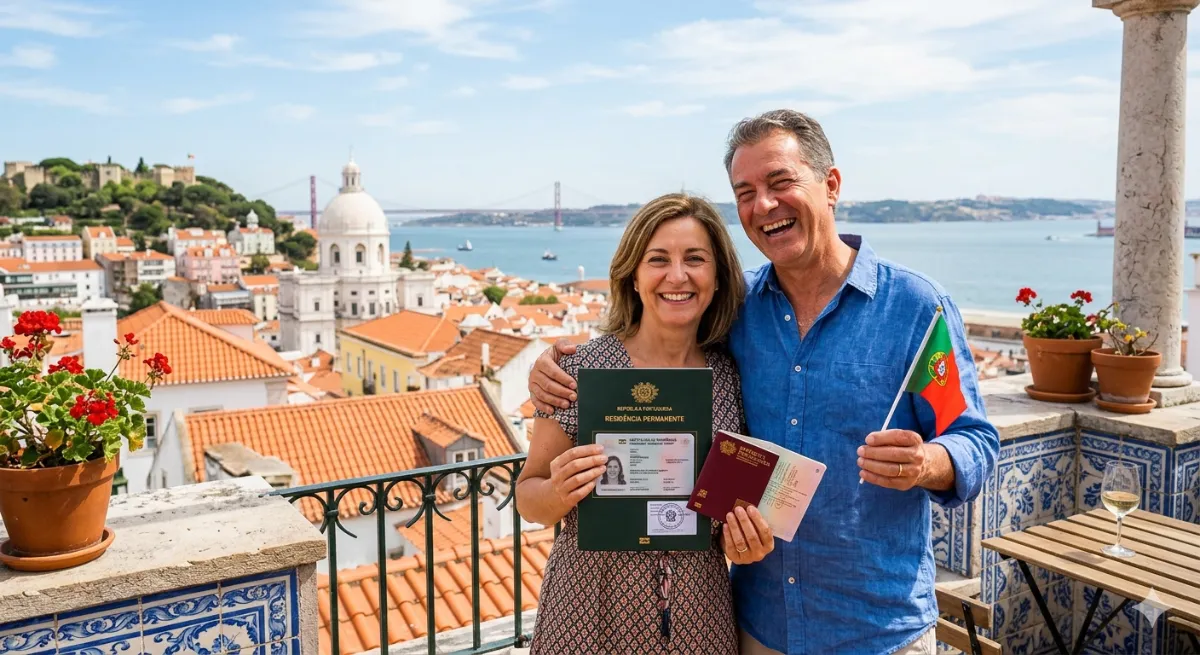
What Portugal Permanent Residency Gives You
Portugal permanent residency (Autorização de Residência Permanente) is not the same as citizenship, but it comes close in practical terms. Here is what it grants:
| Right or Benefit | Details |
|---|---|
| Live in Portugal indefinitely | No need to renew a temporary permit every 1–2 years. The permanent residence card is renewed every 5 years as an administrative formality. |
| Work in Portugal without restrictions | Full work rights across all sectors and employment types, including self-employment. |
| Travel freely in the Schengen Area | Access to 26 Schengen member states for up to 90 days in any 180-day period without a visa. |
| Access to public services | Access to Portugal’s National Health Service (SNS), public education, and social security entitlements. |
| Sponsor family members | Right to apply for family reunification for a spouse, dependent children, and dependent parents (sponsor must have held legal residence for at least 2 years). |
| Path to citizenship | After 5 years of legal residence (subject to proposed law change — see note below), you may apply for Portuguese citizenship, which grants a Portuguese passport and full EU citizenship. |
| Absence allowances | Permanent residents can be absent from Portugal for up to 24 consecutive months, or 30 months total within a 3-year period, without losing their status. |
Important: Portugal’s Parliament approved a change to its Citizenship Law in April 2026 that would extend the residency requirement for citizenship from 5 years to 10 years for most non-EU applicants. The law had not yet been signed by the President at the time of writing. Monitor updates to this before making citizenship timelines part of your planning.
Portugal Permanent Residency: The Core Requirement
Regardless of which pathway you use to enter Portugal, the fundamental requirement for Portugal permanent residency is 5 years of continuous legal residence. What “continuous” means depends on your visa type:
- Golden Visa holders: Minimum physical presence of 7 days per year is sufficient to maintain legal residence status — the most flexible option available.
- D7, D8, and D3 visa holders (passive income, digital nomad, skilled worker): Must spend at least 183 days per year in Portugal — equivalent to standard tax residency. This is a stricter physical presence requirement.
- EU/EEA/Swiss citizens: Registered as residents; eligible for permanent residency after 5 continuous years under more streamlined rules (CRUE certificate pathway).
During the 5-year temporary residence period, you must maintain the conditions that qualified you for your original visa — for Golden Visa holders, this means maintaining the investment.
Pathway 1: Portugal Golden Visa (Investment Route)
The Portugal Golden Visa is the most internationally recognised pathway to Portugal permanent residency for non-EU investors. It allows eligible investors and their immediate family to obtain a temporary residence permit with a minimal physical presence requirement of just 7 days per year.
What Changed in 2023-2026: Real Estate Route Removed
As of October 2023, it is no longer possible to obtain a Portugal Golden Visa through property purchase. This was a significant change — real estate investment had been the most popular Golden Visa route. As of 2026, the eligible investment options are:
| Investment Route | Minimum Amount | Notes |
|---|---|---|
| Investment fund units | EUR 500,000 | Most popular route in 2026. Funds must invest primarily in companies headquartered in Portugal. Investment returned after 5 years. |
| Capital investment in a company | EUR 500,000 | Investment in an existing or new Portuguese company; must create or maintain 5 permanent jobs. |
| Job creation (company formation) | No minimum capital | Must create at least 10 permanent jobs in Portugal. |
| Scientific research investment | EUR 500,000 | Must be approved by a Portuguese government authority. |
| Cultural or artistic donation | EUR 250,000 | Lowest entry point. Supports art, national heritage, or reconstruction projects through official channels. |
Golden Visa Process and Timeline
- Obtain a Portuguese Tax Identification Number (NIF) and open a Portuguese bank account — can be done remotely with a power of attorney.
- Make the qualifying investment.
- Submit your Golden Visa application online through AIMA (Agency for Integration, Migration and Asylum).
- Attend a biometrics appointment in Portugal — the only mandatory in-person step.
- Receive your temporary residence card (valid 2 years, renewable for 2 more years).
- After 5 years: Apply for Portugal permanent residency or citizenship.
Processing time: Approximately 12–18 months from application to biometrics appointment. Planning for a 2-year total timeline from initial investment to card in hand is advisable.
Pathway 2: D7 Passive Income Visa
The D7 Visa — sometimes called the Passive Income Visa or Retirement Visa — is designed for non-EU citizens who have a stable, regular passive income sufficient to support themselves in Portugal without employment. It is a popular option for retirees, property investors with rental income, dividend recipients, and those with pension income.
D7 Visa Income Requirements (2026)
As of 2026, applicants must demonstrate a minimum monthly income of EUR 3,680 (equivalent to four times the Portuguese minimum wage) for the primary applicant, with 50% more for a spouse and 30% more for each dependent child. Acceptable income sources include pensions, rental income, dividends, interest, and royalties — but not employment income from abroad, which is covered by the D8 Visa.
D7 Visa Key Conditions
- Minimum 183 days per year physical presence in Portugal required to maintain residency status.
- Apply for the D7 Visa at the Portuguese consulate in your country before entering Portugal.
- After arrival, register with AIMA for a temporary residence permit.
- After 5 years: Eligible for Portugal permanent residency.
The D7 is one of the most accessible pathways for middle-income applicants who have stable non-employment income, particularly retirees from the US, UK, Brazil, and South Africa.
Pathway 3: D8 Digital Nomad / Remote Worker Visa
The D8 Visa was introduced in 2022 and targets non-EU citizens who work remotely for a foreign employer or as a freelancer for foreign clients. It has the same income thresholds as the D7 (EUR 3,680/month minimum) and the same 183-day physical presence requirement. Like the D7, it leads to Portugal permanent residency after 5 years of continuous legal residence.
Applicants must provide proof of employment or client contracts outside Portugal, evidence of income, and health insurance. The D8 Visa has attracted significant interest from technology professionals and freelancers from the US, UK, Brazil, and India, among others.
Pathway 4: Work-Based Route (D3 Skilled Worker Visa)
Non-EU nationals who have a job offer from a Portuguese employer can apply for the D3 Highly Qualified Activity Visa. This is Portugal’s equivalent of the EU Blue Card for highly skilled workers and is available in science, technology, arts, and other fields. It requires a minimum salary of EUR 1.5x the national average wage. After 5 years of legal employment and residence, D3 visa holders are eligible for Portugal permanent residency.
Portugal also operates a 20-day Green Lane fast-track process for jobs listed on the IEFP shortage occupation list (nurses, software developers, engineers, welders, and others). This significantly speeds up the initial permit stage for eligible applicants.
Pathway 5: Family Reunification
Non-EU nationals who are the spouse, dependent child, or dependent parent of a Portuguese citizen or legal permanent resident can apply for family reunification. The sponsor must have held legal residence in Portugal for at least 2 years. After 5 years of legal residence under family reunification status, the family member is eligible to apply for Portugal permanent residency independently.
Applying for Portugal Permanent Residency: The Process
Once you have completed 5 years of legal residence under any of the above pathways, here is the process to formalise Portugal permanent residency:
- Gather required documents: valid residence permit, proof of 5 years continuous residence (entry/exit stamps, tax records, AIMA records), proof of language proficiency (A2 level Portuguese for most applicants), clean criminal record certificate from Portugal and your home country, proof of accommodation in Portugal.
- Submit your application to AIMA (online portal, with in-person appointment for document verification).
- AIMA processes and verifies all documents. Processing currently takes several months — AIMA has been working through a backlog; applicants should plan for 6–12 months.
- Receive your Portugal Permanent Residence Card (Autorização de Residência Permanente), valid for 5 years and renewable.
Important 2026 update: Since April 2025, AIMA only accepts complete applications at the time of submission — no partial uploads allowed. Missing even one document means the application is returned. Prepare your file in full before submitting.
Costs: What to Budget for Portugal Permanent Residency
| Cost Item | Approximate Amount | Notes |
|---|---|---|
| Golden Visa investment | EUR 250,000–500,000 | Investment amount only. Returned after 5 years for fund route. |
| D7 / D8 Visa application fee | EUR 90 | Consulate fee |
| AIMA residence permit (initial) | EUR 320 (approx.) | Temporary residence card issuance |
| AIMA permanent residence application | EUR 200 (approx.) | Permanent residence card issuance |
| NIF (Tax ID) registration | EUR 10.20 | Required for all applicants |
| Language test (if required) | EUR 50–150 | A2 Portuguese level for most naturalization applicants |
| Immigration lawyer / adviser | EUR 1,500–5,000 | Highly recommended, especially for Golden Visa route |
Frequently Asked Questions: Portugal Permanent Residency
Can I get Portugal permanent residency without living there?
Only through the Golden Visa route. Golden Visa holders need to spend just 7 days per year in Portugal during the 5-year residency period. All other pathways require 183+ days per year.
Does Portugal allow dual citizenship?
Yes. Portugal allows dual nationality, and Portuguese citizenship does not require you to renounce your original citizenship. This is a significant draw for citizens of countries that also permit dual nationality.
How does Portugal permanent residency compare to citizenship?
Permanent residency grants the right to live, work, and access services in Portugal indefinitely. Citizenship adds a Portuguese (EU) passport, the right to vote and stand for election, and the ability to pass Portuguese citizenship to children. For those whose primary goal is a strong passport, citizenship is the end goal. [Passport Ranking]
Can Americans get Portugal permanent residency?
Yes. Americans are one of the largest groups of Golden Visa and D7 Visa applicants in Portugal. In 2025, applications from US citizens for investment migration programmes surged significantly, with Portugal remaining the top choice. The minimal physical presence requirement of the Golden Visa (7 days per year) suits Americans who cannot or do not want to relocate immediately. [US Dual Citizenship]
Is Portugal permanent residency transferable to family members?
Children born in Portugal to permanent resident parents may be eligible for Portuguese citizenship at birth. Spouses and dependent children of permanent residents are eligible for family reunification. Each family member must apply individually for their own residence permit.
Final Note
Portugal’s permanent residency is a realistic, well-structured goal for non-EU citizens who meet the eligibility criteria. The pathway is clear, the country’s immigration framework is mature and improving (AIMA replaced the previous SEF agency in 2023), and the end result — a Portuguese passport and EU citizenship — is one of the most valuable in the world. Work with a reputable immigration lawyer, plan for 5+ years, and verify all current requirements on the AIMA website (aima.gov.pt) before beginning your application. [Visa Application Guide]
Sources
- AIMA — Agency for Integration, Migration and Asylum, Portugal (https://aima.gov.pt)
- GetGoldenVisa.com — Portugal Permanent Residency Guide 2026
- Consiliojus — Portugal Residence Permit Guide 2026
- IMin Portugal — Residency in Portugal 2026
- Henley Passport Index 2026
- Portugal Citizenship Law Amendment — Parliament Vote April 2026