
Knowing how to apply for tourist visa correctly is the difference between a smooth trip and a frustrating rejection. Tourist visas are the most common visa type in the world, yet refusal rates remain high in many corridors — not because applicants are ineligible, but because applications are incomplete, documents are inconsistent, or the wrong visa category is chosen. This guide covers the full process: who needs a tourist visa, what documents are required, how to apply, how long it takes, and what to do if your application is refused.
Whether you hold a weak passport and need a visa for most destinations, or hold a strong passport and only occasionally face visa requirements, the core principles of how to apply for a tourist visa are the same.
Do You Need A Tourist Visa? Start Here
Not every traveller needs a tourist visa. Whether you do depends on two things: your passport nationality and your destination country. The relationship between these two is tracked by the Henley Passport Index, which maps visa-free access for every passport globally. Citizens of Singapore, Japan, and most EU countries can enter the majority of destinations without a prior visa. Citizens of countries ranked lower on the index — such as India, Pakistan, Nigeria, or Bangladesh — require a visa for most Western, Gulf, and many Asian destinations.
Before you begin any visa application, check the official immigration or consular website of your destination country, or use IATA Travel Centre to confirm whether a visa is required for your specific nationality. Requirements can change with little notice when diplomatic relations shift.
Types of Tourist Entry
There are three main ways to enter a country as a tourist, depending on your nationality and destination:
- Visa-free entry: No advance application needed. You present your passport at immigration on arrival.
- Visa on arrival (VOA): You pay a fee and receive a visa stamp at the airport. No pre-approval required but you must carry the correct documents.
- Prior visa required: You must apply at the consulate or online before travelling. This is what most people mean when they say “tourist visa.”
This guide focuses on the prior visa process, which is the most detailed and where most applicants encounter difficulties.
Documents Required When You Apply for a Tourist Visa
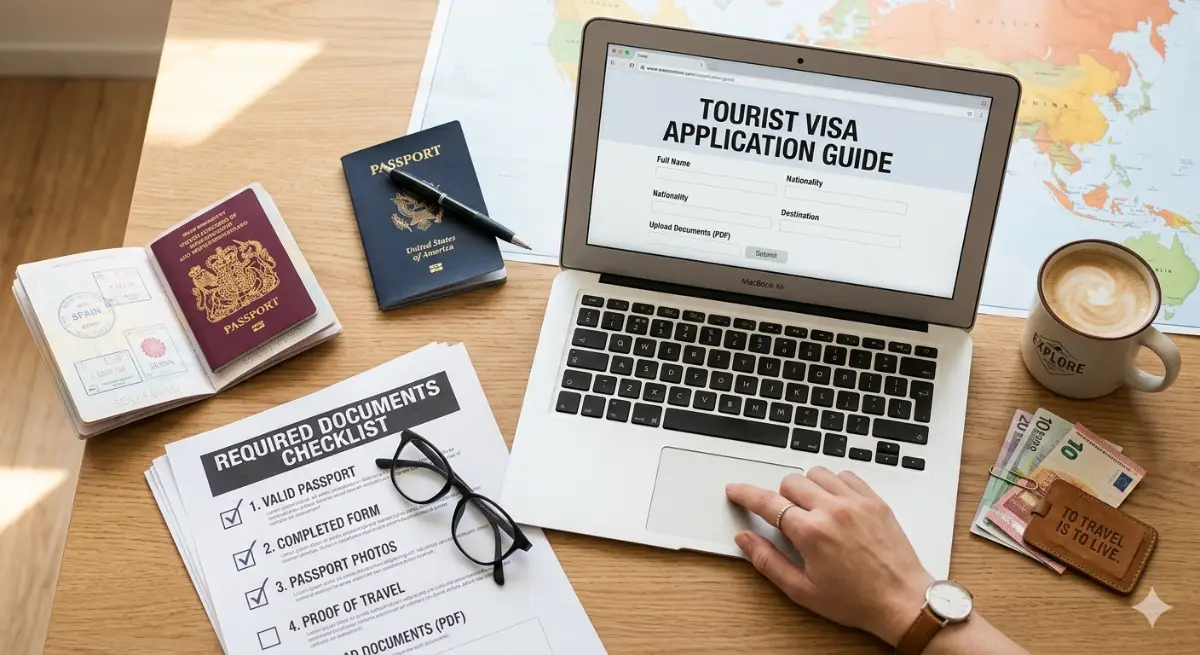
The exact document list varies by destination, but the following are required by almost every country that issues tourist visas. Missing even one of these will typically result in your application being returned unprocessed.
| Document | Details to Note |
|---|---|
| Valid passport | Most countries require at least 6 months validity beyond your planned departure date. Check for blank pages — many require at least 2. |
| Completed visa application form | Fill in every field. Leaving blanks or using N/A incorrectly is a common cause of delay. |
| Passport-size photographs | Must meet the destination country’s specifications (size, background colour, recency). Check each country’s requirements individually. |
| Proof of accommodation | Hotel booking confirmation, Airbnb reservation, or a host’s invitation letter with their address and ID. |
| Proof of return or onward travel | A confirmed return flight booking. Some consulates accept onward bookings (e.g., if travelling multiple countries). |
| Travel insurance | Mandatory for Schengen visas (minimum €30,000 coverage). Strongly recommended for all applications. Increases credibility. |
| Proof of sufficient funds | Bank statements for the past 3–6 months. The required amount varies by destination — Schengen countries typically require €100/day. |
| Employment or student status proof | Letter from employer (stating leave approval and salary), or enrolment letter from a university. |
| Visa fee payment receipt | Pay only through official channels. Fees are non-refundable in most cases even if the visa is refused. |
For specific destinations, additional documents may be required — for example, an invitation letter from a citizen sponsor for Russia, a proof of hotel booking for Indonesia visa on arrival, or confirmed travel insurance for Schengen applications. Always check the consulate’s official checklist for your nationality.
How to Apply for a Tourist Visa: The Step-by-Step Process
Step 1: Identify the Correct Consulate or Application Centre
Tourist visa applications are submitted either directly to the destination country’s consulate or embassy in your country, or through an authorised Visa Application Centre (VAC) such as VFS Global or BLS International. Many countries now also accept applications through their official online portals. Confirm which channel applies to your nationality and destination before doing anything else.
Step 2: Gather Your Documents in Advance
Do not start your application until all documents are assembled. Consulates in many countries operate appointment-only systems with limited slots. If you arrive with an incomplete file, you will lose your appointment slot and may face weeks of delay before the next available appointment. Start collecting documents at least 4–6 weeks before your intended submission date for popular destinations like the US, UK, and Schengen countries.
Step 3: Book Your Appointment
Most consulates and VACs require an appointment for biometrics and document submission. Appointment availability varies dramatically by location and season. For Schengen visa applications from major cities in South Asia, the Middle East, and Africa, appointment slots can be fully booked 6–10 weeks out during peak travel periods (summer, Christmas, Eid). Book your appointment as early as possible — before you have all your documents ready if necessary, since documents can be gathered while you wait.
Step 4: Submit Your Application
At your appointment, you will submit your documents, have biometrics taken (fingerprints and photograph for most Schengen and US applications), and pay any applicable fee. Keep a complete copy of everything you submit. Request a receipt or tracking number for your application.
Step 5: Wait for a Decision
Processing times vary widely. Schengen tourist visas officially take up to 15 calendar days but often arrive faster. US B-2 tourist visa interviews can be booked months out in many countries, and processing can take several weeks after the interview. UK tourist visas typically take 3 weeks. Always check current processing times on the relevant consulate’s website before planning travel.
| Destination | Typical Processing Time | Notes |
|---|---|---|
| Schengen Area (EU) | 10–15 working days | Apply no more than 3 months before travel. Country of main destination handles the application. |
| United States (B-2) | 4–12 weeks post-interview | Interview wait times vary greatly by country. Check travel.state.gov for current waits. |
| United Kingdom | 3 weeks | Priority and super priority services available for a fee. |
| Canada | 4–8 weeks | Online applications often faster. Biometrics required for most nationalities. |
| Australia | 20–40 working days | eVisitor and ETA available for eligible nationalities — much faster. |
| UAE | 3–5 working days | Online application available. Multiple duration options. |
Why Tourist Visa Applications Are Refused — and How to Avoid It
Understanding the most common refusal reasons is as important as knowing how to apply for a tourist visa correctly. Consulates do not always provide detailed reasons for refusal, which makes prevention critical.
Most Common Refusal Reasons
- Insufficient funds: Bank statements show balances too low to cover the trip, or show irregular deposits just before the application — a pattern consulates are trained to spot.
- No proof of ties to home country: This is the single most common reason for refusal, particularly for younger applicants and those from high-emigration countries. Consulates want evidence that you will return — property ownership, stable employment, family responsibilities, or business interests all help.
- Incomplete or inconsistent documents: Dates that do not add up, inconsistencies between your application form and your supporting documents, or missing pages.
- Previous overstay or visa violation: If you have overstayed a visa or violated conditions in any country, this significantly reduces your chances for future applications.
- Vague travel purpose: Applications that lack a clear, credible reason for the visit are viewed with suspicion. A detailed, realistic itinerary helps.
- Travel insurance issues: For Schengen visas, inadequate or non-compliant travel insurance is an automatic ground for refusal.
How to Strengthen a Tourist Visa Application
- Provide 6 months of bank statements, not just the most recent month. Steady, regular income is more convincing than a large recent deposit.
- Include an employer letter that explicitly confirms your leave has been approved and that your job will be waiting for you on return.
- If you own property, a car, or have dependent family members — include documentation. These are all evidence of ties to your home country.
- Write a clear cover letter explaining the purpose of your visit, your planned itinerary, and your intended return date.
- Apply well in advance. Last-minute applications create the impression that the trip is unplanned, which raises flags for immigration officers.
Tourist Visa Fees: What to Expect
Tourist visa fees are set by each country and are non-refundable in almost all cases, regardless of the outcome. Here are typical fee ranges for major destinations as of 2026:
| Destination | Visa Fee (approx.) | Notes |
|---|---|---|
| Schengen Area | EUR 90 (adults) / EUR 45 (children 6-12) | Harmonised across all 27 Schengen member states. |
| United States | USD 185 (B-1/B-2) | Non-refundable. Separate ESTA fee (USD 21) for Visa Waiver Program countries. |
| United Kingdom | GBP 127 (standard) | Priority GBP 250, Super Priority GBP 1,000. |
| Australia (visitor visa) | AUD 190 | eVisitor (subclass 651) is free for eligible European nationalities. |
| Canada (visitor visa) | CAD 100 | eTA (CAD 7) for eligible nationalities. Biometric fee CAD 85 additional. |
| UAE (visit visa) | AED 250-600 | Varies by duration (30 or 90 days) and entry type. |
Frequently Asked Questions: Applying for a Tourist Visa
Can I apply for a tourist visa without a confirmed flight booking?
Some consulates accept a provisional or dummy booking, but many — including all Schengen consulates — require a confirmed, paid itinerary. Check the specific consulate’s requirements. Some applicants use refundable flight bookings to satisfy this requirement.
How far in advance should I apply for a tourist visa?
For most destinations, applying 6–8 weeks before your intended travel date is advisable. For the US and UK, where appointment slots can be scarce, 3–4 months in advance is safer. Schengen rules prevent you from applying more than 3 months (90 days) before your travel date.
What is the difference between a single entry and multiple entry tourist visa?
A single entry visa allows you to enter the country once. Once you leave, the visa is used up even if its validity period has not expired. A multiple entry visa allows repeated entries within the validity period. Multiple entry visas are generally only issued to applicants with a travel history, stable financial background, and prior visa records.
Can a refused tourist visa affect future applications?
Yes. Most visa application forms ask whether you have been refused a visa previously. A refusal on record can make subsequent applications harder, particularly for the same destination. Addressing the specific reason for refusal in your next application — for example, by providing stronger proof of ties to home country — significantly improves your chances.
What happens if my tourist visa expires while I am abroad?
Overstaying a visa — even by a single day — is a serious violation. It can result in fines, detention, deportation, and a ban on future entry to that country. It will also be flagged in future visa applications for many countries globally. If you need to extend your stay, always apply for an extension before your current visa expires, through official immigration channels in the destination country.
Final Note
The process of how to apply for a tourist visa is straightforward when you are well-prepared. The majority of refusals are preventable. Start early, assemble a complete and consistent document file, and give the consulate a clear picture of who you are, why you are travelling, and why you will return.
Sources
- IATA Travel Centre — timaticweb2.com (entry requirement database)
- European Commission — Schengen Visa Application Rules (ec.europa.eu)
- US State Department — B-2 Visitor Visa (travel.state.gov)
- UK Home Office — Visit Visa Guidance (gov.uk)
- Henley Passport Index 2026