
The Estonian startup visa lets founders from outside the EU move to Estonia to build a technology company, provided that Estonia’s Startup Committee first confirms the business is a genuine startup. There is no minimum investment. Instead, a founder needs the committee’s positive decision, enough money to live on, and then either a long-stay D visa or a residence permit for business.
This guide covers who qualifies for the Estonian startup visa, how the committee stage works, how the startup D visa differs from the start-up entrepreneur residence permit, and the fees, funds and documents involved as of October 2026. Figures come from the Estonian Ministry of Foreign Affairs, which issues visas, and the Police and Border Guard Board (PBGB), which issues residence permits. For every other route into the country, see our guide to the types of Estonia visa.
Key Takeaways
- The Estonian startup visa is open to non-EU founders whose company the Startup Committee has judged an innovative, scalable startup. There is no capital minimum.
- The committee gives its evaluation within 10 working days, and its review carries no fee.
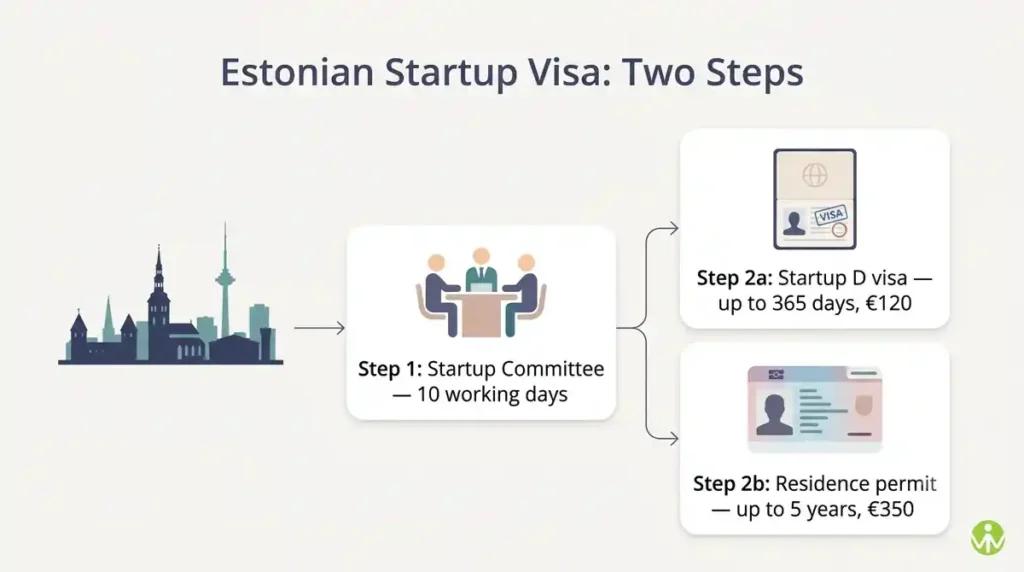
- After approval, founders choose a startup D visa (up to 365 days, €120) or a residence permit for business (up to five years, €350 in Estonia or €380 abroad).
- A startup D visa requires €880 a month in funds for the founder and €704 a month for a spouse.
- Two consecutive D visas cannot cover more than 548 days in any 730, so founders who plan to stay move to the residence permit.
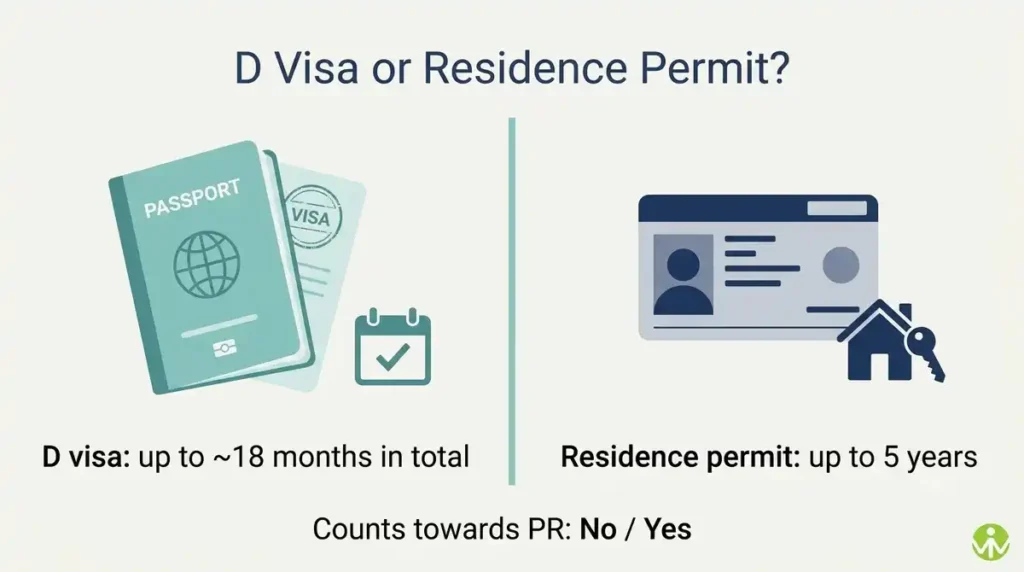
- Only time on a residence permit counts towards permanent residence, which needs five years and B1 Estonian.
Table of Contents
What is the Estonian startup visa?
The Estonian startup visa is not a single visa with its own application form. It refers to a set of immigration routes that open once a company has startup status. Estonia introduced the scheme in 2017 to attract non-EU founders and to make it easier for Estonian startups to hire talent from outside the EU.
In practice, a founder with a positive Startup Committee decision can come on a short-stay Schengen visa for up to 90 days, a national long-stay D visa for up to a year, or a temporary residence permit for business that lasts up to five years. The same startup status also lets the company hire non-EU employees under easier terms.
People often confuse the Estonian startup visa with e-Residency. e-Residency is a digital identity that lets someone run an Estonian company online from abroad, but it doesn’t grant the right to live or work in Estonia. Our guide to Estonian e-Residency explains the programme. Founders who simply want to work remotely for foreign clients may find a digital nomad visa a better fit.
Who qualifies for the Estonian startup visa?
The Estonian startup visa is for citizens of countries outside the EU, the EEA and Switzerland. EU, EEA and Swiss citizens can already live and work in Estonia and only need to register their right of residence.
The legal definition of a startup
Estonia’s Aliens Act defines a startup as a business developing an innovative, repeatable business model with strong global growth potential that contributes to the development of the Estonian business environment. According to Startup Estonia, the government programme that runs the scheme’s front end, the company must also be no older than ten years. The PBGB describes the same test as an early-stage company with an innovative business model and strong international growth potential.
What the Startup Committee looks for
Startup Estonia describes a qualifying business as technology-based, innovative and scalable, with a minimum viable product and first traction. Traditional businesses such as restaurants, one-person consultancies and generic trading companies do not qualify, and ideas that exist only on paper are usually turned down. The committee draws its members from Estonia’s startup community, and it is looking for a product that can grow well beyond the Estonian market.
Step 1: get Startup Committee approval
Every Estonian startup visa application begins with the startup evaluation. Founders apply online through Startup Estonia’s founder pages, introducing the company, team, and business model as they would to an investor. The application must be in English.
An expert committee appointed by the Ministry of the Interior reviews the file and gives its evaluation within 10 working days of receiving a complete application. A successful applicant receives a confirmation letter with a unique startup code, which every later visa or permit application relies on. The committee’s review carries no state fee.
Two exceptions apply. A company the committee has already evaluated does not need a second evaluation, and companies on a list of exempt companies set by the Minister of the Interior skip the step altogether. In both cases, founders go straight to the visa or permit application.
Step 2: choose a startup D visa or a residence permit
With a positive decision, a founder has two main options. The startup D visa is quicker to obtain and suits founders who want to start working in Estonia before the company is fully set up. The start-up entrepreneur residence permit requires a company registered in Estonia, but it lasts far longer and counts towards permanent residence. Startup Estonia’s guidance treats company registration as the step between the two: founders can come on a D visa first and apply for the permit once the company is registered. Table 1 compares the two routes of the Estonian startup visa.
Table 1: Estonian startup visa routes compared
| Feature | Startup D visa | Start-up entrepreneur residence permit |
|---|---|---|
| Issued by | Ministry of Foreign Affairs (embassies) or PBGB in Estonia | Police and Border Guard Board |
| Maximum stay | 365 days in 12 months; two in a row capped at 548 days in 730 | Up to 5 years, extendable up to 10 years at a time |
| Company registered in Estonia? | Not needed to come | Required, in the Estonian Business Register |
| Money to show | €880 a month (spouse €704 a month) | Income of four times the subsistence level |
| State fee | €120 (children 6–11: €60) | €350 in Estonia, €380 abroad |
| Decision time | Varies by representation | Within 90 days, card within 30 days after |
| Counts towards permanent residence? | No | Yes |
| Sources: Estonian Ministry of Foreign Affairs long-stay (D) visa page; PBGB residence permit for start-up entrepreneurs and state fee table. Checked October 2026. | ||
The startup D visa
A long-stay D visa is a national visa issued for up to 365 days within 12 consecutive months. According to the Ministry of Foreign Affairs, it also allows stays of up to 90 days in any 180-day period in other Schengen countries. A founder can apply for a second D visa, but two consecutive long-stay visas cannot cover more than 548 days within any 730, which in practice means about 18 months in total.
Founders who need a visa to enter the Schengen area apply in person at an Estonian representation in their country of residence. Founders whose nationality allows visa-free travel can enter Estonia and apply at a PBGB service office before their visa-free stay ends. The PBGB takes ten fingerprints when the application is lodged.
The start-up entrepreneur residence permit
The PBGB’s residence permit for start-up entrepreneurs is a temporary business residence permit. The founder must hold a shareholding in a company registered in the Estonian Business Register that has a positive Startup Committee evaluation, have income of at least four times the subsistence level set each year in the State Budget Act, hold a health insurance contract, and settle in Estonia and register an address in the Population Register. Unlike the shareholder version of the same permit, it does not require a €65,000 investment.
The permit is issued for up to five years and can be extended for up to ten years at a time. The PBGB decides within 90 days and issues the residence card within 30 days after that.
Documents for an Estonian startup visa
For the startup D visa, the Ministry of Foreign Affairs asks every applicant for:
- a passport issued within the last ten years, with at least two blank pages and valid for at least three months after the visa expires;
- the completed long-stay visa application form and one colour photo (35 × 45 mm);
- travel medical insurance covering the stay until Estonian health insurance takes over;
- proof of financial means, including evidence of income for the three months before applying;
- the forms on close relatives and family members, a biographical data form and, for citizens of non-NATO countries, additional application form 1;
- the Startup Committee confirmation letter as proof of the purpose of the stay;
- a travel booking to Estonia.
Foreign public documents must be legalised or apostilled and translated into Estonian or English. For the residence permit, the PBGB asks for the application, the committee’s decision and proof that the state fee has been paid, and the founder confirms sufficient income and health insurance by signing the application.
Estonian startup visa fees and funds
The money involved in the Estonian startup visa falls into two parts: the state fees, and the funds a founder must show to support themselves. Table 2 sets out both.
Table 2: Estonian startup visa fees and funds
| Item | Amount | Notes |
|---|---|---|
| Startup Committee review | No fee | Decision within 10 working days |
| Short-stay (C) Schengen visa | €90 | Children 6–11: €45 |
| Long-stay (D) visa | €120 | Children 6–11: €60; under 6: free |
| Funds for a startup D visa: founder | €880 per month | For each month of the planned stay |
| Funds for a startup D visa: spouse | €704 per month | MFA lists no separate figure for children |
| Residence permit for business | €350 in Estonia, €380 abroad | PBGB state fee from 1 January 2025 |
| Extension of residence permit for business | €350 | Applied for in Estonia |
| Income for the residence permit | 4 × subsistence level | Set each year in the State Budget Act |
| Sources: Estonian Ministry of Foreign Affairs long-stay (D) visa page; PBGB state fee table; Startup Estonia. Checked October 2026. Fees change; confirm before applying. | ||
The D visa fee is €120, or €60 for children aged 6 to 11, and a short-stay Schengen visa costs €90. The residence permit for business costs €350 in Estonia or €380 at a foreign mission, according to the PBGB state fee table. For a startup D visa, a founder must show €880 for each month of the planned stay. Some older guides, including parts of Startup Estonia’s own site, still quote lower fees and funds; the Ministry of Foreign Affairs table is the current reference.
Bringing family on an Estonian startup visa
If a founder is granted an Estonian startup visa, Startup Estonia says the same visa may be granted to the spouse, minor children, and adult children who cannot support themselves because of health or disability. The same applies when the founder extends their visa. A spouse needs €704 a month in funds for a startup D visa.
Once the founder holds a residence permit, family members apply for a residence permit for a family member, which cannot run longer than the founder’s own permit. Our pillar guide to the types of Estonia visa covers family permits in more detail.
Hiring non-EU staff through the startup route
Startup status is not only for founders. An Estonian startup with a positive committee evaluation can hire non-EU employees on easier terms than a regular employer. For a startup employee on a D visa, the Ministry of Foreign Affairs sets the funds requirement at €880 once, rather than every month, and €704 once for a spouse. Startup employees can also apply for a residence permit for employment, where a reduced salary threshold applies to start-up companies.
Estonia amended the Aliens Act in 2025 and 2026 to tighten the rules on employers bringing in foreign workers, with some distinctions for startups. Employers should confirm the current conditions with the PBGB before applying.
How long the Estonian startup visa lasts
The D visa route of the Estonian startup visa is time-limited by design: at most 18 months across two consecutive visas. Founders planning to stay longer need to switch to a business residence permit, which requires the company to be registered in Estonia.
Only time on a residence permit counts towards permanent residence. After five years on a temporary residence permit, a founder can apply for a long-term residence permit, which requires B1-level Estonian, a steady legal income, and health insurance. Time on a D visa does not count towards those five years.
Citizenship by naturalisation takes longer still. According to the PBGB, an applicant needs a long-term residence permit or permanent right of residence, at least eight years of residence in Estonia of which at least five on a permanent basis, and passes in the Estonian language exam and the exam on the Constitution and the Citizenship Act. Naturalising citizens are generally expected to give up any other citizenship.
To see how the Estonian startup visa compares with other schemes, read our startup visa by country comparison, and our guides to Startup Denmark, which also relies on an expert panel but caps permits at 75 a year, and the Italy startup visa, which requires €50,000 in funds.
Estonian startup visa FAQ
Is there a minimum investment for the Estonian startup visa?
No. The Estonian startup visa has no capital requirement. Founders need a positive Startup Committee decision and sufficient personal funds: €880 a month for a startup D visa, or income four times the subsistence level for a residence permit. A separate shareholder residence permit for businesses without startup status requires an investment of €65,000.
How long does the Startup Committee take?
The committee gives its evaluation within 10 working days of receiving a complete application. Visa and permit processing come on top of that, and the PBGB decides residence permit applications within 90 days.
How much does the Estonian startup visa cost?
The committee’s review is free. A long-stay D visa costs €120, a short-stay Schengen visa €90, and a business residence permit costs €350 in Estonia or €380 at a foreign mission.
How long can I stay on an Estonian startup visa?
A D visa allows up to 365 days, and a second can follow, but two consecutive D visas cannot cover more than 548 days in 730. The business residence permit lasts up to five years and can be extended for up to ten years at a time.
Can my family join me on an Estonian startup visa?
Yes. A spouse, minor children and adult children who cannot support themselves for health reasons can receive the same visa. A spouse must show €704 a month for a startup D visa.
Does the Estonian startup visa lead to permanent residence?
Not directly. Time on a business residence permit counts toward the five years needed for a long-term resident’s permit, but time on a D visa does not. Citizenship requires at least eight years of residence.