
The Italy startup visa, officially called the Italia Startup Visa (ISV), lets non-EU citizens move to Italy to launch an innovative startup. A committee under Italy’s Ministry of Enterprises and Made in Italy (MIMIT) reviews each application, usually within 30 days, and applicants must show at least €50,000 available for the business. Approved founders receive a one-year national visa for self-employment, followed by a residence permit that can be renewed while the company keeps operating.
This guide explains who qualifies for the Italy startup visa, what the €50,000 rule accepts, how the application works step by step, how the quota applies, and what happens after you arrive. For every other long-stay and short-stay route, see our guide to the types of Italy visa.
Key Takeaways
- The Italy startup visa (Italia Startup Visa, ISV) is for non-EU founders who want to set up an innovative startup in Italy.
- You must show at least €50,000 available for the business. Property and shares in non-joint-stock companies do not count.
- A committee under Italy’s business ministry (MIMIT) reviews the file, normally within 30 days, and there is no application fee.
- The consulate then issues a one-year national visa (fee €116). The visa counts against the self-employment quota of the Decreto Flussi.
- Apply for the residence permit within 8 days of arrival. It can be renewed for two years at a time while the business keeps operating.
- Founders already living in Italy use the Italia Startup Hub instead, and investors who want a quota-free route can compare the Investor Visa.
Table of Contents
What is the Italy startup visa?
Italy launched the Italia Startup Visa in 2014 to attract founders under its 2012 Startup Act. It is a fast-track version of the ordinary self-employment visa (lavoro autonomo). Instead of gathering certificates from several offices, founders send one application by email to a central secretariat, and a technical committee decides on the business idea. Italy renamed the ministry that runs the scheme in 2022 (from the Ministry of Economic Development to MIMIT), but the official Italia Startup Visa portal and its email address still use the older mise.gov.it domain.
Four features set the Italy startup visa apart:
- It is free at the committee stage. The only government fees come later, at the consulate and for the residence permit.
- Applications can be written in Italian or English, and the committee corresponds by email.
- Founders can apply directly or through a certified Italian incubator, whose support can count towards the funding requirement.
- Teams of up to five non-EU cofounders can apply together, and up to ten in exceptional cases approved by the committee.
Who qualifies for the Italy startup visa?
The Italy startup visa is open to non-EU citizens who live outside Italy and plan to set up an innovative startup there. You apply from the country where you legally reside, because the visa is issued by the Italian consulate responsible for that area. People already living in Italy on another permit use the Italia Startup Hub, covered below.
The innovative startup test
The company you plan to create must meet the legal definition of an innovative startup (startup innovativa), which MIMIT sets out on its website. In summary, the company must:
- be an Italian capital company (including a cooperative), with shares that are not listed on a stock exchange;
- be a micro, small or medium-sized enterprise under the EU definition;
- have its headquarters in Italy, or in another EU or EEA country with a production site or branch in Italy;
- have an annual production value of no more than €5 million from its second year;
- not distribute profits, and not have agency or consultancy as its main activity;
- have as its main purpose the development and sale of innovative, high-technology products or services.
It must also meet at least one of three innovation criteria: research and development spending of at least 15% of the higher of costs or production value; a workforce in which at least one third hold or are studying for a PhD, or at least two thirds hold a master’s degree; or ownership or licence of at least one patent, or ownership of registered software.
How long a company counts as a startup
Italy’s 2023 competition law (Law 193 of 16 December 2024) tightened the rules. A MIMIT circular of 29 July 2025 says a company now keeps innovative startup status for three years. It can extend this to five years, and then in further two-year steps, if it meets growth, investment or research targets. The ISV Guidelines add one protection for founders: if the company later loses startup status after the visa has been confirmed, the founder’s residence permit is not revoked for that reason alone.
Founding teams
Each member of a founding team must be a cofounder working for the company on a self-employed basis. There is no minimum shareholding for each founder, and the €50,000 minimum can be met by the team as a whole rather than by every member.
The €50,000 rule: Italy startup visa funding requirements
The core financial condition of the Italy startup visa is proof that at least €50,000 is available to develop the startup. The funds can be in any currency, provided you state the euro equivalent at the current exchange rate. You declare the sources in a signed cover letter, and the committee checks the supporting evidence.

Table 1 — Evidence accepted for the Italy startup visa €50,000 rule
| Source of funds | Accepted? | What to submit |
|---|---|---|
| Personal bank deposits | Yes | Bank statements for the last three months, dated no more than 30 days before applying, plus a bank letter confirming ownership, amount and availability |
| Investment portfolio or other financial instruments | Yes | Portfolio statement from the bank or fund confirming value and ownership |
| Venture capital or angel investment | Yes | Signed investment contract naming the investor, plus bank evidence |
| Grants from public bodies or non-profits (Italian or foreign) | Yes | Grant award documents |
| Services from a certified Italian incubator | Yes, counts towards the €50,000 | The incubator’s signed undertaking |
| Real estate | No | Not accepted |
| Shares in companies that are not joint-stock companies | No | Not accepted |
| Source: Italia Startup Visa Guidelines (MISE, MAECI and Ministry of the Interior, 20 March 2018). Funds may be held in any currency; state the euro equivalent. | ||
Funds must be liquid or quickly convertible. The ISV Guidelines state that non-liquid assets, such as real estate or holdings in companies that are not joint-stock companies, will not be accepted as proof.
Documents for an Italy startup visa application
The committee needs three mandatory documents:
- the application form, in Italian or English, covering your background, the startup idea, the business model, its innovative features, target markets, cost and revenue forecasts, and the Italian region where you plan to operate;
- the signed cover letter confirming the financial resources, with the bank or investor evidence described above;
- a clear copy of the main page of a valid passport.
A pitch deck, a detailed business plan and a CV are optional, but the Guidelines strongly recommend them because they help the committee understand the project. Keep the signed originals of the application form and the funding letter, because the consulate will ask to see them later. Applicants who come through a certified incubator file the incubator’s signed undertaking instead of the standard form.
How to apply for the Italy startup visa, step by step
The Italy startup visa process has four stages. The table below shows who handles each one and the time limits that apply.
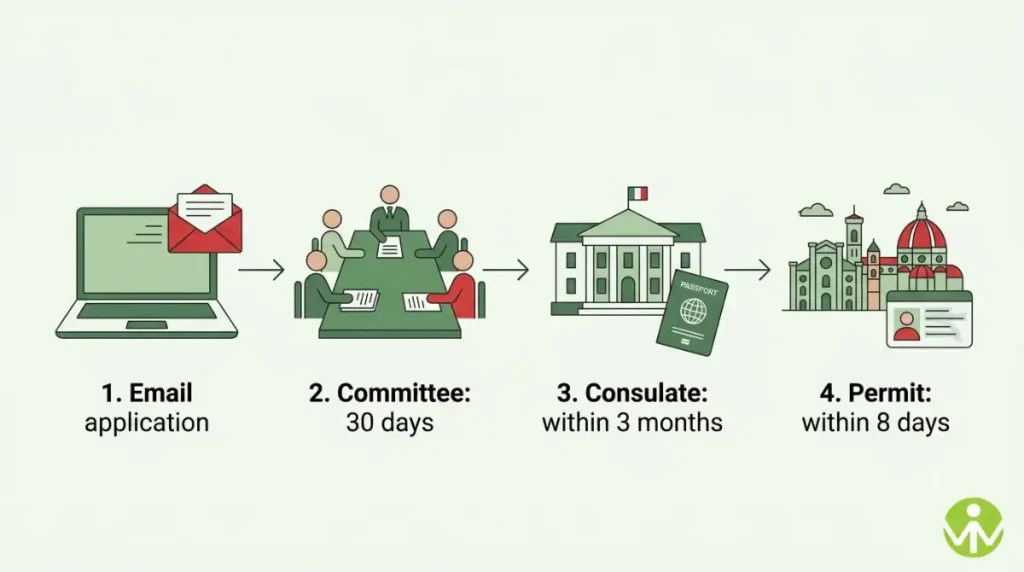
Table 2 — Italy startup visa application stages and time limits
| Stage | Who handles it | Time limit |
|---|---|---|
| 1. Email application | ISV secretariat (MIMIT) | 60 days to complete a missing file |
| 2. Committee review and police clearance | ISV committee and Questura | Decision aimed within 30 days |
| 3. National visa | Italian consulate in your country of residence | Apply within 3 months of the nulla osta |
| 4. Residence permit | Post office and Questura in Italy | Within 8 days of arrival |
| Renewal | Questura | From 60 days before expiry; up to 2 years at a time |
| Source: Italia Startup Visa Guidelines (20 March 2018) and the Italia Startup Visa portal, checked 27 September 2026. | ||
Step 1: Send the application by email
Send the scanned documents to [email protected]. If someone else sends the email for you, your own address must be copied in. If the file is incomplete, you have 60 days to supply what is missing, or the application lapses. Forms and templates are in the filing cabinet section of the Italia Startup Visa portal.
Step 2: Committee review and police clearance
The committee assesses the business idea and the funding, and aims to reply within 30 days. At the same time, the police headquarters (Questura) issues a provisional clearance. If the committee intends to refuse, you have 10 days to send your observations.
Step 3: Collect the Italy startup visa at the consulate
Approved founders receive the Italy startup visa nulla osta by email. You then have three months to apply at the Italian consulate for your area. Bring the nulla osta, the original application documents, proof of accommodation in Italy, proof of income from the previous year above the level that exempts residents from health charges (about €8,500), four passport photographs, a valid passport, and proof that you live in that consulate’s district. The consulate issues a one-year national (type D) visa for startup self-employment. The consular fee for a national visa is €116, payable in local currency. General visa information is on the Foreign Ministry’s Visto per l’Italia site.
Step 4: Apply for the residence permit within 8 days
Within eight days of arriving in Italy, apply for a self-employment residence permit (permesso di soggiorno) using the kit available at post offices, then attend your appointment at the Questura. The old version of this guide said founders had 180 days to move and apply; that was wrong. The 8-day rule applies to all national visa holders.
Is the Italy startup visa subject to quotas?
Yes. The Italy startup visa is issued against the self-employment quota of the Decreto Flussi, Italy’s annual decree on work entries. The ISV Guidelines say the consulate issues the visa within the quota for self-employment set for the year. For 2026 to 2028, the decree of 2 October 2025 sets 650 self-employment places a year. Of these, 500 a year are reserved for specific groups, which include founders of innovative startups, entrepreneurs investing at least €500,000 and creating three jobs, qualified professionals, company officers and well-known artists.
Some sources describe the Italy startup visa as outside the quota, and our own startup visa comparison said so until it was corrected. The committee stage runs all year, but the visa itself still counts against the annual quota. Founders who need a route outside the quota can look at the Investor Visa, compared below.
Italy startup visa costs
There is no fee to apply to the committee. The costs come at the visa and residence permit stages.
Table 3 — Italy startup visa costs in 2026
| Item | Cost | Notes |
|---|---|---|
| Committee application | Free | No fee is set in the Guidelines |
| National (type D) visa | €116 | Consular fee table, July to September 2026; paid in local currency |
| Residence permit contribution | €40 to €50 | Depends on permit length |
| Electronic permit card | €30.46 | Paid at the post office |
| Revenue stamp (marca da bollo) | €16 | Attached to the application |
| Post office handling | €30 | For the permit kit |
| Funds for the business | At least €50,000 | Must be available, not paid to the government |
| Sources: consular fee table for 1 July to 30 September 2026 (Consulate General of Italy in Miami); ISV Guidelines 2018; permit charges as published for 2026. Fees change; confirm with the consulate and Questura. | ||
After arrival: permit, renewal and family
The first residence permit under the Italy startup visa is valid for one year. You can apply to renew it up to 60 days before it expires, for up to two years at a time. Renewal requires an extract from the Chamber of Commerce showing the company is registered in the special section for innovative startups, proof of income above the health-charge exemption level, and continuous residence in Italy with no absence of more than six months. Permits longer than one year also require signing Italy’s integration agreement.
After five years of legal residence, founders can apply for an EU long-term residence permit, which has no expiry date. Italian citizenship by residence generally needs ten years for non-EU citizens. Family members can join under Italy’s ordinary family reunification rules.
A separate route, called aggregation, lets a non-EU manager-investor join an existing innovative startup. It requires at least €100,000 of personal funds invested in the company and a board or executive role.
Italia Startup Hub: for founders already in Italy
Non-EU citizens who already hold an Italian residence permit, for example a study permit, do not need to leave Italy to apply. The Italia Startup Hub lets them convert their permit into a self-employment permit for startups through the same committee, with a target decision time of 20 days. The documents mirror the Italy startup visa, plus a copy of the current permit and a €16 revenue stamp, and applications go to [email protected]. Students coming to Italy on an Italy student visa can use this route after graduation if they want to found a company.
Italy startup visa vs investor visa vs self-employment visa
The Italy startup visa is one of three business routes to Italy. The right one depends on your role in the company and how much capital you have.
Table 4 — Italy startup visa compared with other business routes
| Route | Who it suits | Money required | Quota | First visa or permit |
|---|---|---|---|---|
| Italia Startup Visa | Founders building an innovative startup | At least €50,000 available for the project | Within the self-employment quota | 1-year visa and permit, renewable for 2 years |
| Investor Visa for Italy | Investors funding a business or the state | €250,000 in an innovative startup; €500,000 in a company; €1 million donation; €2 million in government bonds | Outside the quota | 2-year visa |
| Self-employment visa (lavoro autonomo) | Freelancers, professionals and entrepreneurs | Resources for the activity; €500,000 and three jobs for the entrepreneur category | Within the self-employment quota | Tied to the activity, renewable |
| Sources: ISV Guidelines 2018; MIMIT Investor Visa page; DPCM of 2 October 2025 (650 self-employment places a year, 2026 to 2028). | ||||
The Investor Visa for Italy suits people who want to fund a business rather than run it day to day, and our golden visa by country guide sets it alongside other European schemes. Freelancers and professionals who do not have an innovative startup use the ordinary self-employment route in our Italy work visa guide. For wider context on moving to Italy, see our guide on how to migrate to Italy, and to compare Italy with other countries, see our startup visa by country guide.
Tips before you apply for the Italy startup visa
- Explain clearly what is innovative about the product. The committee is assessing the idea, not only the paperwork.
- Use liquid funds and make sure the bank letter confirms ownership, the amount and that the money is available.
- Keep the signed originals of the application form and funding letter for the consulate.
- Apply to the consulate within three months of the nulla osta, and ask whether quota places remain for the year.
- Plan for the residence permit costs and the 8-day deadline before you travel.
Italy startup visa FAQ
How long does the Italy startup visa take?
The committee aims to decide within 30 days of a complete application. After that, consular processing time varies by country, and you have three months from the nulla osta to apply for the visa.
Is there an application fee for the Italy startup visa?
No fee is charged at the committee stage. The national visa costs €116, and the residence permit costs about €116 to €126 in total, depending on its length.
Can I use property to meet the €50,000 requirement?
No. The funds must be liquid or quickly convertible, such as bank deposits, investment portfolios, investor funding or grants. Real estate and shares in non-joint-stock companies are not accepted.
Is the Italy startup visa outside Italy’s immigration quotas?
No. The visa is issued within the self-employment quota of the Decreto Flussi, which is 650 places a year for 2026 to 2028. The Investor Visa is the business route that sits outside the quota.
Can my family come with me?
Yes. Spouses, children and some other relatives can join you under Italy’s ordinary family reunification rules once you hold your residence permit.
Can I switch to the startup route if I already live in Italy?
Yes. If you hold a valid Italian residence permit, such as a study permit, you can apply through the Italia Startup Hub without leaving the country.
Does the Italy startup visa lead to permanent residence?
It can. After five years of legal residence, you can apply for an EU long-term residence permit. Citizenship by residence generally requires ten years for non-EU citizens.