
Key Takeaways
- Most visitors use the tourist e-visa: US$30 for a single entry or US$65 for multiple entries, from the official Ministry of Interior portal.
- A visa on arrival costs US$30 in cash; Cairo airport also offers a digital QR-code version for US$36 by card.
- A free Sinai-only stamp covers stays under 15 days in Sharm El-Sheikh, Dahab, Nuweiba and Taba.
- Living, working or studying in Egypt needs a residence permit, and working also needs a Ministry of Labour work permit.
- Entry visa fees are set to rise from 1 January 2027, with the single-entry visa expected to cost US$33.
Table of Contents
Egypt visa types fall into three broad groups: short-stay visas for visitors, residence permits for people who want to live, work or study in the country, and a separate citizenship-by-investment programme. Most visitors need only a tourist e-visa or a visa on arrival. Anyone staying longer than a few weeks needs to understand Egypt’s residence system, because it works differently from the visa-and-permit model used in many other countries.
This guide explains each Egypt visa type, who it suits, what it costs, and where to apply, using fees published by Egypt’s Ministry of Interior as of November 2026. Fees and rules change often, so check the official Egypt e-Visa Portal before you travel.
Egypt Visa Types at a Glance
The table below summarises the main Egypt visa types and residence routes. Short-stay options are for tourism. Long-stay options are residence permits, issued inside Egypt by the General Administration of Passports, Immigration and Nationality.
| Visa or permit | Main purpose | Where to apply | Typical length | Cost |
|---|---|---|---|---|
| Tourist e-visa (single entry) | Tourism | visa2egypt.gov.eg | Up to 30 days per stay | US$30 |
| Tourist e-visa (multiple entry) | Repeat tourist visits | visa2egypt.gov.eg | Up to 30 days per stay | US$65 |
| Visa on arrival (paper) | Tourism | Airport kiosk, cash | Up to 30 days | US$30 |
| Digital visa on arrival | Tourism | Cairo airport or visaonarrival.gov.eg | Up to 30 days | US$36 |
| Sinai-only entry stamp | South Sinai resort stays | Sharm El-Sheikh airport | Under 15 days | Free |
| Embassy or consulate visa | Nationalities and purposes not covered above | Egyptian mission abroad | Varies | Varies by mission |
| Work permit and work residence | Employment | Ministry of Labour, then Ministry of Interior | Usually 1 year, renewable | Permit fee capped at EGP 100,000 (reported) |
| Study residence | Full-time study | Ministry of Interior, via the institution | Academic year, renewable | Varies |
| Family residence | Joining a spouse or parent | Ministry of Interior | Linked to the sponsor | Varies |
| Property or bank-deposit residence | Living in Egypt without working | Ministry of Interior | 1, 3 or 5 years, renewable | From US$50,000 invested |
| Citizenship by investment | Egyptian nationality | Citizenship by Investment Unit | Permanent | From US$250,000 plus fees |
| Fees as shown on official and government sources on 8 November 2026. Entry visa fees are expected to rise on 1 January 2027. Residence and citizenship figures are as reported and should be confirmed with the Egyptian authorities. | ||||
Two points shape every choice in the table. First, a tourist visa never allows paid work. Second, Egypt does not offer a permanent residence status like that found in Europe or North America. Long-term residents renew time-limited permits, and the only direct route to a passport is the citizenship-by-investment programme.
Short-Stay Egypt Visa Types for Visitors
Short-stay Egypt visa types cover tourism and short visits. Which one applies depends on your nationality, where you arrive and how long you plan to stay. Whichever route you use, your passport must be valid for at least six months from the day you arrive and have at least one blank page.
Tourist e-Visa
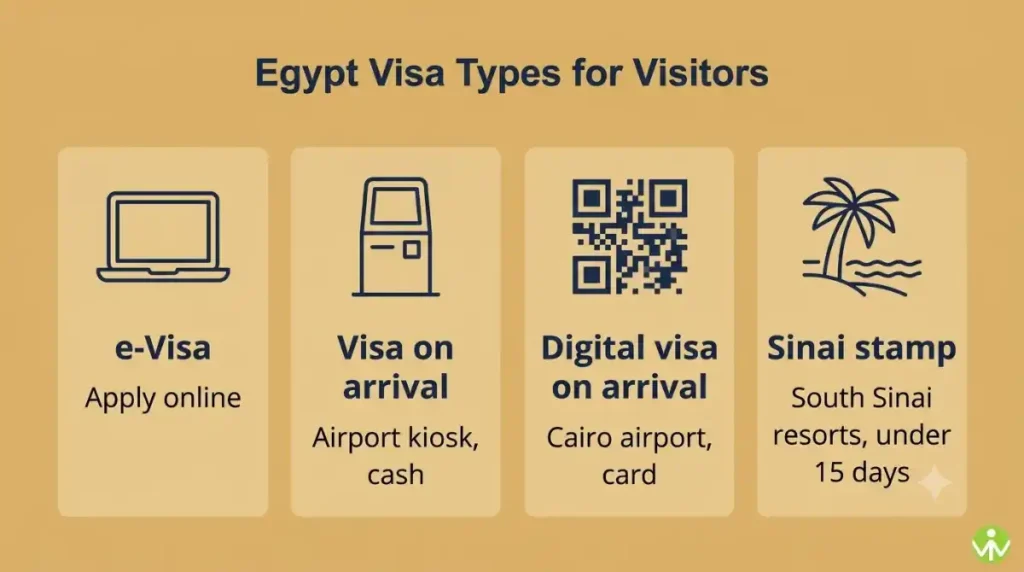
The e-visa is the online version of the standard tourist visa. Apply on the official Egypt e-Visa Portal, run by the Ministry of Interior: create an account, enter your passport details and pay by card. The approved e-visa arrives by email; print it to show at immigration.
The portal lists two tourism options: a single-entry visa at US$30 and a multiple-entry visa at US$65. It currently names 78 eligible nationalities, including most of Europe, the United States, Canada, Australia, India, China, Japan, Brazil, Mexico, South Africa and several Gulf states. UK government travel advice describes tourist e-visas as valid for up to three months, and each stay is generally limited to 30 days.
On arrival, carry your e-visa printout, travel itinerary, and hotel bookings. Business and family visitors should also carry a supporting letter, such as a company letter or an invitation. Among the Egypt visa types for tourists, the e-visa is the one most travellers choose because it avoids queues and cash payments at the airport. Only the .gov.eg portal is official; other websites selling Egyptian e-visas are resellers that add their own charges.
Visa on Arrival
Travellers from eligible countries can buy a visa on arrival at approved airports, from kiosks before the immigration counters. The single-entry fee rose from US$25 to US$30 on 1 March 2026 and is paid in cash, ideally in US dollars. The visa on arrival is valid for up to 30 days.
As with the other Egypt visa types for visitors, eligibility for the visa on arrival is set by nationality and can change at short notice, so check with the nearest Egyptian embassy or consulate before relying on it. If you would rather not carry cash or queue, the e-visa gives the same result.
Digital Visa on Arrival at Cairo Airport
Since 1 August 2026, Cairo International Airport has also offered a digital visa on arrival. Instead of a paper sticker, you receive a QR code, either from self-service machines in the terminal or through the official Visa on Arrival portal before you travel. It costs US$36, made up of the US$30 visa fee plus a US$6 digital service fee, and is paid by card only.
The digital system is a pilot that runs alongside the paper sticker and is meant for tourism rather than business travel. Other airports, including Hurghada, Luxor and Sharm El-Sheikh, still issue paper visas on arrival. Egypt plans to extend the system to more airports but has not published dates.
Sinai-Only Entry Stamp
Visitors who fly into Sharm El-Sheikh and stay for less than 15 days in the resorts of Sharm El-Sheikh, Dahab, Nuweiba or Taba can enter on a free entry permission stamp instead of a visa. It is the only Egypt visa type that costs nothing, but it does not cover travel elsewhere in Egypt, including Cairo, Luxor, or Hurghada, or stays of 15 days or more. If your plans change, you can buy a visa at Sharm El-Sheikh airport or apply online.
Travellers entering Sinai by land, for example at the Taba crossing from Israel, pay separate border charges, which have changed several times during 2026. Check current amounts with the Egyptian consulate before you travel.
Visas from an Egyptian Embassy or Consulate
Travellers whose nationality is not eligible for the e-visa or visa on arrival, and those travelling for purposes other than tourism, apply through an Egyptian embassy or consulate before departure. Requirements and processing times vary by mission, so contact the one that serves your country of residence.
Some nationalities, mainly from neighbouring Arab states, are exempt from visas altogether or under specific conditions such as age. These rules change often, so confirm them with the consulate rather than relying on published lists.
Extending a Short Stay
Visitors who want to stay longer can apply for an extension at an Egyptian Passport and Immigration office. Leaving on an expired visa can cause problems at departure, and an overstay of more than 14 days can lead to a fine. For stays of several months or more, a residence permit is usually the better fit among the Egypt visa types.
Egypt Visa Types and Fees From 1 January 2027
Egypt visa types issued at ports of entry or by embassies will become slightly more expensive from 1 January 2027. Prime Ministerial Decree No. 2553 of 2026, published in Egypt’s Official Gazette in August 2026, raises a fixed fee built into entry and transit visas from US$12 to US$15, as reported by Ahram Online.
The decree does not set new consumer prices. A circular from the Egyptian Travel Agents Association indicates the single-entry visa will rise from US$30 to US$33, with the digital visa on arrival at Cairo expected to rise by the same amount. As of 8 November 2026, the official e-visa portal still lists US$30 and US$65. If you are travelling in early 2027, check the portal on the day you apply.
Long-Stay Egypt Visa Types: Residence Permits
For stays beyond a few months, Egypt issues residence permits rather than visas. The General Administration of Passports, Immigration and Nationality at the Ministry of Interior issues them, usually after you enter Egypt, and each type is tied to a reason for being in the country. Residence permits are renewable, but none automatically leads to permanent residence or citizenship.
Work Permit and Work Residence
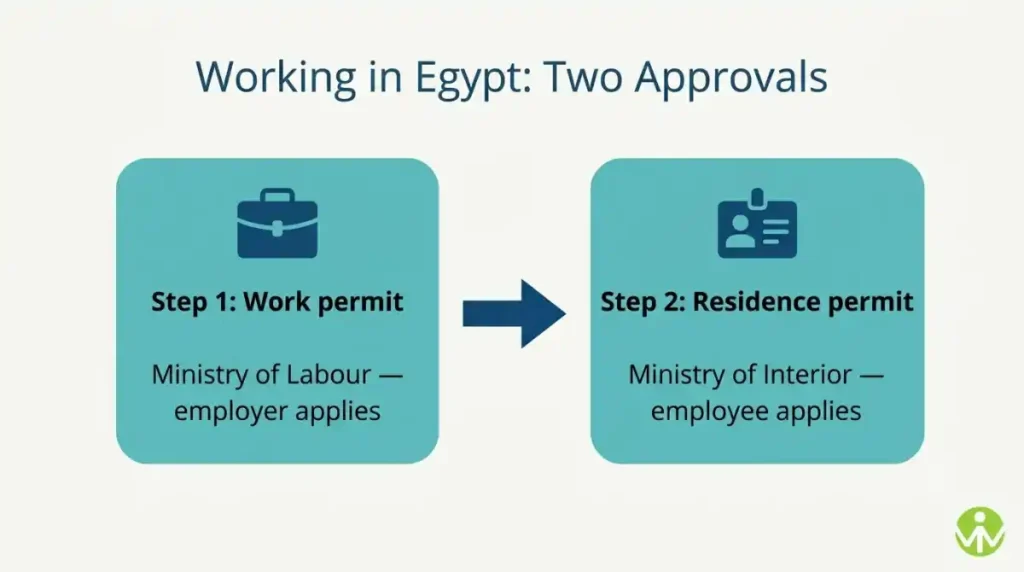
Working in Egypt requires two separate approvals. The employer first obtains a work permit from the Ministry of Labour, which authorises a named foreign national to do a specific job. The employee then applies to the Ministry of Interior for a residence permit linked to that employment. Working on any short-stay Egypt visa type is not allowed.
The work permit system now operates under Labour Law No. 14 of 2025 and Ministerial Decree No. 279 of 2025. Law firms advising on the new rules report that permit fees are capped at EGP 100,000 and that foreign workers should generally make up no more than 10% of an employer’s workforce, with exceptions in some sectors. Applicants must include HIV test results with the work permit application. Because the permit is tied to one employer and one role, changing jobs means a new application.
Our work visa for Egypt guide covers the employer’s side of the process in more detail.
Study Residence
International students enrolled at a recognised Egyptian university or institute can apply for a residence permit for study. It is one of the more straightforward Egypt visa types: the institution usually confirms enrolment to the immigration authorities, and the permit is renewed for each academic year. Procedures differ between institutions, so check with your university’s international office before you arrive.
Family Residence
Spouses and dependent children of Egyptian citizens, and of foreigners who hold a valid residence permit, can apply for family residence. Of all Egypt visa types, this depends most on someone else’s status: the permit is tied to the relationship and the sponsor’s status, so it generally runs alongside the sponsor’s permit.
Residence Through Property or a Bank Deposit
Egypt grants renewable residence to foreigners who own qualifying property or who hold a qualifying hard-currency deposit in an Egyptian bank. The permit length depends on the amount involved.
| Route | Minimum value | Residence period | Renewable |
|---|---|---|---|
| Property ownership | US$50,000 | 1 year | Yes, while the property is owned |
| Property ownership | US$100,000 | 3 years | Yes, while the property is owned |
| Property ownership | US$200,000 | 5 years | Yes, while the property is owned |
| Bank deposit | US$50,000 | 1 year | Yes, while the deposit is held |
| Bank deposit | US$100,000 | 3 years | Yes, while the deposit is held |
| Thresholds as reported from a 2023 Ministry of Interior decision, in US dollars or the equivalent in another freely convertible currency. Confirm with the Egyptian authorities before committing funds. | |||
The residence lasts as long as the property is owned or the deposit is held; selling the property removes the basis for renewal. These thresholds are widely reported from a 2023 Ministry of Interior decision but are not published on an official English-language site, so confirm current figures with the Passports, Immigration and Nationality Administration or a qualified Egyptian lawyer before committing funds. Buying property in Egypt also has its own rules, including limits on how many properties a foreigner may own.
Egypt visa types linked to property are sometimes marketed as a “golden visa”. Egypt has no programme officially called that; the property route is an ordinary renewable residence permit.
Special Residence
A special residence permit, valid for ten years, is available to certain long-standing residents, including foreigners born in Egypt. Holders of ordinary residence pay an annual fee, reported at EGP 500 a year.
Egyptian Citizenship by Investment
Egypt offers citizenship in exchange for investment under Law No. 190 of 2019, with the current terms set by Prime Ministerial Decree No. 876 of 2023. Strictly speaking, it is not an Egypt visa type at all, because a successful application leads directly to Egyptian nationality, and investors are reportedly able to keep their existing citizenship. Applications are handled by a dedicated Citizenship by Investment Unit under the Council of Ministers.
| Route | Minimum amount | Key condition |
|---|---|---|
| Non-refundable contribution | US$250,000 | Paid to the state and not returned |
| Property purchase | US$300,000 | Property held for at least five years |
| Business investment plus contribution | US$350,000 investment plus US$100,000 contribution | Project must meet Egyptian investment-law requirements |
| Bank deposit | US$500,000 | Returned in Egyptian pounds after three years, without interest |
| As reported under Prime Ministerial Decree No. 876 of 2023, with a government fee of about US$10,000. Figures are not published on an official English-language site; confirm with the Citizenship by Investment Unit. | ||
Applicants also pay a non-refundable government fee reported at US$10,000, and must transfer funds from abroad in foreign currency. Earlier versions of the programme required much larger sums, such as US$500,000 for property or US$750,000 to US$1 million for deposits, so older guides may quote figures that no longer apply. Citizenship by investment carries legal and tax considerations that differ for each applicant, and nothing in this guide is investment advice.
How to Choose Between Egypt Visa Types
For a holiday of up to a month, the e-visa is the simplest Egypt visa type for eligible nationalities, with the visa on arrival as a cash alternative. If your trip is limited to the South Sinai resorts for less than 15 days, the free Sinai stamp may be enough.
If you have a job offer, your employer must start the work permit process before you can live and work in Egypt. Students and family members apply for residence through their institution or sponsor. People who want to live in Egypt without working, such as retirees, most often use the property or bank-deposit route.
Citizenship by investment suits a much smaller group: people prepared to commit a large sum for a second nationality rather than a right to live in Egypt for a fixed period.
For a closer look at the tourist routes, see our guide on how to get a tourist visa for Egypt.
Frequently Asked Questions About Egypt Visa Types
Which Egypt visa types can I get online?
The tourist e-visa, in single-entry and multiple-entry versions, is issued online through the Ministry of Interior’s e-visa portal. Visitors arriving at Cairo Airport can also request the digital visa on arrival online before they travel. Work permits and residence permits are not issued through either portal.
How much does an Egypt tourist visa cost?
The e-visa costs US$30 for a single entry and US$65 for multiple entries. The paper visa on arrival costs US$30 in cash, and the digital visa on arrival at Cairo costs US$36 by card. The single-entry fee is expected to rise to US$33 from 1 January 2027.
Can I work in Egypt on a tourist visa?
No. Paid work needs a work permit from the Ministry of Labour and a work residence permit from the Ministry of Interior. You can look for a job while visiting, but you cannot start work until you have both approvals.
Does Egypt offer permanent residency?
Not in the form found in many Western countries. Residence permits for work, study, family, property or bank deposits are all time-limited and renewable. A ten-year special residence exists for certain long-standing residents, and citizenship by investment leads directly to nationality.
Do I need a visa for Sharm El-Sheikh?
Not if you fly into Sharm El-Sheikh and stay for less than 15 days in Sharm El-Sheikh, Dahab, Nuweiba or Taba. You receive a free Sinai-only stamp on arrival. Travel beyond those resorts, or a longer stay, requires a full visa.
Can I switch from a tourist visa to a residence permit inside Egypt?
In most cases, residence permits are applied for in Egypt after entry, once the basis for them, such as a job, a university place or a property purchase, is in place. Requirements differ between Egypt visa types, so check the specific route with the Passports, Immigration and Nationality Administration.