
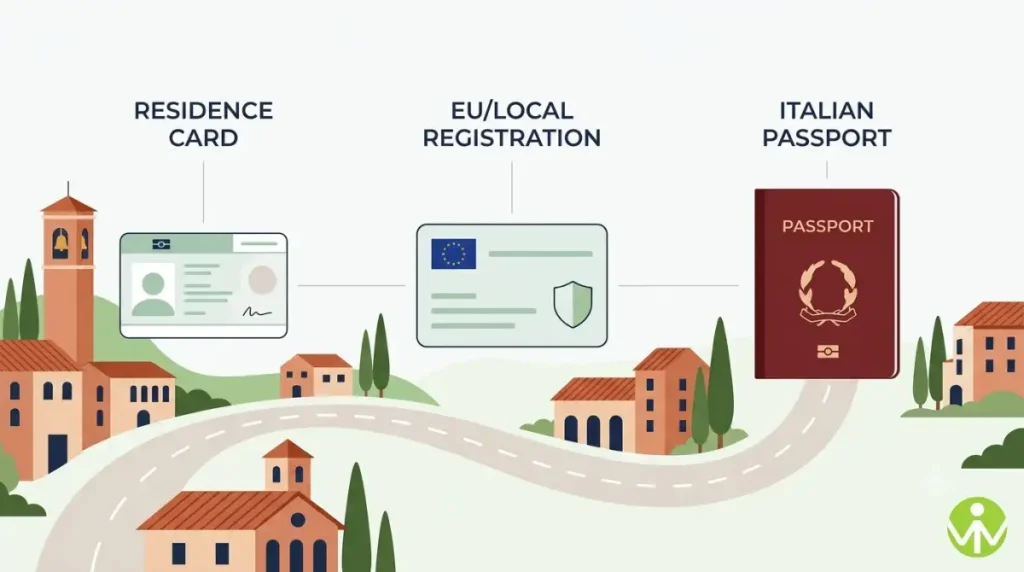
Italy permanent residency is the EU long-term residence permit (permesso di soggiorno UE per soggiornanti di lungo periodo), which non-EU nationals can apply for after five years of legal residence in Italy. It is the middle step of a three-stage path: a residence permit when you first arrive, permanent status after five years and, for those who want it, Italian citizenship after ten.
This guide follows that path in order. It covers the residence permit you must request within 8 working days of arrival, the income, housing and A2 Italian rules for Italy permanent residency, what the status lets you do, how you can lose it and the routes to citizenship. Which visa gets you to Italy in the first place is covered in our guide to the types of Italy visa.
Key Takeaways
- Italy permanent residency means the EU long-term residence permit, available after five years of continuous legal residence.
- Every long-stay visa holder must request a residence permit (permesso di soggiorno) within 8 working days of arriving.
- For 2026 you need a lawful yearly income of at least €7,101.12, plus half that amount for each family member included in the application.
- You must prove A2-level Italian, usually by passing a free test at the prefecture or holding a recognised certificate.
- The status is permanent; the card is renewed every 10 years (5 for minors). It can be lost after 12 consecutive months outside the EU or six years outside Italy.
- Citizenship by residence normally takes 10 years for non-EU nationals, needs B1 Italian and costs €250, with a decision due within 24 to 36 months.
Table of Contents
Table 1: The path to Italy permanent residency and citizenship
| Stage | Document | When | Main requirements | Validity |
|---|---|---|---|---|
| Entry | National (Type D) visa | Before you travel | Depends on the visa type: work, study, family, self-employment and so on | Usually up to one year |
| Residence | Residence permit (permesso di soggiorno) | Within 8 working days of arrival | Same purpose as the visa; fingerprints at the Questura | Tied to the purpose, usually 1 to 2 years, renewable |
| Italy permanent residency | EU long-term residence permit | After 5 years of legal residence | Income of at least €7,101.12, A2 Italian, clean record | Permanent status; card renewed every 10 years (5 for minors) |
| Citizenship | Italian citizenship by residence | After 10 years (non-EU nationals) | Steady income, B1 Italian, clean record | Permanent |
| Sources: Legislative Decree 286/1998, article 9; Law 91/1992, articles 5 and 9; INPS circular 153/2025. As of September 2026. | ||||
The old name for Italy permanent residency, the carta di soggiorno, still turns up in older guides and on some forms. It was replaced by the EU long-term residence permit in 2007, when Italy brought the EU long-term residents directive into national law.
Step 1: the residence permit (permesso di soggiorno)
A national (Type D) visa only gets you through the border. Within 8 working days of arrival, you must request a residence permit for the same purpose as your visa: work, study, family, self-employment, elective residence and so on. The previous version of this article said “within one week”; the legal deadline is 8 working days.
How to apply for the residence permit
For most permit types, you collect a pre-printed kit at a post office with a Sportello Amico counter, send it by registered post and receive an appointment at the Questura (police headquarters) for fingerprints and photographs. Work and family permits start instead at the prefecture’s immigration desk (Sportello Unico per l’Immigrazione), where you sign a residence contract or complete the family reunification file. Keep the post-office receipt: it shows that you applied while the permit is being processed.
What the residence permit costs
The fees depend on how long the permit lasts. A first permit of up to a year costs about €116 in total, and the permit that proves Italy permanent residency costs about €176. The EU Immigration Portal lists the individual charges for Italy.
Table 2: Residence permit and Italy permanent residency costs
| Item | Permit of 3 to 12 months | Permit of 12 to 24 months | EU long-term permit |
|---|---|---|---|
| Contribution fee | €40 | €50 | €100 |
| Electronic permit card | €30.46 | €30.46 | €30.46 |
| Revenue stamp | €16 | €16 | €16 |
| Post-office kit fee | €30 | €30 | €30 |
| Total | €116.46 | €126.46 | €176.46 |
| Source: EU Immigration Portal, Italy (updated 1 April 2025). Language certificates, translations and document legalisation cost extra. | |||
The integration agreement and renewals
If your first permit lasts a year or more and you are 16 or older, you also sign an integration agreement (accordo di integrazione). It commits you to reaching A2-level spoken Italian and a basic knowledge of civic life in Italy within two years, measured in credits. Meeting it at A2 also counts as proof of Italian when you later apply for Italy permanent residency.
Permits are renewed through the Questura before they expire, usually with the same post-office kit. The timing and conditions vary by permit type: our Italy student visa guide, Italy work visa guide and Italy startup visa guide give the details for those routes.
How the five years toward Italy permanent residency are counted
To apply for Italy permanent residency, you need to have held a valid residence permit for at least five years. Three rules decide which years count.
- Absences: being away from Italy for more than six consecutive months, or for more than ten months in total over the five years, breaks the count, unless the absence was for military service or another serious, documented reason.
- Study and humanitarian permits: you cannot apply while you hold one of these, but the years spent on them do count toward the five once you have moved to another permit, such as a work permit.
- Temporary and diplomatic stays: time on short-term permits, or with diplomatic or consular status, does not count at all.
EU Blue Card holders get a special rule. Time spent as a Blue Card holder in other EU countries can be added to their time in Italy, provided the last two years before the application were spent in Italy. Our EU Blue Card guide explains the card itself.
Italy permanent residency requirements in 2026
Once the five years are complete, the EU long-term residence permit is granted to applicants who meet the conditions in article 9 of Italy’s Consolidated Immigration Act. The Italian government’s integration portal sets out the official rules for the EU long-term residence permit (in Italian). The main Italy permanent residency requirements are income, housing if family members are included, A2 Italian and a clean record.
Minimum income
You must show a lawful yearly income at least equal to the annual social allowance (assegno sociale). For 2026, that is €7,101.12, which is €546.24 a month over 13 payments, as set by INPS circular 153 of December 2025. If you also apply for family members, the threshold rises by half the social allowance for each one. The figure is updated every January, so check it in the year you apply.
Table 3: Minimum yearly income for Italy permanent residency in 2026
| Household included in the application | Minimum yearly income |
|---|---|
| Applicant alone | €7,101.12 |
| Applicant + 1 family member | €10,651.68 |
| Applicant + 2 family members | €14,202.24 |
| Applicant + 3 family members | €17,752.80 |
| Applicant + 4 family members | €21,303.36 |
| Based on the 2026 social allowance (assegno sociale) of €546.24 a month over 13 payments (INPS circular 153/2025), plus half that amount per family member. Updated every January. | |
Suitable housing
If your application includes family members, you must also prove suitable housing. This is a certificate from the town hall or local health authority (idoneità alloggiativa) confirming that the home meets regional public-housing size and hygiene standards. The rules and waiting times vary by region, so ask your comune early.
A2 Italian
You must show Italian at A2 level on the Common European Framework of Reference. Most applicants either sit the free test organised by the prefecture, booked online, or submit a certificate from a recognised body: the universities for foreigners of Perugia, Siena and Reggio Calabria, Roma Tre University or the Società Dante Alighieri. The prefecture sets a test date within 60 days, and if you fail, you can retake the test after 90 days.
An Italian school diploma or degree, current enrolment at an Italian university, an integration agreement completed at A2, or entry as a senior manager, university professor or other highly qualified worker also count. Children under 14 are exempt. If you are starting out, our tips on finding a language tutor in Italy may help.

A clean record
Applicants considered a danger to public order or state security are refused. Convictions for serious offences count against you even if they are not yet final.
How to apply for Italy permanent residency
- Check that you have five years on valid permits, with no long absences.
- Pass the A2 test or gather your language certificate and, if family members are included, the housing certificate.
- Collect income evidence, such as tax returns, payslips or pension statements for the previous year.
- Fill in the post office kit, the same one used for ordinary permits, pay the fees and send it by registered post.
- Attend the Questura appointment for fingerprints and then collect the permit.
By law, the Questura should decide an application for Italy permanent residency within 90 days, but many offices take longer. The post-office receipt keeps you legally resident while you wait.
What Italy permanent residency gives you
Long-term resident status is permanent. Since a 2021 change in the law, the card that proves it is valid for 10 years for adults and 5 years for minors. You can renew it on request with new photographs, much like an identity card, and it also serves as an official identity document in Italy. Italy permanent residency gives you:
- the right to take any employed or self-employed work, apart from jobs reserved for Italian citizens, without the residence contract that ordinary work permits need;
- access to most public-sector competitions, except posts that involve public powers or the protection of the national interest;
- access to social security, social assistance, healthcare, education and public housing on the same basis as other residents;
- protection from expulsion, which is possible only for serious public-order or security reasons;
- the right to apply to live in another EU country for more than three months to work, study or for other purposes, under that country’s rules for EU long-term residents (Denmark and Ireland do not take part).
For travel, the permit works like any Italian residence permit: you can visit other Schengen countries for up to 90 days in any 180-day period without a visa. Our Schengen visa guide explains the 90/180 rule.
How you can lose Italy permanent residency
The status can be withdrawn if you obtained it by fraud, become a threat to public order, or are expelled. Italian permanent residency is also lost after:
- 12 consecutive months outside the EU;
- six years outside Italy, even if you stayed within the EU;
- being granted long-term resident status by another EU country.
If you plan long spells abroad for work or family, keep track of your travel dates. A single year outside the EU is enough to lose Italy permanent residency, and you would normally have to apply again.
From Italy permanent residency to Italian citizenship
Italy permanent residency is not a legal requirement for citizenship. You can apply for naturalisation on any valid residence permit once you have the required years of residence. It has one practical advantage: B1 Italian is still required, but holders of the EU long-term permit and people who signed the integration agreement are not asked to attach a language certificate when they apply.
Citizenship by residence
Naturalisation is governed by Law 91 of 1992. The standard period is ten years of legal residence for non-EU nationals, with shorter periods for some groups.
Table 4: Residence needed for Italian citizenship
| Who is applying | Legal residence needed | Legal basis |
|---|---|---|
| Non-EU national | 10 years | Law 91/1992, art. 9(1)(f) |
| EU citizen | 4 years | Art. 9(1)(d) |
| Stateless person | 5 years | Art. 9(1)(e) |
| Adult adopted by an Italian citizen | 5 years after the adoption | Art. 9(1)(b) |
| Born in Italy | 3 years | Art. 9(1)(a-bis) |
| Child or grandchild of an Italian citizen by birth | 2 years (3 before Law 74/2025) | Art. 9(1)(a) |
| Five years’ service for the Italian state, including abroad | No residence period | Art. 9(1)(c) |
| Spouse of an Italian citizen | 2 years in Italy after the marriage, or 3 years from the wedding if living abroad; halved with children | Art. 5 |
| Source: Law 91/1992 as in force on Normattiva (last updated 30 December 2025). Recognised refugees are generally treated like stateless persons (5 years). | ||
Beyond residence, applicants need B1-level Italian, a clean criminal record and a steady income. The Interior Ministry’s long-standing guideline is about €8,263 a year for a single applicant and about €11,362 with a dependent spouse, plus about €516 for each child, usually checked over the three years before the application. Applications are made online to the Interior Ministry and cost €250 plus a €16 revenue stamp. The law sets a deadline of 24 months, which can be extended to 36. If citizenship is granted, you swear an oath at your town hall within six months.
Citizenship by marriage
The foreign spouse of an Italian citizen can apply after two years of legal residence in Italy following the marriage, or three years after the wedding if the couple lives abroad. Both periods are halved if the couple has children, born or adopted. B1 Italian and the €250 fee apply here too, and the marriage must still be in place when the decree is issued.
Citizenship by descent
Citizenship by descent (iure sanguinis) is a separate route based on recognition rather than residence, and it has narrowed sharply. A decree of March 2025, converted into Law 74/2025, restricted automatic recognition for people born abroad who hold another nationality. It kept exceptions mainly for close ancestry, meaning a parent or grandparent, and for cases already filed by 27 March 2025. The Constitutional Court upheld the restrictions in April 2026. The same law cut the residence period for naturalising the children and grandchildren of Italian citizens by birth from three years to two.
Italy allows dual citizenship, so you do not have to give up your current nationality, although your other country may have its own rules. Italy does not grant residence or citizenship for buying property. Its investor visa is a residence route only: our golden visa comparison sets it against other European schemes, and our citizenship by investment guide explains which countries offer citizenship through investment.
EU citizens: a different route
Citizens of other EU and EEA countries and Switzerland do not need a visa or a residence permit to live in Italy. The previous version of this article said that they needed work and residence permits, which is wrong. After three months, they register their residence at the town hall (iscrizione anagrafica), showing work, study or enough money and health cover. After five years of continuous legal residence, they can ask the town hall for a certificate of permanent residence (attestazione di soggiorno permanente). They can apply for citizenship by residence after four years.
What changed for Italy permanent residency in 2025 and 2026
- The income threshold rose to €7,101.12 a year in 2026, from €7,002.84 in 2025, following the yearly update of the social allowance.
- Law 74/2025 narrowed citizenship by descent and cut the naturalisation period for descendants of Italian citizens by birth from three years to two.
- A June 2025 referendum proposal to cut the ten-year residence requirement for citizenship to five years failed: turnout was 30.6%, well below the 50% quorum.
- In March 2025, the Constitutional Court ruled that the B1 language requirement for citizenship must exempt people whose serious disabilities prevent them from learning a language.
- An EU plan to revise the long-term residents directive, which in the European Parliament’s version would cut the qualifying period to three years, remains blocked in the Council, so the five-year rule is unchanged.
Italy permanent residency FAQ
Does Italy have permanent residency?
Yes. Italy permanent residency takes the form of the EU long-term residence permit (permesso di soggiorno UE per soggiornanti di lungo periodo). The status is permanent, and the card is renewed every 10 years for adults.
How long does it take to get permanent residency in Italy?
You need five years of legal residence on valid permits before you can apply. The Questura should then decide within 90 days, although delays are common.
Do years on a student permit count toward Italy permanent residency?
Yes, but you cannot apply while you still hold a study permit. Once you move to a work or other permit, the study years count toward the five.
How much does Italy permanent residency cost?
About €176 in fees: a €100 contribution, €30.46 for the electronic card, a €16 revenue stamp and about €30 for the postal kit. A language certificate, if you use one instead of the free test, costs extra.
Can I lose Italy permanent residency?
Yes. It can be withdrawn after 12 consecutive months outside the EU, after six years outside Italy, or if you gain long-term resident status in another EU country. Fraud and serious public-order reasons are also grounds for withdrawal.
Do I need Italy permanent residency before applying for citizenship?
No. You can apply for citizenship on any valid residence permit once you have the required years of residence, usually ten for non-EU nationals. Long-term permit holders do not have to attach a separate language certificate, but they still need B1 Italian.
Does Italy allow dual citizenship?
Yes. Italy has allowed dual citizenship since 1992, so you do not have to give up your current nationality to become Italian. Your other country may not allow it, so check its rules before you apply.