
Italian citizenship can be acquired in three main ways: by living in Italy long enough to naturalise, by marrying an Italian citizen, or by descent from an Italian ancestor. The first two are applications that the Interior Ministry decides. Descent is different: it is the recognition of a status the law treats you as having held since birth.
The rules on descent changed sharply in 2025. Law 74/2025 now treats most people born abroad who hold another nationality as never having been Italian, unless they meet one of a short list of exceptions. In 2026, Italy’s Constitutional Court rejected one challenge to the law and then sent a second set of questions to the Court of Justice of the European Union, where the case is pending. This guide explains each route to Italian citizenship as the law stands in September 2026, what it costs and how long it takes. If you are still choosing a visa to get to Italy in the first place, start with our guide to the types of Italy visa.
Key Takeaways
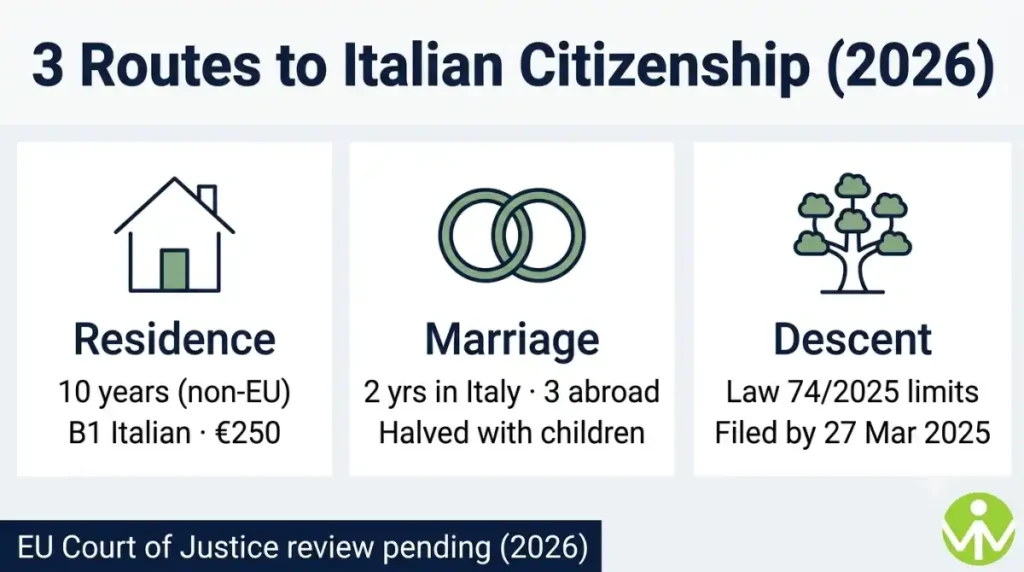
- Italian citizenship by residence normally needs 10 years of legal residence for non-EU nationals, B1 Italian and a €250 fee.
- Spouses of Italian citizens can apply after 2 years of residence in Italy after the marriage, or 3 years if they live abroad; both periods are halved if the couple has children.
- Since Law 74/2025, people born abroad who hold another nationality qualify by descent only if a parent or grandparent held Italian citizenship alone, a parent lived in Italy for 2 years before their birth, or their claim was filed by 27 March 2025.
- The Constitutional Court upheld the law in judgment 63/2026, then referred further questions to the EU Court of Justice in July 2026. The law stays in force while that case is pending.
- Children and grandchildren of Italian citizens by birth can naturalise after 2 years of legal residence in Italy.
- Italy allows dual citizenship and does not grant Italian citizenship for investment.
Table of Contents
Italian citizenship at a glance
Table 1 compares the main routes to Italian citizenship. Residence and marriage applications end in a decree after an online application to the Interior Ministry. Descent claims and the declaration routes are handled by consulates, town halls (comuni) or the courts. For people living abroad, the Italian Foreign Ministry’s official citizenship page sets out the documents each consulate expects.
Table 1: Routes to Italian citizenship in 2026
| Route | Who it is for | Main condition | Italian language | Fee | Where to apply |
|---|---|---|---|---|---|
| Residence (naturalisation) | Foreign nationals living in Italy | 10 years of legal residence (4 for EU citizens, 5 for stateless people and refugees) | B1 | €250 + €16 stamp | Interior Ministry, online |
| Marriage or civil union | Spouse or civil partner of an Italian citizen | 2 years of residence in Italy after the marriage, or 3 years if living abroad; halved with children | B1 | €250 + €16 stamp | Interior Ministry, online |
| Descent (recognition) | People with Italian ancestry | Born abroad with another nationality: must meet a Law 74/2025 exception | None | €600 per adult at a consulate; €600 per applicant in court | Consulate, town hall or court |
| Descent (naturalisation) | Child or grandchild of an Italian citizen by birth | 2 years of legal residence in Italy | B1 | €250 + €16 stamp | Interior Ministry, online |
| Minor child of a citizen | Child under 18 of a parent who is Italian by birth | Declaration within 3 years of birth, or 2 years of residence in Italy afterwards | None | €250 | Consulate or town hall |
| Born in Italy | Foreigners born and continuously resident in Italy | Declaration within one year of turning 18 | None | €250 | Town hall |
| Reacquisition | Former citizens who lost citizenship before 16 August 1992 | Born in Italy or 2 years of residence; declaration by 31 December 2027 | None | €250 | Consulate or town hall |
| Sources: Law 91/1992 as in force on Normattiva; Italian Foreign Ministry; Ministry of Justice circular of 16 January 2025. As of September 2026. | |||||
Italian citizenship by residence (naturalisation)
Naturalisation is governed by article 9 of Law 91 of 1992, Italy’s citizenship law. It is discretionary: meeting the conditions makes you eligible, but citizenship is granted by presidential decree and can be refused. The standard period for non-EU nationals is ten years of legal residence, meaning years on a valid residence permit with registration at your town hall.
How many years of residence you need
The period depends on who you are. Table 2 sets out the residence periods for Italian citizenship in the law as it stands in September 2026.
Table 2: Residence needed for Italian citizenship
| Who is applying | Legal residence needed | Legal basis |
|---|---|---|
| Non-EU national | 10 years | Law 91/1992, art. 9(1)(f) |
| EU citizen | 4 years | Art. 9(1)(d) |
| Stateless person or recognised refugee | 5 years | Art. 9(1)(e) |
| Adult adopted by an Italian citizen | 5 years after the adoption | Art. 9(1)(b) |
| Born in Italy | 3 years | Art. 9(1)(a-bis) |
| Child or grandchild of an Italian citizen by birth | 2 years (3 before Law 74/2025) | Art. 9(1)(a) |
| Five years of service for the Italian state, including abroad | No residence period | Art. 9(1)(c) |
| Spouse or civil partner of an Italian citizen | 2 years in Italy after the marriage, or 3 years if living abroad; halved with children | Art. 5 |
| Source: Law 91/1992 as in force on Normattiva, checked 29 September 2026. Recognised refugees are treated like stateless people in practice. | ||
Gaps in legal residence or in town-hall registration can reset the count, so renew permits on time. Holding the EU long-term residence permit is not required, but it helps with the language step described below. Our guide to Italy permanent residency explains how that permit works.
Income and a clean record
Applicants must show a steady, lawful income over the three years before they apply. The Interior Ministry’s long-standing guideline is about €8,263 a year for a single applicant and about €11,362 with a dependent spouse, plus about €516 for each dependent child. A conviction for a serious offence, or a security concern, leads to refusal.
B1 Italian for Italian citizenship
Since December 2018, applicants for Italian citizenship by residence or marriage must prove Italian at B1 level or above on the Common European Framework of Reference. The usual proof is a certificate from a recognised body, such as the universities for foreigners of Perugia and Siena, Roma Tre University or the Società Dante Alighieri, or an Italian school qualification. Holders of the EU long-term residence permit, and people who signed the integration agreement, are not asked to attach a certificate, although the B1 standard still applies. In March 2025, the Constitutional Court ruled that people whose serious disability prevents them from learning a language must be exempt. If you still need to reach B1, our tips on finding a language tutor in Italy are a practical place to start.
How to apply, fees and processing time
Applications are made online through the Interior Ministry’s portal and are examined by the prefecture where you live. You will need your birth certificate and criminal record certificates from your country of origin and any other country you have lived in, legalised or apostilled and translated into Italian, plus your language certificate and proof of income.
The fee is €250, plus a €16 revenue stamp. By law, the ministry must decide within 24 months, which can be extended to 36. If citizenship is granted, you must swear an oath of allegiance before the registrar of your town hall, or at the consulate if you live abroad, within six months of being notified. If you miss that deadline, the decree has no effect.
Italian citizenship by marriage
The foreign spouse or civil partner of an Italian citizen can apply for Italian citizenship under article 5 of Law 91/1992. The qualifying period is two years of legal residence in Italy after the marriage, or three years from the date of the marriage if the couple lives abroad. Both periods are halved if the couple has children, born or adopted, so a couple with a child who lives abroad can apply 18 months after the wedding.
Marriage does not make anyone Italian automatically. The spouse must meet the B1 language requirement, pay the €250 fee and pass the background checks. The marriage must still be in place when the decree is issued: divorce, annulment or legal separation before then ends the application. In 2022, the Constitutional Court ruled that the death of the Italian spouse while the application is pending is not a bar.
When a marriage application is refused
Article 6 of the law lists the grounds for refusal: a conviction for a crime against the state, a conviction for an intentional offence carrying a maximum sentence of at least three years, a foreign sentence of more than one year for a non-political offence that has been recognised in Italy, or proven reasons of state security. Rehabilitation removes the effect of a conviction, and the application is suspended while criminal proceedings for those offences are pending.
Italian citizenship by descent after Law 74/2025
Italian citizenship by descent, known as jure sanguinis, was for decades among the most generous in the world. There was no generational limit, so people could claim through a great-great-grandparent who emigrated in the 19th century, provided no one in the line had given up Italian citizenship before the next person was born. Decree-Law 36 of 28 March 2025, converted into Law 74 of 23 May 2025, ended that for most new claimants.
The new article 3-bis of the citizenship law says that anyone born abroad who holds another nationality is considered never to have acquired Italian citizenship, even if they were born before the law was passed, unless one of the exceptions below applies. It affects people whose status had not been recognised; people already recognised as citizens keep their Italian citizenship.
Who still qualifies for Italian citizenship by descent
Under article 3-bis, a person born abroad who holds another nationality is still Italian by descent if any of the following applies:
- their claim was filed, with the required documents, at an Italian consulate or town hall by 23:59 Rome time on 27 March 2025, or at an appointment the office had notified to them by that deadline;
- they filed a court case by 23:59 Rome time on 27 March 2025;
- a parent or grandparent holds, or held at the time of death, Italian citizenship only; or
- a parent, including an adoptive parent, lived in Italy for at least two continuous years after becoming Italian and before the child’s birth or adoption.
The third condition is narrower than it looks. A grandparent who emigrated and later naturalised in another country no longer counts, because they did not hold Italian citizenship alone, and nor does a parent who is a dual citizen. Claims that meet the 27 March 2025 cut-off are assessed under the old rules, with no generational limit.
Children of Italian citizens
A separate route covers minors. Under article 4(1-bis), a foreign minor whose father or mother is an Italian citizen by birth becomes Italian if the parents declare that they want the child to acquire citizenship and either the declaration is made within three years of the birth, adoption or recognition, or the child then lives legally in Italy for two continuous years. For children who were already minors when Law 74/2025 took effect, a transitional deadline of 31 May 2026 was extended to 31 May 2029 by the 2026 extension law. At 18, a child who became Italian this way can give it up if they hold another nationality.
How recognition works and what it costs
Applicants who live abroad file at their consulate, while applicants who live in Italy file at the town hall where they are legally resident. Since 1 January 2025, consulates have charged €600 for each adult applicant, and town halls may charge up to the same amount. Court claims carry a fee of €600 per applicant, as the Ministry of Justice confirmed in January 2025. The documents are the same for every channel: the birth, marriage and death records of each person in the line, proof of whether and when each ancestor naturalised elsewhere, and apostilles and certified translations.
The two-year route for descendants living in Italy
Descendants who do not qualify for recognition may still become Italian through residence. Law 74/2025 cut the naturalisation period for the child or grandchild of an Italian citizen by birth from three years of legal residence to two. This route follows the ordinary naturalisation process, including B1 Italian, the income test and the €250 fee. A foreigner whose parent or grandparent was Italian by birth can also become Italian by declaration within a year of turning 18, if they have lived legally in Italy for the previous two years. You need a residence permit first: our guides to the Italy work visa, the Italy student visa and the Italy startup visa cover the most common routes.
The court challenges to Italian citizenship by descent
Law 74/2025 was challenged in the courts within months of being passed. Table 3 summarises what has happened since the decree was issued.
Table 3: Law 74/2025 and the court challenges
| Date | Event | Effect |
|---|---|---|
| 27 March 2025, 23:59 | Cut-off in the new article 3-bis | Descent claims filed after this need one of the new exceptions |
| 28 March 2025 | Decree-Law 36/2025 issued | Restrictions on citizenship by descent take effect |
| 23 May 2025 | Law 74/2025 converts the decree | Adds the exceptions for exclusively Italian ancestors and a parent’s 2 years in Italy |
| 28 February 2026 | Law 26/2026 (extension law) | Deadline for minors’ declarations moved from 31 May 2026 to 31 May 2029 |
| 11 March 2026 (filed 30 April) | Constitutional Court judgment 63/2026 | Turin challenge rejected; the law is upheld |
| 9 June 2026 (filed 23 July) | Constitutional Court order 147/2026 | Mantova and Campobasso questions referred to the EU Court of Justice |
| Pending | EU Court of Justice, case C-816/26 | Will decide whether EU citizenship rules preclude article 3-bis |
| Sources: Constitutional Court judgment 63/2026 and order 147/2026; Law 91/1992 on Normattiva; Italian Consulate General in Marseille. As of September 2026. | ||
Judgment 63/2026: the law upheld
In judgment 63/2026, decided on 11 March 2026 and filed on 30 April, the Constitutional Court rejected the questions raised by the Turin court. It held that the cut-off did not breach the principles of equality, reasonableness or legitimate expectations, and that it did not conflict with the EU treaty rules on EU citizenship. Two further questions, based on the Universal Declaration of Human Rights and the European Convention on Human Rights, were declared inadmissible.
Order 147/2026: questions sent to the EU Court of Justice
Courts in Mantova and Campobasso then raised new questions. In order 147/2026, decided on 9 June 2026 and filed on 23 July, the Constitutional Court did not rule on them. It suspended the case and asked the Court of Justice of the European Union whether article 9 of the Treaty on European Union and article 20 of the Treaty on the Functioning of the European Union, which establish EU citizenship, preclude a rule like article 3-bis. The reference has been registered as case C-816/26. No expedited procedure was requested, and references of this kind usually take more than a year.
Until the EU court answers, Law 74/2025 remains in force. Consulates and town halls continue to apply it, and some Italian courts have postponed descent cases while they wait. If you do not meet one of the exceptions, the outcome may matter to you, but it is not a reason to assume that the rules will change.
Other routes to Italian citizenship
Born in Italy
Italy does not grant citizenship simply for being born on its territory, except to children whose parents are unknown or stateless. A foreigner born in Italy who has lived there legally without interruption until the age of 18 can become Italian by declaration within a year of turning 18. Others born in Italy can naturalise after three years of legal residence. Our overview of citizenship by birth compares this approach with other countries.
Reacquiring Italian citizenship
People who lost Italian citizenship before 16 August 1992 under the old 1912 law, usually by naturalising in another country, can reacquire it by declaration between 1 July 2025 and 31 December 2027, provided they were born in Italy or lived there for at least two continuous years. The fee is €250.
Service to the Italian state
A foreigner who has worked for the Italian state for at least five years, including abroad, can apply without any residence period. Citizenship can also be granted for eminent service to Italy, or where there is an exceptional interest of the state, by decision of the Council of Ministers.
Italian citizenship and dual nationality
Italy has allowed dual citizenship since 16 August 1992. Acquiring Italian citizenship does not require you to give up your current nationality, and Italians who naturalise elsewhere keep their Italian citizenship unless they renounce it. Your other country may take a different view: our list of countries that allow dual citizenship and our guide to US dual citizenship explain how other states treat it.
Italy does not grant citizenship for investment or for buying property. Its investor visa is a residence route only, compared with other European schemes in our golden visa guide, and our citizenship by investment guide lists the countries that do grant citizenship through investment.
What changed for Italian citizenship in 2025 and 2026
- Law 74/2025 restricted Italian citizenship by descent for people born abroad who hold another nationality, with a cut-off of 27 March 2025.
- The naturalisation period for descendants of Italian citizens by birth fell from three years of residence to two.
- A June 2025 referendum proposal to cut the residence period for naturalisation from ten years to five failed: turnout was 30.6%, below the 50% quorum.
- A window for former citizens to reacquire Italian citizenship opened on 1 July 2025 and runs until 31 December 2027.
- The deadline for declarations for children who were already minors when the law took effect moved from 31 May 2026 to 31 May 2029.
- The Constitutional Court upheld the descent restrictions in judgment 63/2026, then referred further questions to the EU Court of Justice in order 147/2026.
- A March 2025 Constitutional Court ruling exempted people with serious disabilities from the B1 language requirement.
Italian citizenship FAQ
How long does it take to get Italian citizenship?
It depends on the route. Non-EU nationals normally need ten years of legal residence before they can apply, and the Interior Ministry then has up to 24 months, extendable to 36, to decide. Spouses can apply after two years of residence in Italy or three years abroad, halved with children.
Can I still get Italian citizenship by descent?
Only in limited cases. If you were born abroad and hold another nationality, you qualify if a parent or grandparent held Italian citizenship alone, if a parent lived in Italy for two continuous years before your birth, or if your claim was filed by 27 March 2025.
Is Law 74/2025 suspended while the EU Court of Justice decides?
No. The Constitutional Court referred questions to the EU Court of Justice in July 2026, but the law remains in force and consulates continue to apply it. Some Italian courts have postponed descent cases until the EU court rules.
Do I need to speak Italian to get Italian citizenship?
Yes, for residence and marriage. You need Italian at B1 level, usually proven with a certificate from a recognised body. Descent claims and the declaration routes for minors have no language requirement.
How much does Italian citizenship cost?
Applications by residence or marriage cost €250 plus a €16 revenue stamp. Recognition by descent costs €600 per adult at a consulate, and court claims carry a €600 fee per applicant. Translations, apostilles and certificates cost extra.
Can I keep my current nationality if I become an Italian citizen?
Italy allows dual citizenship, so it does not ask you to give up your current nationality. Your other country may have its own rules, so check them before you apply.
Does marrying an Italian give me Italian citizenship automatically?
No. Marriage makes you eligible to apply after a set period, but you must still meet the language requirement, pass background checks and pay the fee. The marriage must still be in place when the decree is issued.
Can I get Italian citizenship by investment?
No. Italy has no citizenship by investment programme. Its investor visa gives residence, which can lead to Italian citizenship only through the ordinary ten-year naturalisation route.