
The BNO visa lets Hong Kong residents with British National (Overseas) status, and their families, live, work, and study in the UK, with a path to settlement after five years. The UK opened the route on 31 January 2021, and it remains open to new applicants. In 2026, the government widened it to more adult children of BN(O) status holders and confirmed that the five-year settlement timeline will stay in place under its planned settlement reforms.
This guide explains who can apply for a BNO visa, what it costs, how to apply, and what happens after five years. It also covers the BN(O) passport itself, which is not the same thing as the visa. For other UK routes, see our guide to every type of UK visa.
Key Takeaways
- The BNO visa lets people with British National (Overseas) status, and their families, live, work, and study in the UK without a job offer or sponsor.
- Adult children of BN(O) status holders born on or after 1 July 1979 can apply in their own right, following a change that took effect on 8 April 2026.
- The visa costs £206 for 2 years and 6 months or £285 for 5 years per person, plus the immigration health surcharge of £1,035 a year per adult.
- BNO visa holders can apply to settle after five years, and the government confirmed in November 2026 that this timeline will not move to 10 years.
- China and Hong Kong have not recognised the BN(O) passport as a travel document since 31 January 2021, but BN(O) status still qualifies you for the visa.
Table of Contents
What Is the BNO Visa?
The BNO visa, officially the Hong Kong British National (Overseas) visa, is a UK immigration route for people with BN(O) status and their close family. It is not a work or sponsorship route: applicants need no job offer, no sponsor, and no minimum salary, and there is no English test at the application stage.
Holders can work in most jobs, study at school, college, or university, and use the NHS. The main exception is work as a professional sportsperson or sports coach, which the visa does not cover. Most holders cannot claim public funds, although someone without a place to live or unable to afford essentials can ask the Home Office to lift that condition.
Applicants choose a stay of 2 years and 6 months or 5 years and can extend from inside the UK as many times as they need. The official BNO visa page on GOV.UK sets out the full rules.
BN(O) Status and the BN(O) Passport
BN(O) is a form of British nationality created for Hong Kong before the 1997 handover. British Dependent Territories citizens connected to Hong Kong could register as British Nationals (Overseas) before 1 July 1997. The status does not pass to children and cannot be acquired today, so the visa reaches younger family members through separate rules.
The status and the passport are different things. BN(O) status is permanent, while a BN(O) passport is a travel document that expires. A valid BN(O) passport is not required for a visa application: applicants can use another valid passport, such as a Hong Kong SAR passport, and the Home Office can confirm BN(O) status from its own records.
China and Hong Kong stopped recognising the BN(O) passport as a valid travel document or proof of identity from 31 January 2021, the day the visa route opened. In its announcement of 29 January 2021, the Hong Kong government said the passport could no longer be used for immigration clearance in Hong Kong. Residents enter and leave the city with a Hong Kong SAR passport or permanent identity card instead.
Who Is Eligible for a BNO Visa?
To apply for a BNO visa as the main applicant, you must be 18 or older and either hold BN(O) status or be the adult child of a BN(O) status holder born on or after 1 July 1979. If you apply from outside the UK, your permanent home must be in Hong Kong. If you apply from inside the UK, it can be in the UK, the Channel Islands, the Isle of Man, or Hong Kong.
You also need enough money to house and support yourself and your family for six months, and you must pass the standard criminal record and suitability checks. The table below shows who can apply and when.
| Applicant | Who qualifies | When they can apply |
|---|---|---|
| BN(O) status holder | Aged 18 or older with BN(O) status and a permanent home in Hong Kong (or the UK, Channel Islands, or Isle of Man for in-country applications) | Main applicant |
| BN(O) Adult Child | Aged 18 or older, child of a BN(O) status holder, born on or after 1 July 1979 | Separately from the parent |
| Partner | Spouse, civil partner, or unmarried partner of the main applicant | With the main applicant or later |
| Child under 18 | Child of the main applicant or their partner | With the main applicant or later |
| Adult dependent relative | Relative who depends on the main applicant for care | With the main applicant or later |
| Source: GOV.UK, BN(O) visa eligibility page, checked 11 November 2026. | ||
The BN(O) Adult Child Route
Until April 2026, adult children could apply in their own right only if they were born on or after 1 July 1997, after the handover. Changes to the Immigration Rules that took effect on 8 April 2026 moved that date back to 1 July 1979. The change covers people who were children at the handover and never registered for BN(O) status themselves.
From 8 October 2026, the rules call this category BN(O) Adult Child, replacing the earlier name, BN(O) Household Member. An adult child can apply separately from their parent, and the adult child’s own partner and children under 18 can usually apply as their family members.
Family Members
A partner, a child under 18, and an adult dependent relative can travel with the main applicant or apply later to join them. Other eligible family members usually need to apply at the same time as the main applicant. A partner can be a spouse, a civil partner, or an unmarried partner.
BNO Visa Fees and Health Surcharge
BNO visa fees depend on the stay you choose. The application fee is £206 for 2 years and 6 months and £285 for 5 years, charged per person. Every applicant also pays the immigration health surcharge (IHS) upfront for the whole stay: £1,035 a year for adults and £776 a year for children under 18.
| Cost | 2 years and 6 months | 5 years |
|---|---|---|
| Application fee | £206 | £285 |
| Immigration health surcharge, adult (£1,035 a year) | £2,587.50 | £5,175 |
| Immigration health surcharge, child under 18 (£776 a year) | £1,940 | £3,880 |
| Total, one adult | £2,793.50 | £5,460 |
| Total, one child | £2,146 | £4,165 |
| Source: GOV.UK, BN(O) visa costs page, checked 11 November 2026. Fees are charged per applicant in pounds sterling. | ||
The surcharge is the largest cost. For a five-year stay, one adult pays £285 plus £5,175, or £5,460 in total, while a family of two adults and two children pays £19,250 before travel and living costs.
People already in the UK who receive benefits and cannot afford the costs can extend for 30 months without paying the fee or the surcharge. That waiver does not apply to five-year extensions. To compare these figures with other routes, see our UK visa fees guide.
Funds and Documents for a BNO Visa
First-time applicants must show they can pay for housing and support themselves and their family for six months, at roughly the level of Income Support. GOV.UK gives these examples: about £2,000 for a single adult, £3,100 for a couple with a child, and £4,600 for a couple with three children. Applicants who have lived in the UK for 12 months or more usually do not need to show funds.
Documents usually include:
- a valid passport or other travel document
- evidence of BN(O) status, or of a parent’s BN(O) status for an adult child
- proof of a permanent home in Hong Kong, or in the UK for in-country applications
- bank statements or other proof of funds
- marriage, partnership, or birth certificates for family members
How to Apply for a BNO Visa
The application is online, whether you apply from Hong Kong, the UK, or another country. The process follows these steps:
- Check your eligibility and choose a stay of 2 years and 6 months or 5 years.
- Complete the online application on GOV.UK, adding any family members applying with you.
- Prove your identity. Most applicants scan their passport with the UK Immigration: ID Check app; others book a biometrics appointment at a visa application centre.
- Pay the application fee and the immigration health surcharge.
- Upload your documents, then wait for a decision by email.
Approved applicants receive an eVisa, a digital record of their immigration status, rather than a physical document. Keep your UKVI account details up to date, since employers and landlords check status online.
Living in the UK on a BNO Visa
BNO visa holders can take most jobs, change employers freely, run a business, and study without a separate student visa. NHS treatment is covered by the surcharge, although holders still pay for some care, such as prescriptions, dental treatment, and eye tests.
Extensions are made online from inside the UK before the current permission ends. Long trips abroad can break the continuous residence needed for settlement, so check the absence limits before travelling.
BNO Visa Settlement and British Citizenship
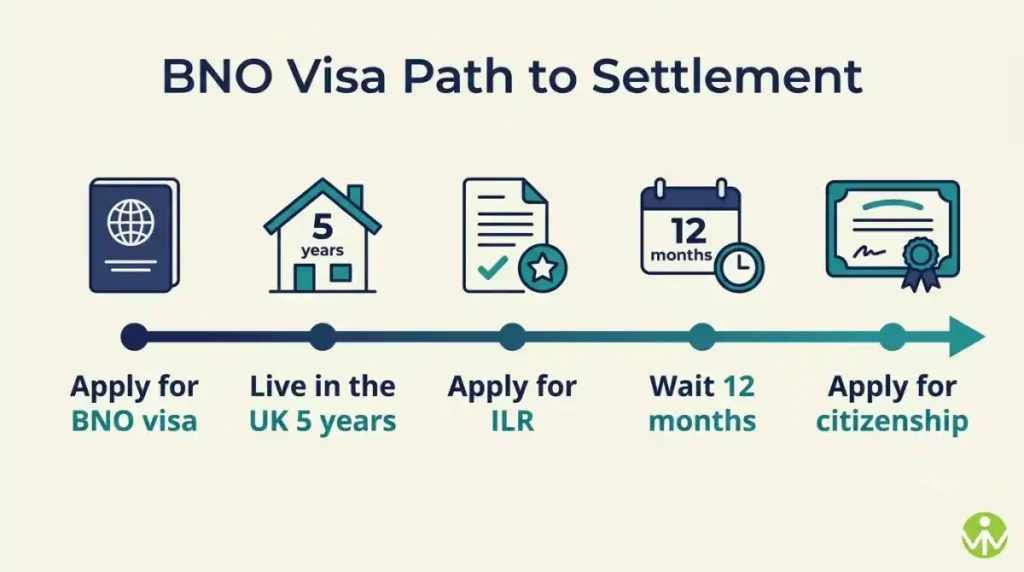
After five years in the UK on a BNO visa, you can apply for indefinite leave to remain (ILR), also called settlement. Settlement applicants must pass the Life in the UK test and meet an English language requirement. Our indefinite leave to remain guide explains the ILR application in more detail.
Earned Settlement and the BNO Visa
On 2 November 2026, the government published its response to the earned settlement consultation, which would raise the standard qualifying period for most routes to 10 years. BNO visa holders keep their five-year route. The government has also said settlement applicants will face tougher conditions, including a higher English level, and reports indicate these will apply to BN(O) applicants too. Most of these changes are not yet in the Immigration Rules and have no start date.
One change is already in the rules: from 26 March 2027, the English level for settlement on most routes rises from B1 to B2. Anyone who expects to apply for settlement after that date should check whether the higher level applies to them.
Becoming a British Citizen
With ILR, most people can apply to naturalise as a British citizen after 12 months, which makes six years the usual minimum from arrival to citizenship. Naturalisation has its own fee and requirements, separate from the visa. Readers comparing Hong Kong routes in the other direction can see our Hong Kong startup visa guide.
BNO Visa FAQ
Is the BNO visa still open?
Yes. The route accepts new applications and extensions, and the UK widened it in 2026 to include more adult children of BN(O) status holders.
Do I need a BN(O) passport to apply for a BNO visa?
No. BN(O) status is what counts. Applicants can use another valid passport, such as a Hong Kong SAR passport, and the Home Office can check BN(O) status from its records.
How much does a BNO visa cost?
The application fee is £206 for 2 years and 6 months or £285 for 5 years per person. The immigration health surcharge adds £1,035 a year for each adult and £776 a year for each child.
Can I apply if I was born after 1997?
Yes, if you are 18 or older and a parent has BN(O) status. The BN(O) Adult Child route covers people born on or after 1 July 1979, which includes everyone born after the handover.
Does the BNO visa lead to British citizenship?
Indirectly. After five years, visa holders can apply for indefinite leave to remain, and most can apply for citizenship 12 months later.
Do I need an English test for a BNO visa?
Not to apply. An English language requirement applies at the settlement stage, and the required level rises from B1 to B2 for most routes from 26 March 2027.