
A Spain tourist visa is the short-stay Schengen visa that Spanish embassies and consulates issue to travellers who need a visa to holiday in Spain, visit family or friends, or see the country for up to 90 days. It is a uniform Type C visa, so the same sticker also covers the other 28 Schengen countries. Spain handles the application only when it is your main destination, and it adds its own national rules, including a fixed daily amount of money visitors must be able to show.
This guide explains who needs a Spain tourist visa, what it costs, which documents consulates ask for, how to apply, and what changes at the border now that the Entry/Exit System is live. For work, study, and residence routes, see our guide to the types of Spain visas.
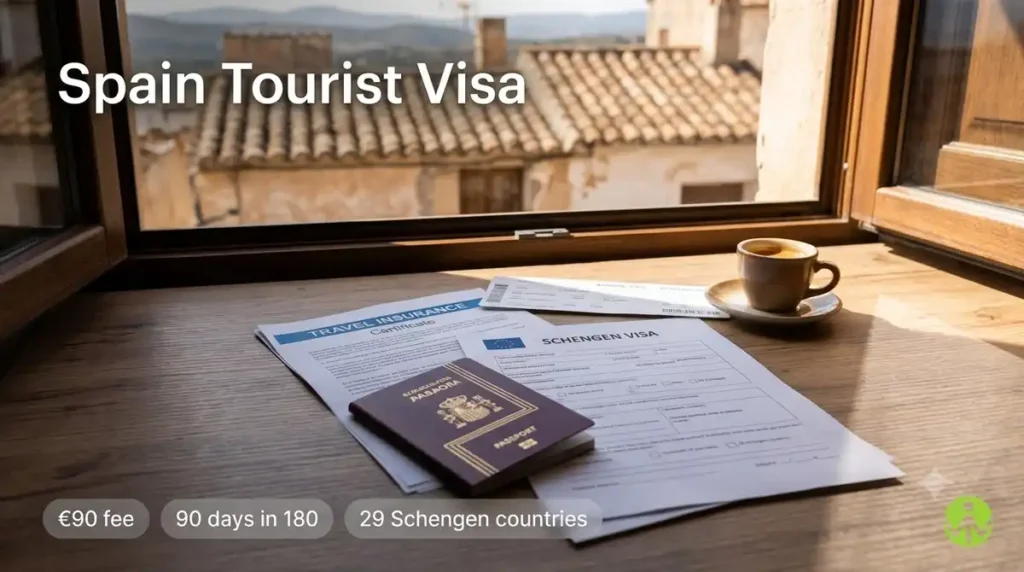
Key Takeaways
- A Spain tourist visa is a uniform Schengen visa (Type C) for stays of up to 90 days in any 180-day period across all 29 Schengen countries.
- Apply to Spain only if it is your main destination, or the country you enter first when your stays are equal.
- The Spain tourist visa fee is €90 for adults and €45 for children aged 6 to 11; children under 6 pay nothing.
- Spain asks visitors to show at least €1,098.90 in funds, and more for trips longer than nine days.
- Apply up to six months before travel and no later than 15 days before; most decisions take 15 calendar days.
- The Entry/Exit System (EES) has replaced passport stamps since 10 April 2026. ETIAS, for visa-free visitors, still has no start date.
Table of Contents
Do you need a Spain tourist visa?
Whether you need a Spain tourist visa depends on your nationality, not on where you live. The EU keeps a single list of countries whose nationals need a visa for short stays, and Spain applies it like every other Schengen state. The European Commission publishes both lists on its visa policy page.
Nationals of visa-required countries, including India, China, Nigeria, Türkiye, and the Philippines, need a Spain tourist visa for any short visit. About 60 countries and territories, including the United Kingdom, the United States, Canada, Australia, Japan, and Brazil, are visa-exempt and can stay for up to 90 days in any 180-day period without one. Holders of a residence permit or long-stay visa issued by another Schengen country can also visit Spain without a separate visa.
| Traveller | Spain tourist visa needed? | Notes |
|---|---|---|
| Nationals of visa-required countries (for example, India, China, Nigeria, Türkiye, and the Philippines) | Yes | Apply at the Spanish embassy or consulate for the place where you legally live |
| Nationals of visa-exempt countries (for example, the UK, the US, Canada, Australia, Japan, and Brazil) | No | Up to 90 days in any 180 days; EES registration at the border; ETIAS once it starts |
| EU, EEA, and Swiss citizens | No | Free movement with a passport or national ID card |
| Holders of a residence permit or long-stay visa from another Schengen country | No | Up to 90 days in any 180 days in other Schengen countries |
| Holders of a UK, US, or Irish visa or residence permit | Depends on nationality | A visa or permit from a non-Schengen country does not replace a Spain tourist visa |
| Source: European Commission visa policy (Regulation (EU) 2018/1806, Annexes I and II). Lists change; check before you book. As at 16 November 2026. | ||
Visa-free visitors: EES now, ETIAS later
Visa-exempt travellers still go through new checks. The EU’s Entry/Exit System (EES) started on 12 October 2025 and became fully operational on 10 April 2026. It records your name, passport details, fingerprints, and facial image at your first crossing, logs every entry and exit, and replaces passport stamps. Spain tourist visa holders are registered in the same way.
ETIAS, the online travel authorisation for visa-exempt travellers, is not yet in operation. The EU has not set a start date and says it will announce one several months in advance. Once it starts, it will cost €20. Travellers who need a Spain tourist visa will not need ETIAS.
What a Spain tourist visa allows
Spanish consulates issue the same short-stay visa for tourism, family visits, business meetings, medical treatment, and short courses. This guide covers tourism and visits to family and friends. Our Schengen visa guide explains the rules that apply in every member state.
A Spain tourist visa lets you spend up to 90 days in any rolling 180-day period across the 29 Schengen countries: Austria, Belgium, Bulgaria, Croatia, the Czech Republic, Denmark, Estonia, Finland, France, Germany, Greece, Hungary, Iceland, Italy, Latvia, Liechtenstein, Lithuania, Luxembourg, Malta, the Netherlands, Norway, Poland, Portugal, Romania, Slovakia, Slovenia, Spain, Sweden, and Switzerland. Cyprus and Ireland are EU members but not part of the Schengen Area, so the visa does not cover them.
Single and multiple entries
The consulate decides how many entries you get and how long the visa stays valid. First-time applicants usually receive a visa that matches their travel dates. Frequent travellers with a record of using earlier Schengen visas correctly may receive a multiple-entry visa valid for a longer period, but the 90/180 limit still applies to every trip.
What you cannot do on a Spain tourist visa
A Spain tourist visa does not allow you to work, take a degree course, or settle in Spain. To study for more than 90 days, apply for a Spain student visa before you travel. Spain extends short-stay visas only in exceptional cases, such as force majeure or serious personal reasons, so plan your trip within the dates on the sticker.
Spain tourist visa requirements
Consulates check three things: that the purpose of your trip is credible, that you can pay for it, and that you will leave the Schengen Area before the visa expires. Your passport must have been issued in the last 10 years, stay valid for at least three months after your planned departure, and have at least two blank pages.
How much money you need for a Spain tourist visa
Spain fixes the amount by law. Orden PRE/1282/2007 links it to the national minimum wage, and from 1 January 2026, Spain’s Ministry of the Interior sets it at €121.10 per person per day, with a minimum of €1,098.90 whatever the length of your stay. The daily rate is 10% of the 2026 minimum wage, which works out to €122.10, and some Spanish embassy pages quote that figure. Use the higher amount to be safe.
For a seven-day trip, the minimum of €1,098.90 applies. For a 12-day trip, 12 days at €122.10 comes to €1,465.20. Border police can ask for the same proof when you arrive. Cash, bank cards, and bank statements all count, and prepaid accommodation that includes meals can lower the amount you need to show.
Travel medical insurance
Every Spain tourist visa application needs travel medical insurance with cover of at least €30,000. The policy must cover emergency treatment, hospital care, and repatriation for the whole stay and the whole Schengen Area, with no excess. For a multiple-entry visa, the first trip must be insured, and you must sign an undertaking to buy cover for later trips.
Documents for a Spain tourist visa application
The core document list is the same at every Spanish consulate, but each mission adds local requirements. Check the checklist of the consulate or visa centre that covers the place where you live before you book.
| Document | What consulates usually ask for |
|---|---|
| Application form | Schengen visa application form, completed and signed; a parent signs for a child |
| Photo | One recent colour passport photo on a light background, with no filters or edits |
| Passport | Issued in the last 10 years, valid for at least three months after you leave, with two blank pages; copies of the data page and earlier visas |
| Proof of legal residence | Residence permit or long-term visa, if you are not a national of the country where you apply |
| Travel medical insurance | At least €30,000 of cover, valid in all Schengen countries for the whole stay, with no excess |
| Flight booking | Return or onward reservation showing entry to and exit from the Schengen Area |
| Accommodation | Bookings for every night, or a letter of invitation (carta de invitación) from a host in Spain, issued through the police |
| Proof of funds | Recent bank statements, usually for the last three months, showing at least the Spanish minimum |
| Ties to home | Employer letter and leave approval, business registration, or a letter from your school or university |
| Visa fee | €90 for adults, paid when you submit the application |
| Consulates add local requirements, such as translations or apostilles. Check the checklist for the consulate or visa centre that covers where you live. As at 16 November 2026. | |
How to apply for a Spain tourist visa, step by step
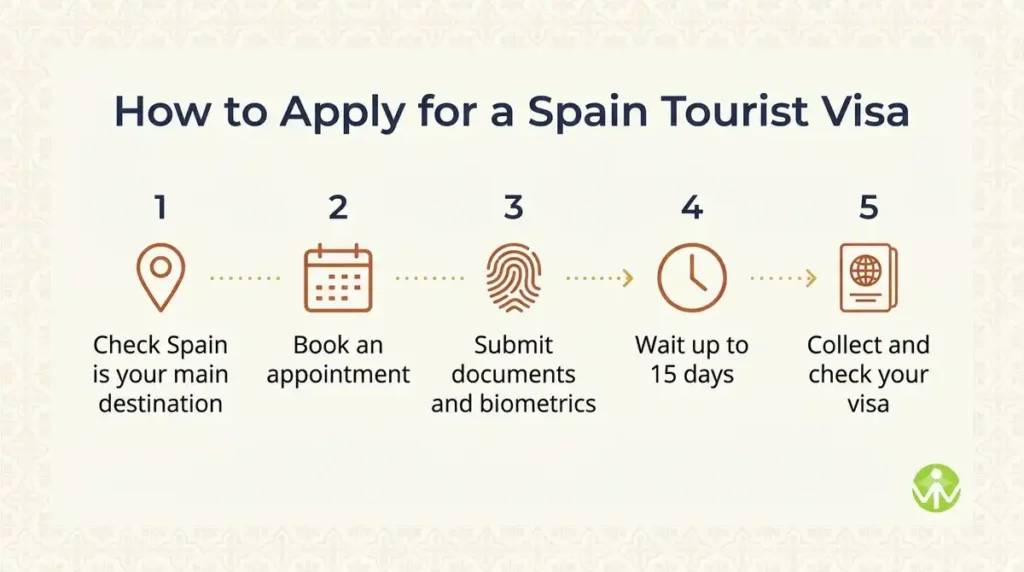
Step 1: Check that Spain is the right country
Apply to Spain if it is your only destination or the country where you will spend the most days. If your stays are equal, apply to the country you enter first. If most of your trip is in Italy, Germany, or Portugal, apply to that country instead; our guides to the Italy tourist visa, the Germany tourist visa, and the types of Portugal visa cover those applications. Apply through the Spanish embassy or consulate that covers the place where you legally live.
Step 2: Book an appointment
Many Spanish consulates use an external service provider, such as BLS International, to take applications. Book through the provider named on the consulate’s website, one appointment per applicant. Submit your application no earlier than six months and no later than 15 days before you travel; seafarers can apply up to nine months ahead. Summer and the December holidays are the busiest periods, so book as early as your plans allow. Our general guide on how to apply for a visa has tips on preparing a file.
Step 3: Submit your file and give biometrics
Attend in person with your documents and the fee. Staff take your fingerprints and a photograph unless you gave fingerprints for a Schengen visa in the last 59 months; children under 12 are exempt from fingerprinting. Keep the receipt, because its code lets you track the application online.
Step 4: Wait for the decision
The consulate must decide within 15 calendar days. It can extend that period to 45 days if it needs more documents or an interview, and applications from some nationalities need a check with authorities in Spain, which takes longer.
Step 5: Collect your passport and check the visa
When your passport comes back, check the name, passport number, validity dates, number of entries, and days allowed. If the sticker says it is valid only for certain countries, you can travel only to those countries. Ask the consulate to correct any error before you travel.
Spain tourist visa fee
Orden AUC/891/2024, published in the Boletín Oficial del Estado, sets the standard Spain tourist visa fee at €90, in line with the EU fee in force since 11 June 2024. Children aged 6 to 11 pay €45, and children under 6 pay nothing. Nationals of countries with an EU visa facilitation agreement pay a reduced fee of €35. Consulates accept payment in euros, US dollars, or local currency at the official exchange rate, and the fee is not refunded if the visa is refused.
Visa centres charge a separate service fee in addition to the visa fee. Family members of EU, EEA, and Swiss citizens who travel with them or join them pay no fee under EU free movement rules.
| Applicant | Visa fee |
|---|---|
| Adult (12 and over) | €90 |
| Child aged 6 to 11 | €45 |
| Child under 6 | Free |
| Nationals of countries with an EU visa facilitation agreement | €35 |
| Family members of EU, EEA, or Swiss citizens covered by free movement rules | Free |
| Source: Orden AUC/891/2024 (BOE, 24 August 2024) and the EU Visa Code, Article 16. Visa centre service fees are charged separately. As at 16 November 2026. | |
Arriving in Spain
Border checks
A Spain tourist visa does not guarantee entry. Border officers can ask for your return ticket, accommodation details, and proof of funds, and they can refuse entry if you cannot show them. Since EES went live, the system counts your days automatically, so it flags any overstay at your next crossing.
Can you extend a Spain tourist visa?
Only in exceptional cases. Spain can extend a short-stay visa for force majeure, humanitarian reasons, or serious personal reasons, such as a sudden illness or a cancelled flight that leaves no alternative. Apply to the police or the immigration office in Spain before your visa expires. Overstaying can lead to a fine, removal, and an entry ban.
If your Spain tourist visa is refused
The consulate gives its decision in writing, on a standard form that states the reasons. You can ask the same consulate to reconsider (recurso de reposición) within one month of being notified, or take the case to the High Court of Justice of Madrid within two months. Many applicants instead reapply, submitting documents that address the stated reason.
Spain tourist visa FAQs
Can I apply for a Spain tourist visa online?
No. You book the appointment online, but you must submit the application and give biometrics in person at the consulate or visa centre.
How long can I stay in Spain on a tourist visa?
Up to 90 days in any 180-day period, counted across all 29 Schengen countries, and only within the validity dates on the visa.
Can I visit other Schengen countries on a Spain tourist visa?
Yes. A Spain tourist visa is valid in all 29 Schengen countries unless the sticker limits it, but Spain must be your main destination.
How much bank balance do I need for a Spain tourist visa?
At least €1,098.90 per person, or about €122 per person per day for longer trips, whichever is higher.
How early should I apply for a Spain tourist visa?
Up to six months before travel and no later than 15 days before. Applying 4 to 6 weeks ahead leaves time for appointment wait times.
Do UK or US citizens need a Spain tourist visa?
No. Both can stay up to 90 days in any 180-day period without a visa. They register in EES at the border and will need ETIAS once it starts. See our lists of visa-free destinations for UK citizens and US citizens.
Can I work on a Spain tourist visa?
No. Paid work in Spain needs a work visa and permit, which you apply for before you travel.