
Permanent residency in Japan gives a foreign national the right to live in Japan with no limit on their period of stay and to work in any job, for any employer, without changing status. It is granted by the Immigration Services Agency of Japan (ISA) under Article 22 of the Immigration Control and Refugee Recognition Act, and it is the end point of most of the long-stay routes described in our guide to the types of Japan visa.
2026 brought the biggest changes to permanent residency in Japan in years. The application fee rose from ¥10,000 (convert ¥10,000) to ¥200,000 on 1 October 2026, and on the same day the ISA revised the guidelines it uses to assess applications, adding tests on household income, pension and Japanese-language ability. This guide explains who qualifies today, what changes and when, the documents and fee involved, and how permanent residency in Japan compares with naturalisation.
Key Takeaways
- Permanent residency in Japan normally requires 10 years of continuous residence, including at least five years in a work or status-based status.
- Spouses and children of Japanese nationals and permanent residents, Highly Skilled Professionals, J-Skip holders and long-term residents can apply sooner.
- The permanent residence fee rose from ¥10,000 to ¥200,000 for applications received from 1 October 2026. It is paid only if the application is approved.
- On 1 October 2026 the Immigration Services Agency revised its guidelines, adding tests on household income, projected pension and Japanese at B1 level.
- Most of the new tests apply to applications from April 2027, when the spouse route also lengthens to five years of marriage and three years of residence.
- Average processing time was 310.2 days for permanent residence applications approved in July 2026.
Table of Contents
What Permanent Residency in Japan Gives You
Permanent residents never have to renew their status of residence. There are no restrictions on activities, so a permanent resident can change employer, switch careers, run a business or work freelance without applying for a new status. Banks generally treat permanent residents more favourably for mortgages and business loans, and a spouse or child can apply for the Spouse or Child of Permanent Resident status, which also carries no work restrictions.
Permanent residency in Japan is not citizenship. A permanent resident keeps their existing nationality and passport, cannot vote in national or local elections, must still carry a residence card and needs a re-entry permit when travelling. The status can also be revoked under defined circumstances, as covered below.
Who Is Eligible for Permanent Residency in Japan
The law sets three requirements for permanent residency in Japan. The applicant must be of good conduct, meaning they obey the law and live in a way that attracts no social criticism. They must have an independent livelihood, with assets or skills that indicate a stable future without relying on public funds. The grant must also be in Japan’s national interest, which the ISA judges mainly through length of residence, tax and social insurance payments, and whether the applicant holds the longest available period of stay. Spouses and children of Japanese nationals, permanent residents and special permanent residents are exempt from the first two requirements, though their payment records are still checked.
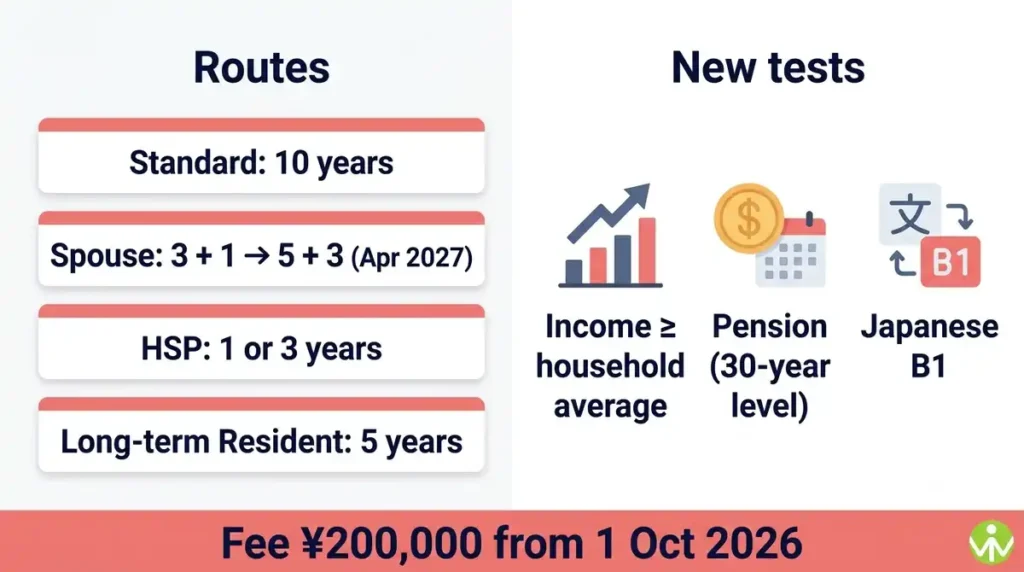
The residence period needed for permanent residency in Japan depends on the route. The table below shows the current position and what the October 2026 revision changes.
Table 1 — Routes to permanent residency in Japan
| Route | Residence required (current guideline) | Change from the October 2026 revision |
|---|---|---|
| Standard route | 10 years’ continuous residence, including at least 5 years in a work or status-based status | Unchanged; income, pension and Japanese B1 tests added (April 2027) |
| Spouse of a Japanese national, permanent resident or special permanent resident | 3 years of marriage and 1 year of residence | 5 years of marriage and 3 years of residence (April 2027) |
| Child of a Japanese national, permanent resident or special permanent resident | 1 year of continuous residence | Check ISA guidance for applications from April 2027 |
| Long-term Resident | 5 years’ continuous residence in that status | No change reported |
| Refugee or complementary protection | 5 years’ continuous residence after recognition | No change reported |
| Highly Skilled Professional, 70+ points | 3 years at 70 or more points | Exempt from the Japanese B1 test |
| Highly Skilled Professional, 80+ points | 1 year at 80 or more points | Exempt from the Japanese B1 test |
| J-Skip (Special Highly Skilled Professional) | 1 year | Exempt from the Japanese B1 test |
| Source: Immigration Services Agency guideline on permanent residence (revised 24 February 2026) and the 1 October 2026 revision as reported by Kyodo News. Correct as of 2 October 2026. | ||
The standard 10-year route
Most applicants reach permanent residency in Japan through the standard route: at least 10 years of continuous residence, of which at least five years must be in a work status, such as Engineer/Specialist in Humanities/International Services or Business Manager, or in a status-based status. Years spent as a student count towards the 10 years but not towards the five-year work component. Long trips abroad can break continuity, and the revised guideline indicates that a single absence of six months or more, or long cumulative absences, may be treated as a break unless there is a justifiable reason.
Founders should note that neither the startup visa nor Business Manager status offers a shortcut. Our Japan startup visa guide explains how those routes fit together and why the 10-year rule still applies to most business owners.
Spouses and children of Japanese nationals and permanent residents
A spouse of a Japanese national, a permanent resident or a special permanent resident can currently apply after three years of genuine marriage and one year of residence in Japan. The October 2026 revision lengthens this to five years of marriage and three years of residence for applications from April 2027. Children, including specially adopted children, can currently apply after one year of continuous residence.
Highly Skilled Professionals and J-Skip
The points-based Highly Skilled Professional (HSP) system is the fastest route to permanent residency in Japan. Applicants with 70 or more points for three years, or 80 or more points for one year, can apply. J-Skip, the special HSP track for researchers and engineers earning at least ¥20 million a year and executives earning at least ¥40 million, also allows an application after one year. HSPs are exempt from the new Japanese-language test.
Long-term residents and refugees
Holders of Long-term Resident status can apply after five years of continuous residence in that status. People recognised as refugees, or granted complementary protection, can apply after five years of continuous residence following recognition.
The October 2026 Changes to Permanent Residency in Japan
On 1 October 2026 the ISA revised its guidelines on permanent residency in Japan after a public consultation that drew around 5,000 comments. The revision does not change the law itself. It changes how the agency judges whether an applicant meets the independent-livelihood and national-interest requirements, and a separate guideline explains how the agency will use new grounds for revoking permanent status.
Income above the Japanese household average
Household income must be at or above the average income of Japanese households of the same size, and it must be sustained over time rather than reached in a single year. The guideline does not publish a fixed yen figure. For context, Kyodo News reported that average Japanese household income was about ¥5.75 million (convert ¥5.75 million) in 2024. Dependants living overseas count towards household size, but their income cannot be added to the applicant’s.
A projected pension
Applicants must show projected pension benefits at the level a person would receive after 30 years in the Employees’ Pension Insurance scheme at that average income. A shortfall can be offset by financial assets, and a younger applicant needs to show less in assets than one close to retirement age.
Japanese at B1 level
For the first time, permanent residency in Japan will require Japanese-language ability at B1 level, described as an independent language user on the government’s reference framework for Japanese-language education, which is aligned with the CEFR. The ISA has not yet said which tests or certificates it will accept. The draft guideline exempts Highly Skilled Professionals, children of permanent residents born in Japan, and people who completed at least six years of schooling in Japan, among others. Applicants are also expected to understand Japan’s systems and rules, and school-age children in the household should be attending school.
When the new rules apply
The changes take effect in stages. Anyone with an application already in progress should be ready to show income and payment records that meet the new standard.
Table 2 — When the 2026 changes to permanent residency in Japan apply
| Change | Applies to |
|---|---|
| Fee of ¥200,000 (previously ¥10,000) | Applications received from 1 October 2026 |
| Household income and tax and social-insurance payment checks | New applications, and reportedly pending applications filed from around April 2026 |
| Projected pension and Japanese B1 tests | Applications from April 2027 |
| Spouse route of 5 years’ marriage and 3 years’ residence | Applications from April 2027 |
| New grounds for revoking permanent status | From 1 April 2027 (amended Immigration Control Act) |
| Sources: ISA fee leaflet; ISA draft guideline overview; Kyodo News, 1 October 2026. Reports differ on how pending applications are treated, so confirm with the ISA. | |
Core Requirements for Permanent Residency in Japan
Tax, pension and health insurance records
Late or missing payments are among the most common reasons for refusal. The ISA asks for proof that residence tax, national taxes, pension contributions and health insurance premiums have been paid in full and on time, typically five years of residence-tax records for applicants in a work status and two years of pension and health-insurance records. Under the revised guideline, past delinquencies weigh against an application even if they were later paid.
The longest period of stay
Applicants must hold the longest period of stay available for their current status, which in practice is five years. Until 31 March 2027, a three-year period of stay meets this requirement.
Good conduct and a guarantor
Criminal convictions, including fines, repeated traffic offences and breaches of immigration law all count against an applicant. Applicants also need a guarantor who is a Japanese national or a permanent resident. The guarantee is a moral commitment to support the applicant’s compliance with Japanese law, not a financial liability.
Documents Required for Permanent Residency in Japan
The exact list depends on the applicant’s current status, and the ISA publishes separate checklists for work-status holders, spouses, long-term residents and HSPs on its permanent residence page. A typical application includes:
- the application form for permission for permanent residence, with one photograph (4 cm × 3 cm)
- a written statement of reasons for applying
- passport and residence card, shown at submission
- a certificate of residence covering all household members
- proof of employment, such as a certificate of employment, or company registration and financial statements for business owners
- residence tax certificates showing income and payment
- proof of payment of national taxes such as income tax and consumption tax, where applicable
- pension records and health insurance payment records
- a letter of guarantee and the guarantor’s identity documents
- marriage or family registration documents for spouse and child applications
- for HSP applicants, a points calculation table with supporting evidence
Documents in other languages must come with a Japanese translation. Under the revised guideline, applicants should also expect to show evidence of household income, projected pension and, from April 2027, Japanese-language ability.
How to Apply for Permanent Residency in Japan
- Check your route and records. Confirm the residence period for your route, that you hold the longest period of stay, and that all tax, pension, and insurance payments are complete.
- Submit the application in person. File applications at the regional immigration bureau that covers your address. You cannot apply for permanent residence online, but a registered lawyer or administrative scrivener can submit it on your behalf.
- Keep your current status valid. A pending application does not extend your period of stay, so apply to extend it separately if it will expire before a decision.
- Answer any requests for more information. The bureau may request additional documents or an interview, and each family member must file their own application.
- Receive the decision and pay the fee. If the application is approved, you are notified by postcard, pay the fee with revenue stamps and receive a new residence card.
Permanent Residency in Japan Fee and Processing Time
The fee for permanent residency in Japan is ¥200,000 (convert ¥200,000) for applications received on or after 1 October 2026, up from ¥10,000. The fee is due only if the application is approved, and the date the bureau receives the application, not the date of decision, decides which fee applies. Reductions are available to applicants recognised as being in financial hardship. Other residence fees rose on the same day, reaching ¥75,000 (convert ¥75,000) at the counter for a five-year stay. The full schedule is in the ISA’s fee leaflet.
Table 3 — Japan residence fees before and after 1 October 2026
| Procedure | Before 1 October 2026 | From 1 October 2026 (counter) | From 1 October 2026 (online) |
|---|---|---|---|
| Permanent residence | ¥10,000 | ¥200,000 | Not available online |
| Extension or change, 3 months or less | ¥6,000 (¥5,500 online) | ¥10,000 | ¥10,000 |
| Extension or change, 1 year | ¥6,000 (¥5,500 online) | ¥33,000 | ¥27,000 |
| Extension or change, over 1 to 3 years | ¥6,000 (¥5,500 online) | ¥48,000 | ¥42,000 |
| Extension or change, 3 to 5 years | ¥6,000 (¥5,500 online) | ¥64,000 | ¥56,000 |
| Extension or change, over 5 years | ¥6,000 (¥5,500 online) | ¥75,000 | ¥65,000 |
| Source: Immigration Services Agency fee leaflet, effective 1 October 2026. Fees are paid on approval, by revenue stamp at the counter or electronically online. The fee applying is set by the date the application is received. | |||
Processing is slow. The ISA’s own statistics show an average of 310.2 days for permanent residence applications approved in July 2026, or roughly ten months, and times vary between regional bureaus.
Keeping Permanent Residency in Japan
Residence card renewal
Permanent status has no expiry date, but the residence card does. Permanent residents aged 16 or over must renew the card every seven years, and must report changes of address and other details on time.
Travelling abroad
A permanent resident who leaves Japan without a re-entry permit loses the status. The special re-entry permit, declared at departure, covers trips of up to one year, while a re-entry permit issued in advance by an immigration bureau covers up to five years.
Revocation
Permanent status can be revoked for false statements in an application, failure to report an address change and other grounds in the Immigration Control Act. The 2024 amendment to the Act adds wilful non-payment of taxes or social insurance and imprisonment for certain offences as grounds, from 1 April 2027. In many such cases the ISA may grant a different status of residence instead of requiring the person to leave.
Permanent Residency in Japan vs Japanese Citizenship
Table 4 — Permanent residency in Japan vs Japanese citizenship
| Aspect | Permanent residency | Japanese citizenship |
|---|---|---|
| Nationality and passport | Keep your existing nationality and passport | Japanese passport; other nationalities generally given up |
| Residence normally required | 10 years (shorter routes available) | 5 years under the Nationality Act; about 10 years reportedly applied in practice from April 2026 |
| Voting | No | Yes |
| Residence card and re-entry permit | Required | Not required |
| Can the status be revoked? | Yes, on grounds in the Immigration Control Act | Not applicable |
| Deciding authority | Immigration Services Agency | Ministry of Justice (Legal Affairs Bureau) |
| Sources: Immigration Services Agency; Ministry of Justice. The naturalisation residence practice reported in 2026 is not written into the Nationality Act. | ||
Because Japan generally requires naturalised citizens to give up other nationalities, many long-term residents choose permanent residency in Japan so they can keep their existing passport. Our list of countries that allow dual citizenship explains how this differs elsewhere, and our guide to permanent residency programmes worldwide compares Japan with other countries.
Frequently Asked Questions About Permanent Residency in Japan
How long does it take to get permanent residency in Japan?
Most applicants need 10 years of continuous residence, including five years in a work or status-based status. Highly Skilled Professionals can apply after one or three years, and spouses of Japanese nationals or permanent residents can apply after three years of marriage and one year of residence until April 2027. Processing then takes around ten months on average.
How much does permanent residency in Japan cost?
The fee is ¥200,000 for applications received from 1 October 2026. You pay it by revenue stamp only if the application is approved. Applications received by 30 September 2026 pay the old fee of ¥10,000.
Is Japanese required for permanent residency in Japan?
Not for applications made before April 2027. From April 2027 the revised guideline requires Japanese at B1 level, with exemptions for groups including Highly Skilled Professionals and people who completed at least six years of schooling in Japan. The accepted tests have not yet been announced.
What income do I need for permanent residency in Japan?
Household income must be at or above the average for Japanese households of the same size. There is no fixed published figure; Kyodo News reported an average household income of about ¥5.75 million in 2024. Income checks already apply to new applications and, according to reports, to many pending ones.
Can I lose permanent residency in Japan?
Yes. You lose your status if you leave Japan without a re-entry permit or stay abroad beyond the permit’s validity, and it can be revoked for false statements and certain other violations. From 1 April 2027, wilful non-payment of taxes or social insurance and imprisonment for certain offences will also be grounds for revocation.
Do I have to give up my nationality for permanent residency in Japan?
No. Permanent residents keep their existing nationality and passport. Only naturalisation as a Japanese citizen generally requires giving up other nationalities.
Can my family get permanent residency in Japan with me?
Each family member files a separate application. A spouse or child of a permanent resident can either hold the Spouse or Child of Permanent Resident status, which has no work restrictions, or apply for permanent residency after the shorter residence periods that apply to family members.