
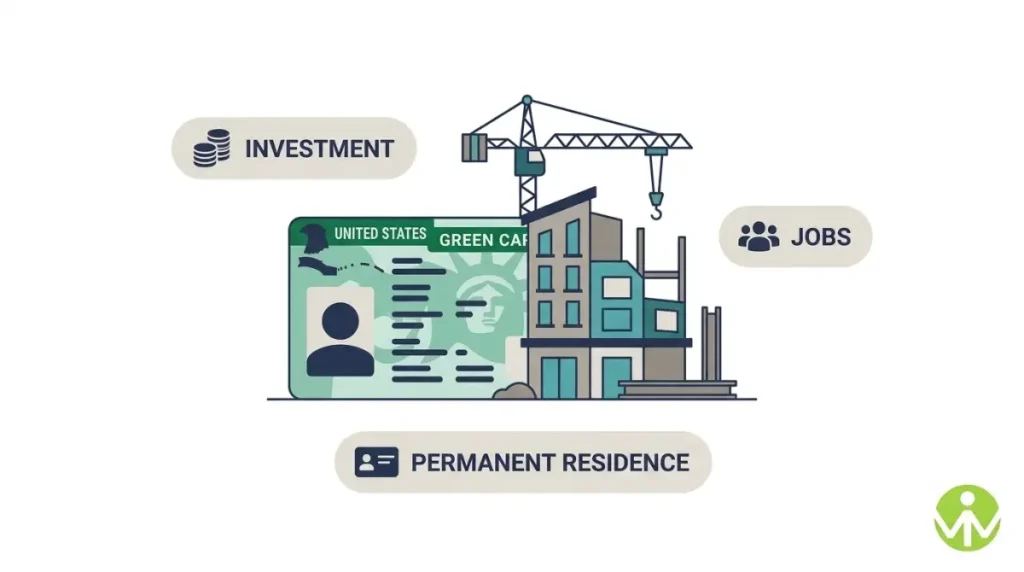
The EB-5 visa is the United States immigrant investor route. A foreign national who invests a set minimum in a new US commercial enterprise, and whose investment creates at least ten full-time jobs, can obtain a green card for themselves, their spouse and their unmarried children under 21. It is the fifth employment-based preference category, which is why it sits alongside the job-based routes in our guide to the employment-based green card, even though it involves no employer or job offer.
Key Takeaways
- The EB-5 visa grants US permanent residence to a foreign investor who puts at least $1,050,000 — or $800,000 in a targeted employment area or infrastructure project — into a new US business that creates ten full-time jobs.
- Both amounts rise for inflation on 1 January 2027. Petitions filed before then keep the current figures.
- 32% of EB-5 visa numbers are reserved for rural, high-unemployment and infrastructure projects. In September 2026 those queues were current for every country; the unreserved queue was unavailable for India and backlogged for China.
- Regional centre petitions filed on or before 30 September 2026 are protected if the Regional Center Program lapses. The programme itself is authorised until 30 September 2027.
- The first green card is conditional for two years. Form I-829 removes the conditions and brings a ten-year card.
- The EB-5 visa is not the Trump Gold Card, which is a $1 million gift processed through EB-1 and EB-2 numbers rather than an investment.
Table of Contents
What the EB-5 visa is
Congress created the investor category in 1990 and added the regional centre model in 1992. The current rules come from the EB-5 Reform and Integrity Act of 2022, which raised the investment amounts, reserved visas for rural and distressed areas, and tightened oversight of the regional centres that pool investor money. The EB-5 visa category receives 7.1% of the annual employment-based green card limit, and every visa issued to a family member counts against that total.
The EB-5 visa is not a temporary permit. The investor is a permanent resident from the day of entry, although conditionally for the first two years. For readers placing it among other US options, our overview of types of US visas sets out the full range of temporary and immigrant categories.
EB-5 visa investment amounts in 2026
The minimum investment for an EB-5 visa is $1,050,000 in most of the country. It falls to $800,000 where the project is in a targeted employment area (TEA) or is a qualifying infrastructure project. Both figures have applied to petitions filed since 15 March 2022. The older $500,000 and $1,000,000 thresholds no longer apply, and neither do the $900,000 and $1.8 million figures from a 2019 rule that a federal court vacated in 2021.
A targeted employment area is either a rural area — outside a metropolitan statistical area and outside any city or town of 20,000 or more people — or a high-unemployment area where unemployment is at least 150% of the national average. Since 2022, high-unemployment areas are designated by the Department of Homeland Security rather than by state governments, which ended the practice of stitching census tracts together to qualify city-centre projects.
| Investment route | Minimum investment | Share of annual EB-5 numbers reserved | Processing |
|---|---|---|---|
| Standard (not in a targeted employment area) | US$1,050,000 | None (unreserved) | Standard |
| Targeted employment area: rural | US$800,000 | 20% | Priority processing required by statute |
| Targeted employment area: high unemployment | US$800,000 | 10% | Standard |
| Qualifying infrastructure project | US$800,000 | 2% | Standard |
| Source: INA 203(b)(5) as amended by the EB-5 Reform and Integrity Act of 2022; USCIS Policy Manual, Volume 6, Part G. Amounts apply to petitions filed from 15 March 2022 to 31 December 2026 and adjust on 1 January 2027. | |||
The reserved 32% often matters more than the lower price. Each reserved category has its own queue, and unused reserved numbers carry forward within the reserved categories rather than returning to the general pool. That is why the reserved queues have stayed open while the unreserved one has backed up.
The EB-5 visa increase on 1 January 2027
The 2022 Act links both amounts to the Consumer Price Index for All Urban Consumers and adjusts them automatically on 1 January 2027 and every five years after that, as the USCIS Policy Manual confirms. USCIS has not yet published the new figures, which depend on inflation data that is only complete close to the date. Independent estimates put the new TEA minimum at roughly $900,000 to $940,000 and the standard minimum at roughly $1.2 million to $1.25 million, but these are projections, not official numbers.
The amount that applies is the one in force when you file the petition. An EB-5 visa petition filed on or before 31 December 2026 keeps the current figures for the life of the case.
Direct investment or a regional centre
There are two ways to structure an EB-5 visa investment. In a direct investment, the investor puts money into their own business, usually takes an active management role, and files Form I-526. Only jobs held by the business’s own employees count towards the ten.
In a regional centre investment, the investor puts money into a project sponsored by a USCIS-designated regional centre and files Form I-526E. The investor is usually a passive limited partner, and jobs created indirectly — at suppliers, at contractors and in the wider local economy — can be counted using accepted economic models. Most investors choose this route because the job test is easier to meet, but it depends on the Regional Center Program staying authorised by Congress, which is covered below.
Travel to inspect a business or project before investing is generally allowed on a B-1 business visitor visa, but directing the business once the money is in is not.
Jobs, capital at risk and the source of funds
The ten-job requirement
Each investor must create at least ten full-time positions, meaning 35 hours or more a week, for qualifying US workers. That includes US citizens, lawful permanent residents and other immigrants authorised to work, but not the investor or their family. The jobs must exist, or be shown to be on track, by the time the investor applies to remove conditions.
Capital at risk
The money must be genuinely at risk of loss. A guaranteed return, a redemption agreement or any arrangement that makes repayment certain disqualifies the investment. Capital can be cash, equipment, inventory or debt secured by the investor’s own assets, but not a loan secured by the business receiving the investment.
Lawful source of funds
Every dollar must be traced to a lawful source — salary, business profits, the sale of property, a gift or an inheritance — with documents covering the whole path from origin to the US enterprise. This is where most EB-5 visa petitions face questions, and gifted funds need the donor’s own source documented as well.
Where the EB-5 visa queues stand
Visa numbers are allocated by country of birth. When demand from one country exceeds its share, a cut-off date applies, and applicants wait until their priority date — the date the I-526 or I-526E was filed — becomes current. The State Department publishes these dates each month in the Visa Bulletin.
Table 2: EB-5 visa final action dates, September 2026 Visa Bulletin
| EB-5 category | All other countries | China (mainland born) | India | Mexico | Philippines |
|---|---|---|---|---|---|
| Unreserved | Current | 1 December 2016 | Unavailable | Current | Current |
| Reserved: rural (20%) | Current | Current | Current | Current | Current |
| Reserved: high unemployment (10%) | Current | Current | Current | Current | Current |
| Reserved: infrastructure (2%) | Current | Current | Current | Current | Current |
| Source: US Department of State Visa Bulletin for September 2026, final action dates. Unavailable means the annual limit for that category and country has been reached. Dates reset with the new fiscal year on 1 October 2026. | |||||
For most nationalities, an EB-5 visa number is available as soon as the petition is approved. For applicants born in mainland China or India, choosing a reserved or an unreserved project directly affects the wait. The same country-of-birth limits drive the far longer queues facing H-1B holders moving to a green card.
How to apply for an EB-5 visa, step by step
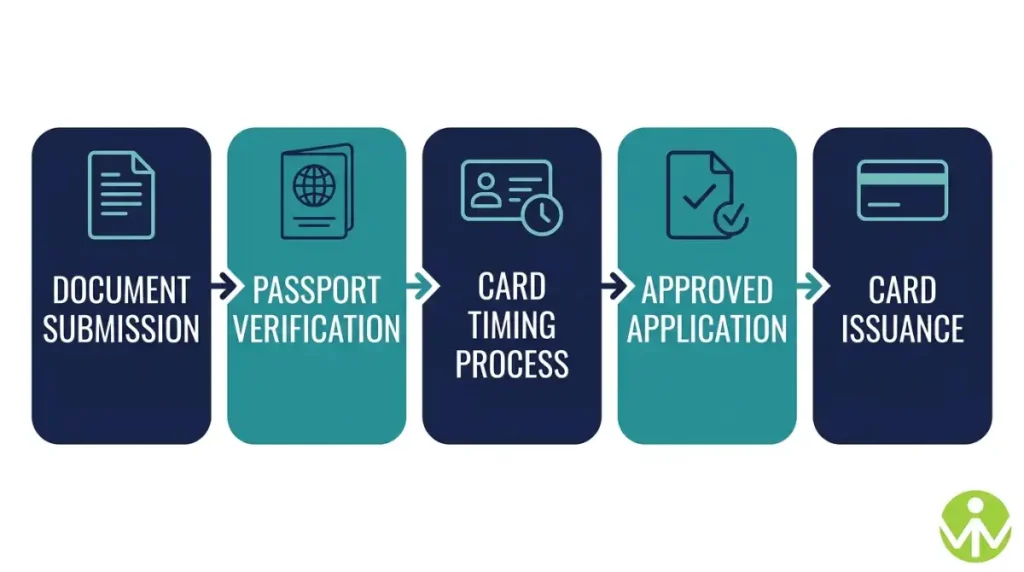
An EB-5 visa case runs in three stages, each with its own form and its own wait.
Stage 1: the investor petition
The investor makes the investment, or places it in escrow where the offering allows, and files Form I-526 (direct) or Form I-526E (regional centre) with evidence of the investment, the business plan, the job-creation case and the source of funds. Approval confirms eligibility but does not yet grant status. USCIS publishes current processing times by form, and they vary widely by route and project.
Stage 2: the immigrant visa or adjustment of status
Once the petition is approved and the priority date is current, an investor living abroad applies through the National Visa Center with Form DS-260 and attends an interview at a US embassy or consulate. An investor already lawfully in the United States files Form I-485 to adjust status instead. Regional centre investors in the United States can file the I-485 together with the I-526E when a visa is immediately available, which lets them apply for work and travel permits while the case is pending.
Stage 3: removing conditions
The first green card is conditional and valid for two years. In the 90 days before it expires, the investor files Form I-829 to show that the investment was sustained and the jobs were created. Filing extends status while the petition is pending, and approval brings a standard ten-year US green card.
EB-5 visa fees
The main government fees are $3,675 for Form I-526 or I-526E, $3,750 for Form I-829, and a $1,000 EB-5 Integrity Fund fee on each regional centre petition. These are the pre-April 2024 amounts, reinstated by a federal court in November 2025. A separate EB-5 fee rule proposed in October 2025 has not been finalised, so fees should be checked on the USCIS fee schedule before filing. Legal, accounting and regional centre administrative fees come on top.
Table 3: EB-5 visa government fees in 2026
| Form or fee | Purpose | Fee |
|---|---|---|
| Form I-526E | Regional centre investor petition | US$3,675 |
| Form I-526 | Standalone (direct) investor petition | US$3,675 |
| EB-5 Integrity Fund fee | Paid with each Form I-526E | US$1,000 |
| Form DS-260 | Immigrant visa application from abroad, per person | US$345 |
| Form I-485 | Adjustment of status inside the US, per person | US$1,440 |
| Form I-829 | Petition to remove conditions | US$3,750 |
| USCIS fees are the court-reinstated amounts in effect since November 2025 and may change if the October 2025 EB-5 fee rule is finalised. DS-260 fee from the US Department of State fee schedule. Check both before filing. | ||
Regional centre deadlines: 2026 and 2027
The Regional Center Program is not permanent law. The 2022 Act reauthorised it until 30 September 2027, and it has lapsed before: between July 2021 and March 2022 no regional centre investments could be processed. To protect investors from a repeat, the Act includes a grandfathering clause. Regional centre petitions filed on or before 30 September 2026 continue to be processed, through to the removal of conditions, even if the programme later expires.
Petitions filed after that date have no such protection. If Congress does not extend the programme before 30 September 2027, those cases could stall until it does. Direct EB-5 visa investments are not affected, because the standalone category is permanent law. As of late September 2026, no extension had been enacted.
The July 2026 proposed EB-5 visa rule
On 2 July 2026 the Department of Homeland Security published a proposed rule to write the 2022 Act into regulation. It would codify annual regional centre certification, audits and site inspections, require direct and third-party promoters to register, allow penalties and debarment for misconduct, and define a qualifying infrastructure project. It would also stop repaid bridge financing from counting towards job creation and clarify how investors keep their priority dates if a regional centre is terminated. The comment period closed on 31 August 2026, and nothing in the proposal takes effect until a final rule is published.
Is the EB-5 visa a US golden visa?
The EB-5 visa is often listed alongside European golden visas and is the closest US equivalent, but it works differently. A typical golden visa grants a renewable residence permit in return for buying property, bonds or fund units. EB-5 requires an investment in an operating business that creates jobs, and it grants permanent residence from the start. Our comparison of golden visa programmes by country covers the residence-by-investment routes elsewhere. Nor is EB-5 citizenship by investment: US citizenship comes only through naturalisation.
The Trump Gold Card
Since late 2025 the “gold card” name has belonged to a separate programme. The Trump Gold Card, created by Executive Order 14351 on 19 September 2025 and open to applications from December 2025, asks for a $1,000,000 gift to the US government, or $2 million from a corporate sponsor, plus a $15,000 processing fee. Applicants are then processed as EB-1 or EB-2 immigrants. There is no business, no job creation and no return of capital. Take-up has been slow, with one approval reported by April 2026, and the programme faces a legal challenge over whether it can be created without Congress. It did not replace the EB-5 visa.
The E-2 treaty investor visa
The E-2 treaty investor visa suits investors from treaty countries who want to run a US business without committing EB-5 sums. It is a temporary, renewable status with no direct route to a green card, and nationals of countries without a treaty, including China and India, cannot use it.
Table 4: EB-5 visa, Trump Gold Card and E-2 visa compared
After the EB-5 visa: permanent residence and citizenship
Once conditions are removed, an EB-5 investor holds the same permanent residence as any other green card holder, with the same obligation to keep the United States as their main home. Time spent as a conditional resident counts towards naturalisation, so an investor can usually apply for US citizenship five years after first becoming a resident.
Readers who have not yet settled on a route may also want to compare the EB-1A and EB-2 NIW self-petition routes, which need no investment at all but set a high bar on professional achievement.
Frequently asked questions about the EB-5 visa
How much does an EB-5 visa cost in 2026?
The minimum investment is $800,000 in a targeted employment area or infrastructure project and $1,050,000 elsewhere, plus government fees of several thousand dollars and professional fees. Both minimums increase on 1 January 2027.
Does an EB-5 visa lead directly to a green card?
Yes. The investor receives a two-year conditional green card on entry or adjustment of status, and a ten-year card once Form I-829 is approved.
Can my family be included in an EB-5 visa application?
A spouse and unmarried children under 21 are included as derivatives and do not need their own investment. Children who turn 21 during the process may be protected by the Child Status Protection Act, depending on the dates.
Do I have to live where I invest?
No. EB-5 investors can live and work anywhere in the United States, and regional centre investors normally have no role in running the business.
Will I get my EB-5 investment back?
It is not guaranteed. The capital must be at risk, and repayment depends on how the project performs and on the terms of the offering.
What happens if the Regional Center Program expires?
Regional centre petitions filed on or before 30 September 2026 remain protected by statute. Later filings depend on Congress extending the programme beyond 30 September 2027. Direct investments are unaffected.
Is the EB-5 visa the same as the Trump Gold Card?
No. The EB-5 visa is a statutory investment route with a job-creation requirement. The Gold Card is a gift-based programme created by executive order and processed through EB-1 and EB-2.