
St Kitts citizenship by investment is the oldest programme of its kind still operating: the Federation of St Kitts and Nevis has granted citizenship in return for an approved economic contribution since 1984. In 2026 the minimum is US$250,000, every main applicant is interviewed, and the programme is under closer outside scrutiny than at any point in its history.
This guide explains what St Kitts citizenship costs, who qualifies, how the application works, what the passport does and does not open, and the regulatory changes that anyone weighing the programme should understand, from a new regional regulator to a European Union deadline of 1 June 2028. It is part of our wider guide to citizenship by investment, which compares every programme open in 2026.
Key Takeaways
- St Kitts citizenship by investment starts at US$250,000, through a government contribution (SISC) or a Public Benefit Option project, for a family of up to four.
- Real estate routes start at US$325,000 in an approved development or US$600,000 for a private home, and the property cannot be resold for seven years.
- Due diligence costs US$10,000 for the main applicant and US$7,500 for each dependant aged 16 or over.
- Every main applicant is interviewed, and everyone who holds St Kitts citizenship through the programme must complete biometric enrolment by 31 July 2027.
- The passport ranks 21st with 157 visa-free or visa-on-arrival destinations (Henley Passport Index, July 2026), the strongest of the Caribbean programmes.
- The EU has asked St Kitts and Nevis and four neighbours to phase out citizenship by investment by 1 June 2028. Schengen access has not been suspended.
Table of Contents
What St Kitts citizenship by investment is
St Kitts citizenship by investment grants full citizenship, not residence, to a person who makes a qualifying investment and passes the government’s due diligence checks. It is run by the Citizenship by Investment Unit (CIU) under the Citizenship by Investment Unit Act 11 of 2024 and its regulations. St Kitts citizenship granted this way is for life, and it extends to the family members approved on the same application.
That makes it a different product from a golden visa. A golden visa gives a residence permit, and a passport follows only years later, if the holder satisfies that country’s naturalisation rules. St Kitts citizenship is granted directly, and under the current rules there is no requirement to live in the Federation before or after approval.
Five Eastern Caribbean states run programmes of this kind: Antigua and Barbuda, Dominica, Grenada, St Kitts and Nevis and St Lucia. St Kitts is the oldest and the most expensive of the five, and its passport is the strongest.
What St Kitts citizenship costs in 2026
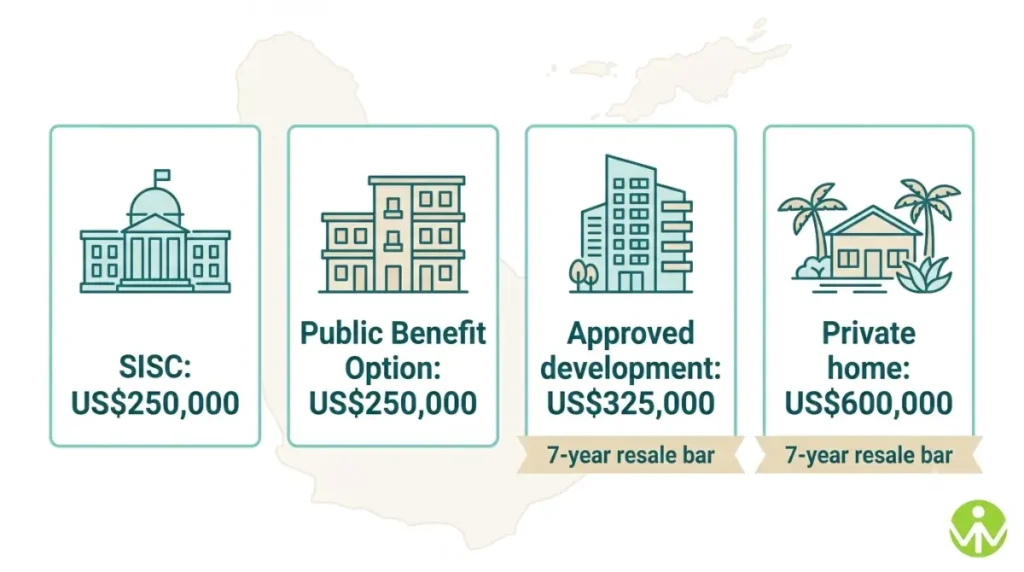
There are four ways to qualify, all set out by the Citizenship by Investment Unit. The minimums below are what a single applicant, or on the two contribution routes a family of up to four, puts into the route itself. Government fees come on top.
Table 1 – St Kitts citizenship by investment routes in 2026
| Route | Minimum investment | What the money buys | Resale |
|---|---|---|---|
| Sustainable Island State Contribution (SISC) | US$250,000 | Non-refundable contribution to the government | Not applicable |
| Public Benefit Option (PBO) | US$250,000 | A unit in a government-approved public benefit project | Not applicable |
| Real estate: approved development | US$325,000 | A share or condominium in a CIU-approved development | Barred for 7 years |
| Real estate: private home | US$600,000 | A private single-family home | Barred for 7 years |
| Source: Citizenship by Investment Unit (ciu.gov.kn), verified 24 September 2026. SISC and PBO minimums cover a main applicant or a family of up to four. Due diligence and other fees are extra. | |||
The Sustainable Island State Contribution
The Sustainable Island State Contribution (SISC) replaced the Sustainable Growth Fund, the route many older guides still describe at US$150,000. It is a non-refundable payment to the government of US$250,000 (see the conversion), and that one figure covers a main applicant alone or a family of up to four. Each additional dependant costs US$25,000 if under 18 and US$50,000 if 18 or over.
For a family of four or fewer, the SISC is usually the lowest-cost route to St Kitts citizenship, because the CIU lists no post-approval application fees for it beyond due diligence.
The Public Benefit Option
The Public Benefit Option (PBO) also starts at US$250,000 for a family of up to four, but the money buys a unit in a government-approved project rather than going straight to the state. The CIU lists six current projects, covering affordable and national housing, educational infrastructure, cultural facilities, resort hospitality and international marketing.
The CIU’s PBO page also lists post-approval fees of US$15,000 for a spouse, US$10,000 for each dependant under 18 and US$15,000 for each dependant aged 18 or over. Some industry reports say these per-member fees were removed from 1 August 2026, so that a couple or a family of four pays US$250,000 in total. The CIU had not published that change on its own site at the time of writing, so confirm the current schedule with an Authorised Agent before relying on either figure.
Real estate: approved developments and private homes
The real estate routes cost more, but the asset can eventually be sold. The minimum is US$325,000 (see the conversion) for a share or condominium in a CIU-approved development, or US$600,000 (see the conversion) for a private single-family home. Either way, the property cannot be resold under the programme for seven years, and buyers also pay purchase costs such as conveyance fees, stamp duty and legal fees.
The two older real estate tiers, US$200,000 held for seven years and US$400,000 held for five, no longer exist.
Due diligence and post-approval fees for St Kitts citizenship
Every route carries a due diligence fee for the main applicant and for each dependant aged 16 or over. The real estate routes, and on the CIU’s published schedule, the PBO, add post-approval application fees once an application is approved in principle.
Table 2 – St Kitts citizenship by investment fees
As a worked example, a married couple with two children under 16 applying through the SISC would pay US$250,000 plus US$17,500 in due diligence fees, a total of US$267,500 before agent fees.
Who qualifies for St Kitts citizenship
The main applicant must be at least 18, must make one of the qualifying investments and must pass the CIU’s due diligence checks. There are no education, language or business-experience requirements. Supporting documents include a valid passport, a birth certificate, police clearance certificates, proof of address, a medical certificate and evidence that the money being invested was lawfully obtained.
Due diligence is where St Kitts citizenship applications fail. Undisclosed criminal history, wealth that cannot be traced to a lawful source, or a refusal by another citizenship programme can each lead to a denial, and the new regional regulator’s register of applicants is intended to make a refusal in one Caribbean programme visible to the others.
Family members you can include
A single application can include a spouse, children under 30 who are financially dependent on the main applicant, and parents or grandparents aged 55 or over. Dependants aged 16 or over go through due diligence in their own right and can be called for interview.
How to apply for St Kitts citizenship, step by step
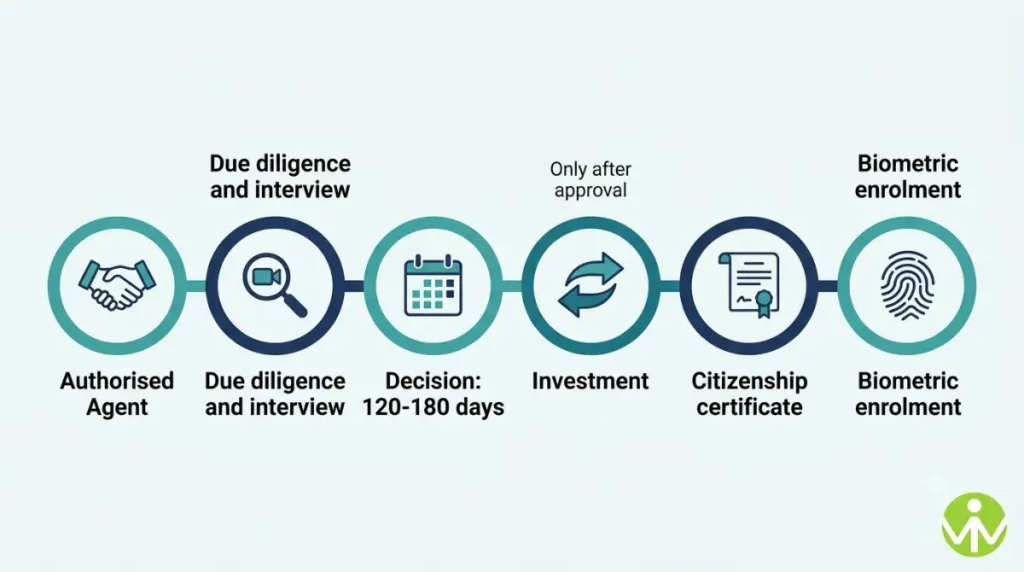
You cannot apply directly to the CIU. They must be filed through an Authorised Agent on the government’s official list, and the CIU’s application process runs in this order:
- Choose an Authorised Agent from the CIU’s published list.
- Complete the application forms and gather supporting documents through the agent.
- The CIU carries out due diligence and holds the interview.
- The CIU issues approval in principle, a denial, or notice that processing is delayed for cause.
- After approval in principle, make the investment and pay any post-approval fees.
- Receive the citizenship certificate, then apply for a passport and complete biometric enrolment.
The order matters. Make the investment after approval in principle, not before, so an applicant who is refused has not committed the main sum.
The mandatory interview and biometric enrolment
Every main applicant is interviewed, either by CIU officials or by an independent professional firm commissioned by the CIU. Interviews take place virtually, in person in St Kitts and Nevis, or at another location approved by the CIU Board. Dependants aged 16 or over can also be interviewed if the CIU considers it necessary.
Since 14 April 2026, everyone who holds St Kitts citizenship through the programme, including dependants and children, must enrol in the National Biometric Enrolment and Passport Modernisation Programme. The deadline for existing citizens is 31 July 2027, and new applicants should plan for biometric capture as part of receiving a passport.
How long St Kitts citizenship takes
The CIU aims to tell applicants within 120 to 180 days of acknowledging an application whether it has been approved in principle, denied or delayed for cause. That is a decision date, not a passport date. The investment, post-approval payments, certificate and passport all follow it, so four to six months is a sensible working estimate for the whole process, and longer where due diligence raises questions.
The 60-day accelerated process that older guides describe, with fees of US$25,000 per main applicant, does not appear on any current CIU page. Anyone offered a guaranteed fast track to St Kitts citizenship should ask the agent to show where the CIU authorises it.
What a St Kitts passport gets you
St Kitts citizenship brings the strongest passport among the Caribbean programmes. In the July 2026 edition of the Henley Passport Index it ranked 21st, with visa-free or visa-on-arrival access to 157 destinations, including the Schengen Area. Our guide to passport rankings explains how the index is compiled.
Table 3 – Caribbean citizenship by investment passports compared
| Programme | Minimum investment | Henley rank | Visa-free destinations |
|---|---|---|---|
| St Kitts and Nevis | US$250,000 | 21st | 157 |
| Antigua and Barbuda | US$230,000 | 24th | 154 |
| Grenada | US$235,000 | 27th | 148 |
| Dominica | US$200,000 | 30th | 144 |
| St Lucia | US$240,000 | 31st | 143 |
| Source: Henley Passport Index, July 2026 edition, verified 19 September 2026. Minimums exclude fees; St Kitts and Grenada verified with the national units, others as published on our citizenship by investment guide. | |||
Two limits are worth knowing before applying. First, St Kitts and Nevis citizens need a visa for the United States, and Canada has required visas since November 2014, citing concerns about passport issuance under the citizenship by investment programme. Since June 2023, citizens who have held a Canadian visa in the past ten years, or who hold a current US non-immigrant visa, can apply for an electronic travel authorisation instead.
Second, St Kitts and Nevis has no investor treaty with the United States, so St Kitts citizenship does not open the E-2 visa. Of the five Caribbean programmes only Grenada has one, and even there US law requires three years’ domicile in Grenada before a citizen by investment can use it.
St Kitts citizenship and the regulatory picture in 2026
St Kitts citizenship by investment now operates under outside pressures that did not exist when most published guides were written. None have closed the programme, and applications continue to be accepted, but each could change what the passport is worth.
ECCIRA, the new regional regulator
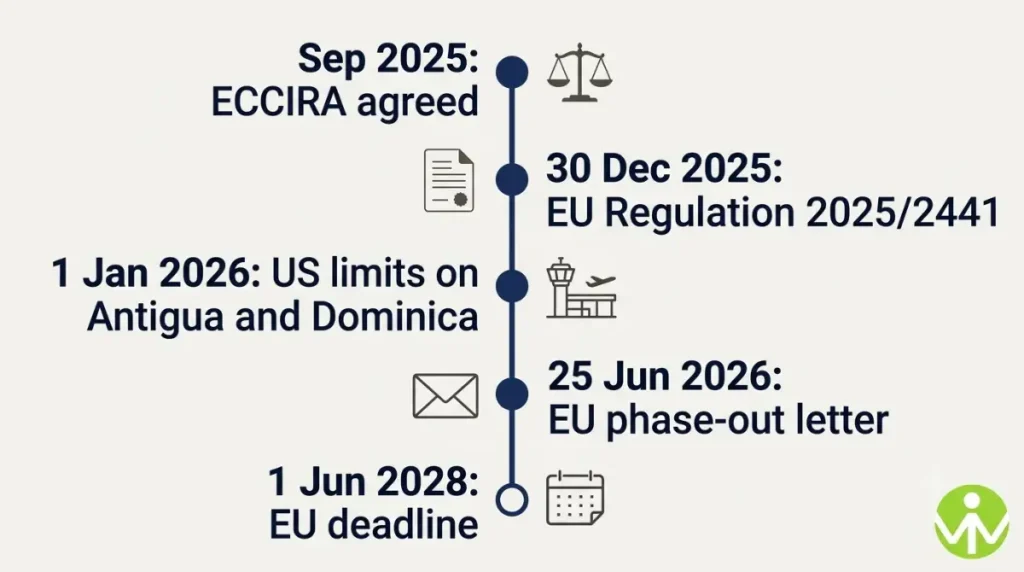
In September 2025 the five Eastern Caribbean programmes agreed to create the Eastern Caribbean Citizenship by Investment Regulatory Authority (ECCIRA), headquartered in Grenada. It is designed to keep regional registers of applicants, licensed agents and developers, to set common standards including interviews and biometrics, and to fine or revoke licences. The five programmes remain separate, and ECCIRA does not create a single Caribbean citizenship. In July 2026 the Eastern Caribbean Central Bank’s Monetary Council said the authority “remains on track for launch in September 2026”.
The EU’s June 2028 deadline
The larger risk is European. Regulation (EU) 2025/2441, in force since 30 December 2025, allows the EU to suspend visa-free access for a country that operates an investor citizenship scheme, without having to show any other problem. In a letter dated 25 June 2026, European Commissioner Magnus Brunner asked St Kitts and Nevis and the four other programmes to phase out citizenship by investment by 1 June 2028.
The five heads of government responded jointly in Roseau on 10 July 2026, proposing a high-level mission to Brussels and asking that any transition come with a framework to replace the revenue. Prime Minister Terrance Drew said the Federation wanted “to engage very positively with the European Union on the matter of the CBI programme”. Schengen access for holders of St Kitts citizenship has not been suspended. The outcome is not yet known, and visa-free travel to Europe is the benefit most exposed if the programme continues past the deadline and the EU acts.
The closest precedent is Malta, whose citizenship route closed after the EU’s highest court ruled against it in April 2025. Brussels cannot act on Caribbean states in the same way, but visa-free access is the lever it holds.
US restrictions on two neighbouring programmes
A US presidential proclamation of 16 December 2025, effective 1 January 2026, partially suspended entry for nationals of Antigua and Barbuda and Dominica, covering immigrants and B, F, M and J visa holders, and cited citizenship by investment without residency as the reason. St Kitts and Nevis was named in an earlier leaked State Department memo but was not included in the proclamation.
The planned genuine-link reforms
In January 2026 the government announced an overhaul intended to replace passive contributions with a “genuine link”, including structured physical presence in the Federation and more active economic participation. As of September 2026, no minimum stay, start date or implementing regulation had been published, and the CIU’s guidance still says St Kitts citizenship carries no residence requirement. Applications filed now are processed under the current rules, but the direction of travel is towards more time in the country, not less.
Keeping St Kitts citizenship: dual nationality, residence and resale
St Kitts and Nevis permits dual citizenship, so applicants do not have to give up their existing nationality under St Kitts law. Whether their current country allows it is a separate question, and our guide to dual citizenship covers how that works for one of the largest groups of applicants. Under the current rules there is no requirement to live in St Kitts to keep citizenship, although citizens have the right to live there.
Real estate bought under the programme cannot be resold within seven years. A property sold before then cannot be used for a later application unless the Federal Cabinet is satisfied that substantial further investment, such as construction or renovation, has been put into it.
St Kitts citizenship: frequently asked questions
How much does St Kitts citizenship cost in 2026?
The minimum is US$250,000 through the Sustainable Island State Contribution or the Public Benefit Option, for a family of up to four, plus due diligence fees of US$10,000 for the main applicant and US$7,500 for each dependant aged 16 or over. Real estate routes start at US$325,000.
Do I need to live in St Kitts to get citizenship?
No. Under the current rules there is no residence requirement before or after approval, although the interview can be held in person in St Kitts. The government has announced a reform that would add a physical presence requirement, but no details or start date had been published by September 2026.
How long does St Kitts citizenship by investment take?
The CIU aims to issue a decision within 120 to 180 days of acknowledging an application. Allow four to six months for the full process, including the investment, the certificate and the passport.
Is there still a fast-track option?
No current CIU page lists one. The 60-day Accelerated Application Process described in older guides should not be assumed to be available.
Can I travel to Europe visa-free with a St Kitts passport?
Yes, as of September 2026. The EU has asked St Kitts and Nevis to phase out its programme by 1 June 2028 and has the legal power to suspend visa-free access if it does not, so this could change.
Does St Kitts citizenship give access to the US E-2 visa?
No. St Kitts and Nevis has no E-2 treaty with the United States. Among the Caribbean programmes, only Grenada has one.
Can my parents be included on my application?
Yes. You can include parents and grandparents aged 55 or over as dependants, as well as a spouse and financially dependent children under 30. Beyond a family of four, each additional dependant adds US$25,000 if under 18 or US$50,000 if 18 or over on the SISC route.