
The TN visa is a US work classification open only to citizens of Canada and Mexico who will work in a profession named in the United States-Mexico-Canada Agreement (USMCA). It has no annual cap, no lottery, and no labour certification, making it one of the quickest routes to US employment for those who qualify. It is also narrower than it looks: the job has to fit a fixed list, and the holder must intend to stay only temporarily.
This guide explains who qualifies, what the professions list covers, how Canadians and Mexicans apply, what it costs in 2026 and how the USMCA review affects it. For the wider picture, see our guide to the types of US visas.
Key Takeaways
- The TN visa lets citizens of Canada and Mexico work in the United States in one of more than 60 professions listed in the USMCA.
- There is no annual cap and no lottery, but the job must genuinely match a listed profession.
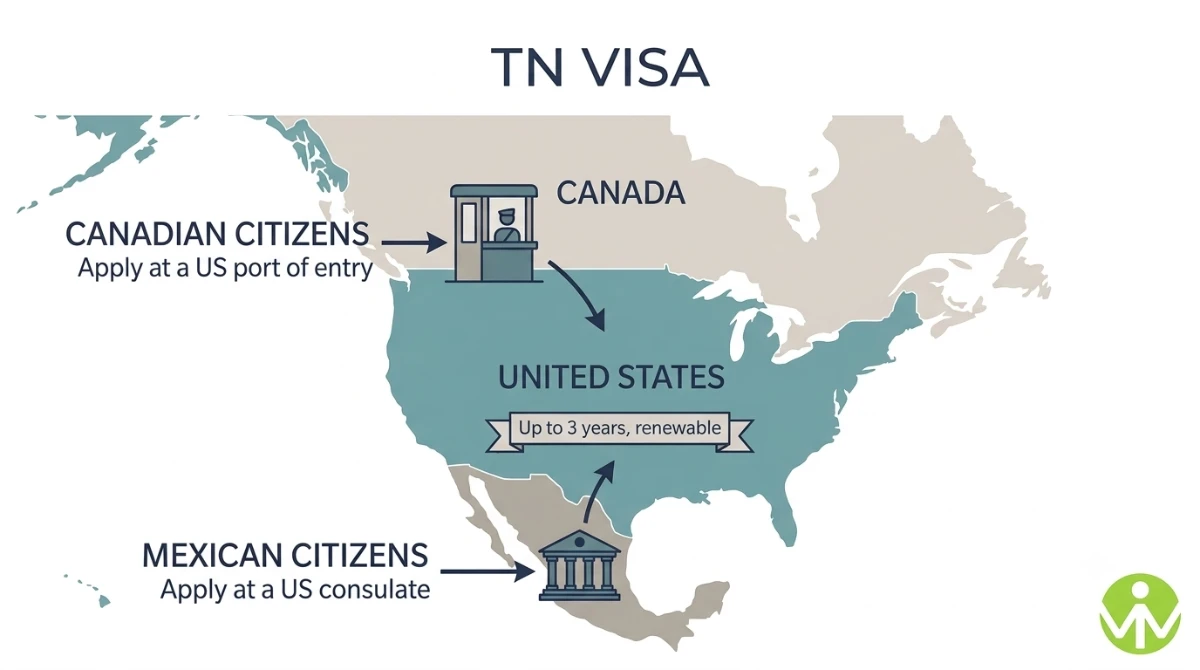
- Canadians usually apply at a US port of entry without a visa; Mexicans must get a TN visa at a US consulate.
- Each grant lasts up to three years and can be renewed with no lifetime limit.
- TN requires temporary intent, which makes planning a green card more delicate than on an H-1B.
- The US did not renew the USMCA at its July 2026 joint review, but the agreement remains in force and TN rules have not changed.
Table of Contents
What is a TN visa?
The TN classification was created by the North American Free Trade Agreement (NAFTA) in 1994. On 1 July 2020 the USMCA replaced NAFTA. Canada calls the same agreement CUSMA and Mexico calls it T-MEC. As the USCIS Policy Manual notes, the new agreement kept every substantive immigration provision and an identical list of professions, so the United States still uses the TN designation and some government pages still refer to NAFTA.
Canadian citizens receive TN-1 status and Mexican citizens receive TN-2 status. Strictly, Canadians do not need a TN visa: they are granted TN status when they are admitted. Mexicans need a TN visa in their passport before they travel. In everyday use, “TN visa” covers both.
TN is not a business visitor classification. Attending meetings or negotiating contracts falls under the B-1 visa. TN is for prearranged professional work for a US employer or client.
TN visa vs H-1B: the differences that matter
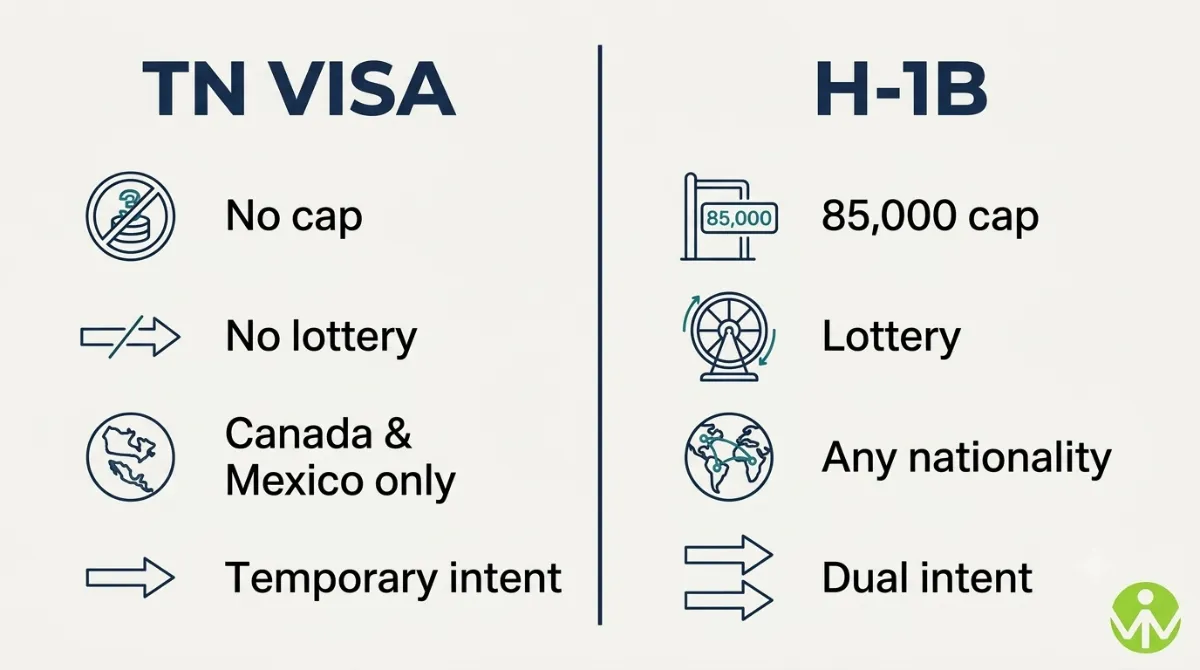
The TN visa is often described as a Canadian or Mexican version of the H-1B. The two share a three-year initial period and a professional-level job requirement, but they differ on almost everything else.
| Feature | TN visa | H-1B |
|---|---|---|
| Who can apply | Citizens of Canada and Mexico only | Any nationality |
| Annual cap | None | 85,000 for cap-subject employers |
| Lottery | No | Yes, for cap-subject registrations |
| Type of job | A profession on the USMCA list | A specialty occupation |
| Labour condition application | Not required | Required |
| Initial period | Up to 3 years | Up to 3 years |
| Maximum stay | No cumulative limit | 6 years, with limited exceptions |
| Dual intent | No, temporary intent required | Yes |
| Dependants | TD: may study, may not work | H-4: may study, work only with an H-4 EAD |
| How to apply | Canadians at the border or via Form I-129; Mexicans at a consulate | Employer petition on Form I-129 |
| Sources: 8 CFR 214.6, USCIS Policy Manual Volume 2 Part P, and USCIS H-1B guidance, checked 15 September 2026. | ||
In practice, a Canadian or Mexican professional whose job fits the list rarely needs the H-1B visa. TN avoids the H-1B lottery, the labour condition application and the higher petition costs, including the $100,000 H-1B payment, whose implementing guidance a federal court has vacated. The trade-off is intent. An H-1B holder can pursue a green card openly, while a TN worker must be able to show that the stay is temporary. Our guide to H-1B visa alternatives compares TN with the O-1, E-3, H-1B1 and L-1.
Who is eligible for a TN visa?
USCIS sets out five conditions. To qualify, you must:
- be a citizen of Canada or Mexico, since permanent residents of either country do not qualify;
- work in a profession listed in the USMCA;
- fill a position that actually requires that profession;
- hold the qualifications the list specifies for that profession; and
- have a prearranged full-time or part-time job with a US employer or entity.
Self-employment is excluded. You cannot use TN status to work for a US company you own or substantially control. A contract with a US client can qualify, provided the client is a separate enterprise and the arrangement is formal and agreed in advance.
Where the list requires a bachelor’s degree or a Mexican licenciatura, experience cannot replace it. Some professions accept an alternative, such as a post-secondary diploma plus three years’ experience. Degrees from outside the United States, Canada or Mexico need a credential evaluation, and experience is normally shown through letters from former employers. Licensed professions must also meet the licensing rules of the US state where the work takes place.
The USMCA professions list for a TN visa
The list sits in Appendix 2 to Chapter 16 of the USMCA and is reproduced in 8 CFR 214.6. It contains more than 60 professions, each with its own minimum credential. The table shows some of the most commonly used categories.
| Profession | Minimum credential |
|---|---|
| Accountant | Bachelor’s or licenciatura degree; or CPA, CA, CGA or CMA |
| Computer systems analyst | Bachelor’s or licenciatura degree; or post-secondary diploma or certificate plus 3 years’ experience |
| Economist | Bachelor’s or licenciatura degree |
| Engineer | Bachelor’s or licenciatura degree; or state or provincial licence |
| Graphic designer | Bachelor’s or licenciatura degree; or post-secondary diploma or certificate plus 3 years’ experience |
| Hotel manager | Bachelor’s or licenciatura degree in hotel or restaurant management; or post-secondary diploma or certificate in that field plus 3 years’ experience |
| Lawyer (including Quebec notary) | LL.B., J.D., LL.L., B.C.L. or licenciatura degree (5 years); or membership of a state or provincial bar |
| Management consultant | Bachelor’s or licenciatura degree; or 5 years’ experience as a management consultant or in a related field |
| Mathematician (including statistician and actuary) | Bachelor’s or licenciatura degree |
| Physician (teaching or research only) | M.D. or equivalent; or state or provincial licence |
| Registered nurse | State or provincial licence; or licenciatura degree |
| Scientific technician or technologist | Theoretical knowledge of a listed science and the ability to solve practical problems in it |
| Scientist (for example biologist, chemist, physicist) | Bachelor’s or licenciatura degree |
| University, college or seminary teacher | Bachelor’s or licenciatura degree |
| Selected professions only; the full list has more than 60. Source: 8 CFR 214.6(c) and USMCA Chapter 16, Appendix 2, checked 15 September 2026. | |
The job title does not decide eligibility; the primary duties do. USCIS guidance published on 4 June 2025 draws several lines that refusals often turn on:
- A computer systems analyst designs and implements computer-based systems. The category does not include programmers.
- An engineer needs a degree in the related engineering field, and cannot fill computer-related jobs without full engineering credentials.
- An economist does not include roles that are mainly financial analysis, market research or marketing.
- A scientific technician or technologist must work in direct support of a supervising professional in a listed science, not in support of physicians providing patient care.
- A physician may teach or research only. Direct patient care is not allowed unless it is incidental.
How to apply for a TN visa as a Canadian citizen
Canadian citizens do not need to visit a consulate. Two routes lead to TN status.
Applying at a port of entry
Most Canadians apply directly to US Customs and Border Protection (CBP) at a Class A land port of entry, at a US airport handling international flights, or at a pre-clearance station in Canada. The officer decides at the counter. Bring:
- proof of Canadian citizenship, normally a passport;
- a letter from the US employer describing the professional role, its purpose, the expected length of stay and the qualifications it requires;
- degree certificates, licences and, where needed, a credential evaluation; and
- payment for the CBP application fee and, at a land crossing, the Form I-94 fee.
If the officer is satisfied, you are admitted in TN status for up to three years and receive an electronic I-94 record. If not, the officer can refuse you on the spot, so the employer letter should closely match the wording of the professions list.
Filing Form I-129 with USCIS first
Alternatively, a US employer can file Form I-129 with USCIS before you travel. Once it is approved, you show the approval notice and proof of citizenship at the border. This costs more and takes longer, but it settles eligibility before you resign from a job or move house. Premium processing is available.
How to apply for a TN visa as a Mexican citizen
Mexican citizens must obtain a TN visa from a US embassy or consulate before travelling. You don’t need a USCIS petition for a first application. The process, as set out by the US Department of State, runs as follows:
- Complete the online DS-160 nonimmigrant visa application and keep the confirmation page.
- Pay the $185 application fee and book an interview.
- Attend the interview with a passport valid for at least six months beyond your stay, the employer letter or contract, and proof of your qualifications.
- Once the TN visa is issued, present it at a US port of entry, where CBP decides the admission period.
Since 1 October 2025, almost all visa applicants must attend an in-person interview, including children under 14 and adults over 79. The US visa interview waiver that survives covers only a narrow set of visitor and agricultural visas, so Mexican TN renewals are interviewed too. The Department of State also now expects applicants to apply in their country of nationality or residence, which for most TN-2 applicants means Mexico.
TN visa fees in 2026
What a TN visa costs depends on your citizenship and the route you take. The figures below are official government fees; legal and credential evaluation costs are extra.
| Fee | Amount (USD) | Who pays and when |
|---|---|---|
| CBP TN application fee | $50 | Canadians applying at a port of entry |
| Form I-94, land border | $30 ($6 + $24) | Land arrivals only; no I-94 fee at air or sea ports |
| Visa application (MRV) fee, TN/TD | $185 | Mexican citizens applying at a consulate |
| Visa issuance (reciprocity) fee | Varies by nationality | Where applicable, on visa issuance |
| Form I-129, TN, paper filing | $1,015 ($510 small employer or non-profit) | Employer: initial petition, extension or change of employer |
| Form I-129, TN, online filing | $965 ($510 small employer or non-profit) | Employer filing online |
| Asylum Program Fee | $600 ($300 small employer; $0 non-profit) | Employer, with every Form I-129 |
| Premium processing (Form I-907) | $2,965 | Optional: decision within 15 business days |
| Fees as published by USCIS (Form G-1055, edition 09/09/26), the US Department of State and CBP, checked 15 September 2026. | ||
For a Canadian applying at the border, the government cost is the $50 CBP fee (USD 50 in CAD) plus $30 for a land-border I-94 (USD 30 in CAD). Travellers arriving by air pay no I-94 fee, according to the Federal Register notice setting the fee. A Mexican applicant pays the $185 visa application fee (USD 185 in MXN) plus any reciprocity fee listed by the Department of State.
An employer filing Form I-129 on paper pays $1,015 (USD 1,015 in CAD) plus the $600 Asylum Program Fee (USD 600 in CAD), with reduced rates for small employers and non-profits, according to the USCIS fee schedule. Premium processing adds $2,965 (USD 2,965 in CAD) for a decision within 15 business days.
A $250 visa integrity fee was written into US law in 2025 for most nonimmigrant visa issuances. The Department of State’s fee page does not list it and collection has been uneven, so Mexican applicants should check with their consulate before budgeting for it.
How long TN visa status lasts, and extensions
Each grant of TN status runs for up to three years. There is no cumulative limit, so a TN worker can keep extending as long as the job remains a qualifying professional role and the stay remains temporary.
There are two ways to extend. Your employer can file Form I-129 with USCIS before your current status expires. Or you can leave the United States and apply for readmission: Canadians at the border, and Mexicans with a new TN visa if theirs has expired.
Changing or adding employers
TN status is tied to a specific employer. To change jobs or add a second employer, the new employer files Form I-129, and you may not start work for it until USCIS approves the petition. Canadians can instead apply at the border with the new employer’s letter, and Mexicans can obtain a new TN visa. A transfer to another office of the same employer, doing the same work, needs no new filing, but a move to a separately incorporated subsidiary does.
TD status for spouses and children
A TN worker’s spouse and unmarried children under 21 can accompany them in TD status for the same period. They do not need to be Canadian or Mexican, although family members who are not Canadian need a TD visa. TD dependants may study full-time but cannot work. A spouse who wants to work needs a status of their own.
The TN visa and the green card: the intent problem
The TN visa is not a dual intent classification. The USMCA defines temporary entry as entry without the intent to establish permanent residence, and USCIS expects a TN assignment to end at a predictable time.
This does not stop a TN worker from ever getting a green card, but it shapes the timing. Unlike the H-1B and L-1, which are dual intent by statute, and the O-1, which has a regulatory safeguard, the TN rules contain no express protection for someone with an approved labour certification or immigrant petition. Officers can treat that filing as evidence of immigrant intent at the border, at a consulate or on an extension. Many TN professionals therefore time the immigrant filing carefully, or move to a dual intent status first. Our guides to the O-1 visa to green card route and the H-1B to green card process explain how those paths compare.
What the 2026 USMCA review means for the TN visa
The USMCA required its three countries to hold a joint review on its sixth anniversary, 1 July 2026. That day the US Trade Representative said the United States had not agreed to renew the agreement in its current form. The USMCA stays in force. Under its review clause, the parties now hold annual joint reviews, and if they never confirm an extension, the agreement expires on 1 July 2036.
For TN visa holders, nothing has changed yet. No change has been announced to the professions list, the application process or extensions. The longer-term question is what happens if the agreement is replaced or ends, because the TN classification in US law is tied to it. Any change would require action by Congress and the executive branch, and none is underway. Anyone planning a long stay in TN status should follow the annual reviews.
Frequently asked questions about the TN visa
Can permanent residents of Canada or Mexico get a TN visa?
No. Only citizens qualify. A permanent resident of Canada or Mexico who holds another citizenship would need a different route, such as the H-1B or O-1.
Is there a cap on TN visas?
No. There is no annual limit for Canadians or Mexicans, and no lottery. The numerical limit that once applied to Mexican professionals ended in 2004.
Can I work for two employers on a TN visa?
Yes, but each employer needs its own approval, either through a separate Form I-129 or, for Canadians, a separate application at the border. You may only work for employers that have been approved.
Can a TN visa holder be self-employed or freelance?
No. You cannot work for a business you own or control. You can work under contract for a separate US client, provided the engagement is formal and prearranged.
How long does a TN visa application take?
A Canadian applying at the border normally gets a decision the same day. A Mexican applicant’s timeline depends on interview waits at their consulate. A Form I-129 filed with USCIS takes months on the regular track, or 15 business days with premium processing.
Can my spouse work on a TD visa?
No. TD spouses and children may study but may not work. A spouse who wants to work needs separate authorisation, for example a TN visa of their own if they are a Canadian or Mexican citizen in a listed profession.