
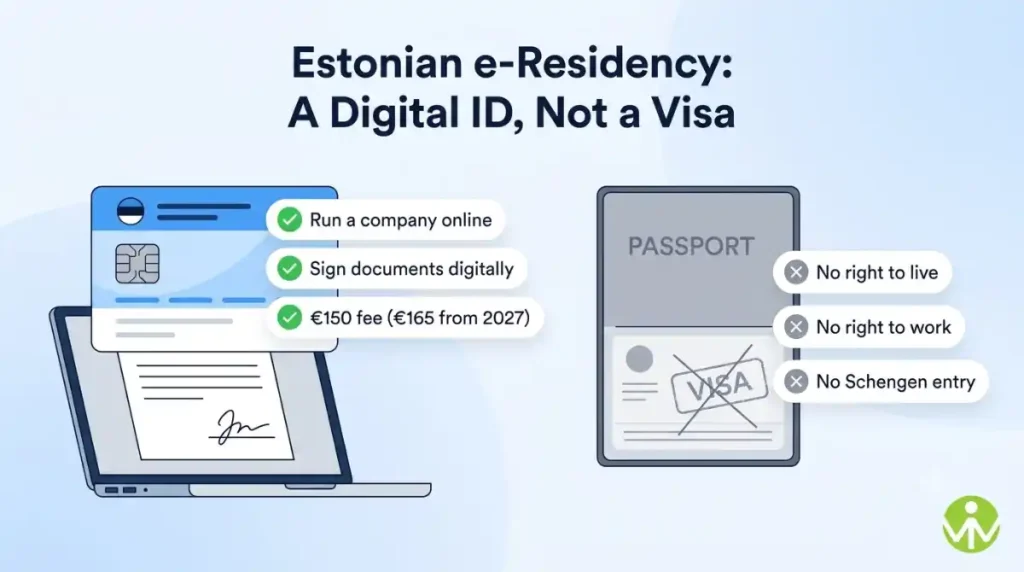
Estonian e-Residency is a government-issued digital identity that lets people worldwide start and run an Estonian company online, sign documents digitally, and use Estonia’s public e-services. It is not a visa. It gives no right to live in, enter or work in Estonia or anywhere else in the EU, and it does not lead to residence or citizenship.
Estonia launched the programme in 2014. This guide explains what Estonian e-Residency does and does not do, who can apply, what it costs as of October 2026, including the fee rise on 1 January 2027, and how the application works. Figures come from the Police and Border Guard Board (PBGB), which issues the digital ID, and the official e-Residency programme. For routes that do let you live in Estonia, see our guide to the types of Estonia visas.
Key Takeaways
- Estonian e-Residency is a digital ID for running an Estonian company and signing documents online. It is not a visa or a residence permit.
- The state fee is €150, rising to a flat €165 from 1 January 2027. It is not refunded if the application is refused.
- The PBGB decides within 30 days, and the card then takes 2 to 5 weeks to reach the pickup location you chose.
- The digital ID is valid for five years, with no annual fee. Renewal costs the same as a first application.
- Since 1 October 2025, applications from citizens of 12 countries, including Russia, Belarus, Iran and Nigeria, are reviewed only in narrow circumstances.
- Living or working in Estonia needs a D visa or a residence permit, and e-Residency does not make either easier to get.
Table of Contents
What is Estonian e-Residency?
In legal terms, an e-resident is a foreign national to whom Estonia has issued a digital identity based on the identity from their own country of nationality. The Police and Border Guard Board describes the e-resident’s digital ID as a document that can only be used to identify the holder and to give a digital signature online.
In practice, Estonian e-Residency is a smart card with a chip, PIN codes and the free DigiDoc software. With it, an e-resident can log in to Estonian state and private e-services, sign documents with a signature recognised across the EU, register and manage an Estonian company from abroad, and file that company’s tax returns online. Most e-residents use it to run a private limited company, which Estonia calls an osaühing, or OÜ for short.
What Estonian e-Residency does not give you
The most common misunderstanding is that Estonian e-Residency is a kind of visa, or a first step towards living in Estonia. The PBGB states plainly that the digital ID does not grant the right to reside in Estonia, and several other limits follow from that.
No right to live, travel or work
An e-resident has no extra right to enter Estonia or the Schengen area. Travellers follow the ordinary Schengen rules, visa-free or with a Schengen visa, for up to 90 days in any 180, as our Schengen visa guide explains. Anyone who wants to live or work in Estonia needs a long-stay D visa or a temporary residence permit, and holding Estonian e-Residency does not make those applications easier. Time as an e-resident does not count towards permanent residence or citizenship.
No change to tax residency
Holding Estonian e-Residency does not make anyone an Estonian tax resident. Personal tax residency depends on where a person actually lives, and a company run from another country may owe tax there as well as in Estonia, depending on where it is managed. Anyone planning a company should take tax advice in their own country before registering it.
Table 1 compares Estonian e-Residency with the routes that do allow a stay in Estonia.
Table 1: Estonian e-Residency compared with Estonian visas and residence permits
| Feature | Estonian e-Residency | D visa or residence permit |
|---|---|---|
| What it is | Digital ID for e-services and digital signatures | Permission to stay in Estonia |
| Right to live in Estonia | No | Yes, for the period granted |
| Right to enter Estonia or Schengen | No; normal Schengen rules apply | Yes, within the visa or permit terms |
| Right to work in Estonia | No | Depends on the visa or permit |
| Run an Estonian company remotely | Yes | Yes |
| Counts towards permanent residence | No | Residence permits yes; D visas no |
| State fee | €150 (€165 from 1 January 2027) | €120 (D visa); €225 to €380 (permits) |
| Validity | 5 years | D visa up to 365 days; permits up to 5 years |
| Sources: Police and Border Guard Board e-resident’s digital ID pages and state-fee table; e-Residency programme; Estonian Ministry of Foreign Affairs. Checked October 2026. | ||
Who can apply for Estonian e-Residency?
The programme is open to foreign nationals who have a justified interest in using Estonia’s e-services. Applicants cannot already hold an Estonian residence permit, a right of residence or an Estonian identity card, and Estonian citizens are not eligible because they can get an Estonian ID card instead. Every applicant explains their reason for applying, such as starting a company, and the PBGB runs a background check on everyone.
Citizenship-based restrictions
Since 1 October 2025, the PBGB does not review applications from citizens of some countries unless an exception applies. For citizens of Afghanistan, Burkina Faso, the Democratic Republic of the Congo, Iran, Mali, Nigeria, North Korea, South Sudan, Syria and Yemen, an application is considered only if the applicant meets one of four conditions: three consecutive years of residence in the EEA, the UK or Switzerland with a valid residence permit there; an active, tax-paying Estonian company; a previous e-Residency card that was genuinely used; or work for an Estonian embassy, an honorary consul or Enterprise Estonia.
Rules for citizens of Russia and Belarus are stricter. They must meet two conditions at once: they must have held an e-Residency card before, and they must have permanent economic activity in Estonia. The PBGB’s restrictions page lists the evidence it expects.
Estonian e-Residency fees
The state fee for an Estonian e-Residency application is €150, paid by Visa or Mastercard when the application is submitted. According to the e-Residency programme, it becomes a flat €165 on 1 January 2027, for first applications and renewals alike and whether the card is issued in Estonia or at an embassy. The PBGB does not refund the fee if it declines to issue the digital ID.
There is no annual fee for holding the digital ID. The card is valid for five years, and renewing or replacing it costs the same state fee. Most of the real cost comes from running a company, which Table 2 sets out using the programme’s own cost overview.
Table 2: Estonian e-Residency and company costs
| Item | Amount | Notes |
|---|---|---|
| e-Residency application (until 31 December 2026) | €150 | State fee; not refunded if refused |
| e-Residency application (from 1 January 2027) | €165 | Flat fee, in Estonia or at an embassy |
| Renewal or replacement card | Same as application fee | Card valid for 5 years |
| Annual fee for holding e-Residency | None | No maintenance charge |
| Register a private limited company (OÜ) online | €265 | State fee to the e-Business Register |
| Contact person in Estonia | €200 to €400 a year | Charged by service providers |
| Accounting | From €50 a month | Charged by service providers |
| Sources: Police and Border Guard Board state fee page; e-Residency programme fee change notice and cost overview. Checked October 2026. Service-provider prices vary. | ||
Registering an OÜ online costs €265 in state fees. Companies managed outside Estonia also need a contact person in Estonia, which service providers charge for, and most e-residents pay an accountant for annual reports and tax returns.
How to apply for Estonian e-Residency
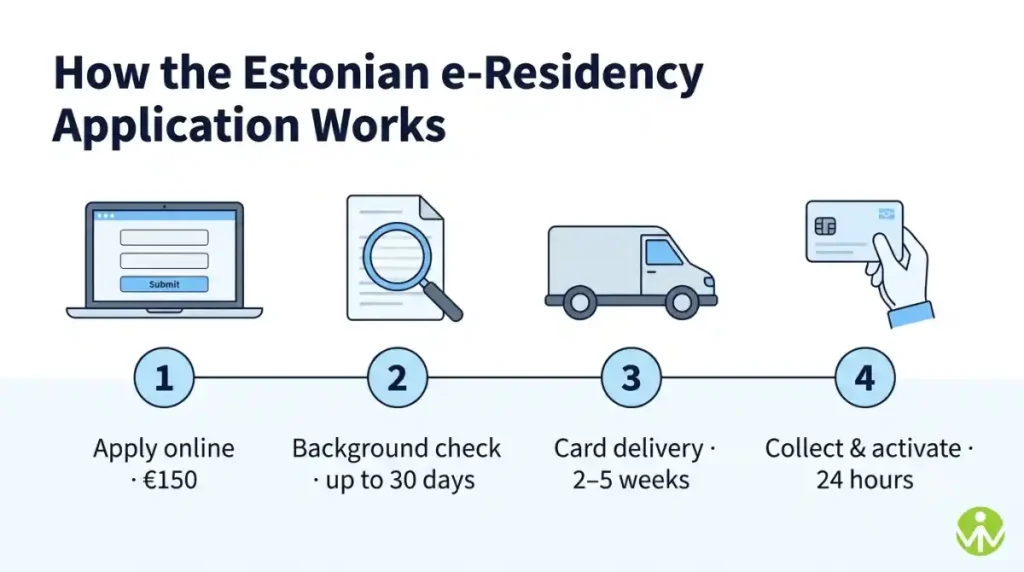
Applications are made online through the official e-Residency application portal and take about 30 minutes to complete. The process has four stages.
1. Prepare your documents
You need a valid passport, a recent passport-style digital photo, a short explanation of why you want Estonian e-Residency, details of your education and work experience, and a Visa or Mastercard to pay the fee. The explanation matters, because applicants must show a justified interest in Estonia’s e-services, and a vague reason can lead to a refusal.
2. Apply and choose a pickup location
In the online form you choose where to collect your card. The programme lists more than 50 pickup locations worldwide, most of them Estonian embassies and consulates, alongside PBGB service offices in Estonia and occasional mobile pickup points.
3. Background check and decision
According to its procedural time limits, the PBGB decides whether to issue the digital ID within 30 days of the application, and it may ask for more information during the check. Once the application is approved, the card takes 2 to 5 weeks to reach the chosen pickup location.
4. Collect and activate the card
You collect the card in person, bringing the same identity document you used in the application, and your fingerprints are taken at collection. The card must be collected within six months of reaching the pickup point. It activates automatically within 24 hours, after which you install the DigiDoc software and can start using it.
What e-residents use Estonian e-Residency for
The main use of Estonian e-Residency is to run an EU-registered company without moving to the EU. An e-resident can register an OÜ online, sign contracts and annual reports digitally, file taxes with the Estonian Tax and Customs Board and deal with the Business Register remotely. According to the e-Residency programme, Estonian companies pay corporate income tax only when profits are distributed, at 22/78, and the standard VAT rate has been 24% since 1 July 2025.
Two practical limits are worth knowing. Banks run their own checks, so Estonian e-Residency does not guarantee an Estonian or EU bank account, and many e-residents use a fintech account instead. And it suits businesses that are genuinely location-independent: founders who want to move to Estonia should look at the Estonian startup visa, and remote workers who want to live there need the digital nomad visa covered in our digital nomad visa overview. Our startup visa by country guide compares Estonia with other founder routes.
Renewal, validity and mobile Estonian e-Residency
Digital IDs issued since 1 May 2018 are valid for five years. Renewal is a new application with the same background check and the same state fee, which will be €165 from 2027.
Estonia is also developing a smartphone app that would let applicants submit their facial image and fingerprints remotely, removing the need for an embassy visit. The e-Residency programme says the app is planned for introduction in 2027, without a confirmed date, and physical cards will continue to be issued until then.
Estonian e-Residency FAQ
Is Estonian e-Residency a visa?
No. Estonian e-Residency is a digital identity for using Estonian e-services and running a company online. It gives no right to enter, live in or work in Estonia or the EU.
How much does Estonian e-Residency cost?
The state fee is €150 until 31 December 2026 and a flat €165 from 1 January 2027. There is no annual fee, and renewal after five years costs the same as a first application.
How long does an e-Residency application take?
The PBGB decides within 30 days. After approval, the card takes 2 to 5 weeks to reach the pickup location.
Is the fee refunded if my application is refused?
No. The PBGB does not refund the state fee when it declines to issue the digital ID.
Can I move to Estonia with e-Residency?
No. Living in Estonia requires a D visa or a residence permit, such as the startup or digital nomad routes, and e-Residency does not make those easier to obtain.
Does Estonian e-Residency make me a tax resident of Estonia?
No. Tax residency depends on where you live. A company run from abroad may also owe tax in the country where it is managed, so take local tax advice before registering one.