
A Japan student visa lets you enter Japan for a full-time course of more than 90 days at a university, vocational school, Japanese language school or other recognised institution, and leads to the Student status of residence (ryugaku) on arrival. This guide covers eligibility, the Certificate of Eligibility (COE), costs after the 2026 fee increases, the 28-hour limit on part-time work, the 2026 changes for language-school students and the options after graduation.
The Japan student visa is one of the long-stay routes in our guide to the types of Japan visa. Visas are issued by Japanese embassies and consulates under the Ministry of Foreign Affairs of Japan, while the Immigration Services Agency (ISA) issues the COE and decides extensions, changes of status and permission to work.
Key Takeaways
- A Japan student visa leads to the Student status of residence, granted for up to 4 years and 3 months, and almost always starts with a Certificate of Eligibility that your school applies for.
- The single-entry visa fee rose to ¥15,000 on 1 July 2026, and since 1 October 2026 extensions in Japan cost ¥10,000 to ¥75,000 depending on the period granted.
- Students may work up to 28 hours a week, and up to 8 hours a day in school vacations, but only after receiving permission to work outside their status.
- From the October 2026 intake, Japanese language school applicants must prove A1-level Japanese with a test certificate or an interview; 150 hours of study no longer counts on its own.
- Nationals of the Philippines, Nepal and Viet Nam need a TB clearance certificate for the Certificate of Eligibility; Indonesia follows, with the certificate required from 4 January 2027.
- Graduates can stay up to one year to look for work on a Designated Activities status, with a possible second year through approved local-government programmes.
Table of Contents
Who Needs a Japan Student Visa
You need a Japan student visa for a degree, a vocational (senmon gakko) diploma, a Japanese language course or an exchange year that lasts longer than 90 days. The visa gets you into Japan; the Student status granted at the airport then sets what you may do and for how long, up to four years and three months at a time.
Shorter courses work differently. Visa-exempt nationals can usually attend a course of up to 90 days as Temporary Visitors, and other nationals apply for a short-term visa; our Japan tourist visa guide covers that process. A Temporary Visitor cannot work and generally cannot switch to Student status inside Japan, so anyone planning a longer programme should apply for the Japan student visa from the start.
Japan Student Visa Requirements
For a Japan student visa, the ISA checks two things above all: that you genuinely intend and are able to study, and that you can pay for your course and living costs without working beyond the rules. The main requirements are:
- Admission to a school that accepts international students, which acts as your sponsor.
- Proof of funds, such as a statement of financial support, bank balance certificates, evidence of your sponsor’s relationship to you and their income, or a scholarship award letter.
- Evidence of language ability suited to the course, such as a Japanese-language test certificate or, for English-taught programmes, proof of English ability.
- Academic records, including graduation certificates and transcripts.
- A TB clearance certificate, if you are a national of a country covered by pre-entry tuberculosis screening.
Proof of funds
There is no single official figure for the money a Japan student visa applicant must show. The ISA expects enough to cover tuition and living costs for the course, and schools usually set their own benchmark. Bank balances should be in the payer’s name, and some applicants must show how the savings were built up over the past year. From the April 2027 intake, Japanese language schools must also complete a new ISA form confirming the applicant’s ability to pay.
Pre-entry TB screening
Japan requires a TB Clearance Certificate from nationals of countries with a large share of tuberculosis cases in Japan who plan a mid- to long-term stay, which includes most Japan student visa applicants from those countries. A designated panel clinic issues the certificate after a chest X-ray; it is valid for 180 days from the X-ray and is submitted with the COE application. The applicant pays for the screening.
The certificate has been mandatory for nationals of the Philippines and Nepal since 23 June 2025 and for Viet Nam since 1 September 2025. Screening opens in Indonesia on 2 November 2026, and the certificate becomes mandatory there on 4 January 2027. Myanmar and China are also covered, but their start dates have not been announced. Applicants who can show they live outside these countries are exempt, as are Japanese Government (MEXT) scholarship students recommended by an embassy. Details are on the Ministry of Health, Labour and Welfare screening page.
How to Apply for a Japan Student Visa
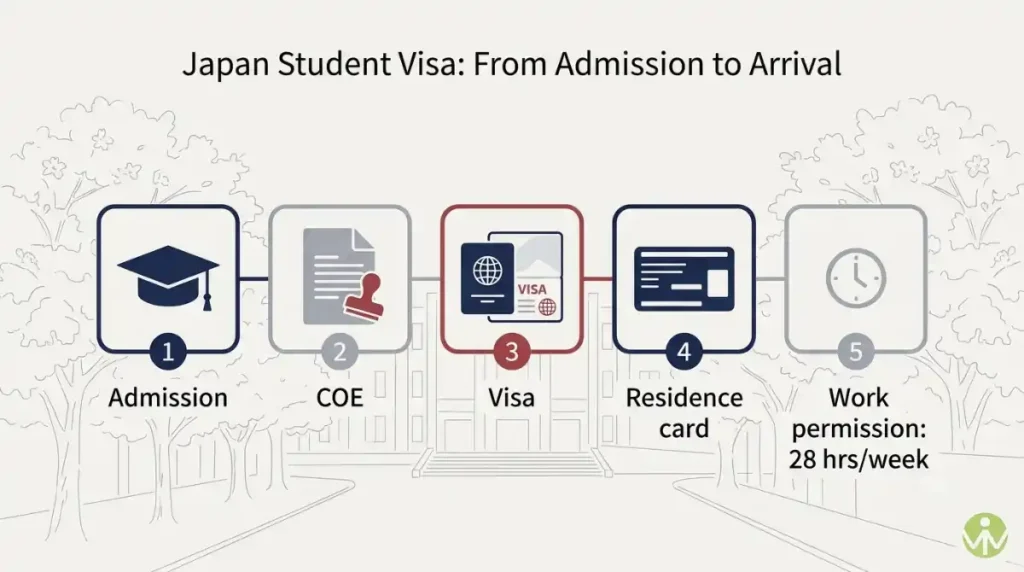
Almost every Japan student visa application follows the same five steps, starting several months before the course begins.
- Gain admission. Apply to the school and receive an offer.
- Let the school apply for the COE. You send the documents, and the school submits the COE application to the regional immigration bureau on your behalf. There is no fee, and the COE can be issued electronically.
- Apply for the visa. Take your passport, the application form, a photograph and the COE to the Japanese embassy or consulate that covers your place of residence. A COE is normally valid for three months, so you need to enter Japan within that time.
- Arrive in Japan. At the major airports you receive your residence card on arrival and can apply for permission to work part time at the same time. Register your address at the local municipal office within 14 days.
- Keep your status in order. Attend classes, tell the ISA within 14 days if you change school, and apply for an extension before your period of stay ends if your course continues.
A Japan student visa application can be made without a COE, but the Ministry of Foreign Affairs warns that this needs many more documents and can take several months.
Japan Student Visa Fees
Japan raised visa issuance fees on 1 July 2026 for the first time since 1978, and fees for residence procedures inside Japan on 1 October 2026. The single-entry visa now costs ¥15,000, up from ¥3,000. For a Japan student visa holder, the extension fee depends on the period of stay granted: ¥33,000 at the counter for one year, and ¥48,000 for a period of over one year but less than three, which covers the common grant of one year and three months.
Table 1: Japan student visa fees in 2026
| Procedure | Fee | Notes |
|---|---|---|
| Certificate of Eligibility | No fee | Applied for by the school |
| Single-entry visa | ¥15,000 (previously ¥3,000) | From 1 July 2026; paid in local currency |
| Permission to work part time | No fee | At the airport or a regional immigration bureau |
| Extension or change of status: over 3 months, up to 6 months | ¥18,000 counter / ¥15,000 online | From 1 October 2026 |
| Extension or change of status: 1 year | ¥33,000 counter / ¥27,000 online | From 1 October 2026 |
| Extension or change of status: over 1 year, less than 3 years | ¥48,000 counter / ¥42,000 online | From 1 October 2026 |
| Re-entry permit | ¥4,000 single / ¥7,000 multiple | Not needed for trips of under one year using the special re-entry permit |
| Sources: Ministry of Foreign Affairs of Japan (visa fee) and Immigration Services Agency fee leaflet (residence procedures). Fees are paid only on approval; online payments carry a separate transaction fee. Checked 31 October 2026. | ||
Residence fees are paid by revenue stamp at the counter, or electronically for online applications, and only once the application is approved. The full schedule is in the ISA fee leaflet.
Working on a Japan Student Visa: The 28-Hour Rule
A Japan student visa does not, on its own, allow paid work. Students must first obtain permission to engage in activity other than that permitted under their status of residence (shikakugai katsudo kyoka). New students can apply at the airport on first arrival; others apply at their regional immigration bureau. There is no fee.
The standard, or comprehensive, permission allows up to 28 hours of work a week during term and up to 8 hours a day during long vacations set by the school’s rules. The 28 hours cover all jobs combined, and ISA guidance issued in 2026 indicates they apply to any seven-day period rather than a fixed calendar week. Work at adult entertainment businesses is excluded even with permission. The full ISA rules for students set out when individual permission is needed instead.
Table 2: Part-time work rules on a Japan student visa
| Situation | Working limit | Permission needed |
|---|---|---|
| During term | Up to 28 hours a week, all jobs combined | Comprehensive permission |
| The school’s long vacations | Up to 8 hours a day | Comprehensive permission |
| Final-year internship as part of job hunting | May exceed 28 hours a week | Individual permission, with documents from the host organisation |
| Freelance work whose hours cannot be verified | As set in the permission | Individual permission |
| Preparing to start a business in Japan | As set in the permission | Individual permission |
| Adult entertainment businesses | Not allowed | Cannot be permitted |
| Source: Immigration Services Agency of Japan, permission to engage in activity outside status for students. Checked 31 October 2026. | ||
Undergraduates can receive individual permission for an internship beyond 28 hours only in their final year, once they have earned about 90% of the credits needed to graduate; final-year master’s and doctoral students also qualify.
Breaking the 28-hour rule has serious consequences. It can lead to refusal of a Japan student visa extension, cancellation of the work permission and, in serious cases, deportation, and employers can be penalised for facilitating illegal work.
2026 Changes for Japanese Language School Students
Most of the 2026 tightening affects Japan student visa holders at Japanese language schools, as set out in an ISA April 2026 notice.
Japanese at A1 level, proven by a test or an interview
Language schools must now confirm that applicants have Japanese at A1 level on Japan’s reference framework for Japanese-language education, using a test certificate or an interview. Until 2026, 150 hours of Japanese study was enough evidence on its own. The rule applies to COE applications for students starting from October 2026, and to changes of status and extensions filed from 1 July 2026. Graduates of foreign universities in countries on an ISA list are exempt.
Quarterly checks on part-time work
Since April 2026, Japanese language schools must ask every student every three months whether they hold work permission, where they work, what they do and how many hours they work each day. Schools must keep records, correct breaches and report to the ISA any student who keeps exceeding the limit or any employer reported to be forcing students to work more than 28 hours a week.
Financial checks from April 2027
For students entering a Japanese language school from April 2027, the school must complete a new ISA form confirming the applicant’s ability to pay for their studies. Ask your school early what evidence it will need from you to complete the form.
Reported but not confirmed
Japanese media reported in late 2025 that the government was considering replacing the blanket work permission granted on arrival with case-by-case screening. No rule change or start date has been announced, and the 28-hour limit is unchanged.
After Graduation: Staying On to Work or Look for Work
A Japan student visa holder who finds a job before graduating can apply to change to a work status, most often Engineer/Specialist in Humanities/International Services, once the employer confirms the offer. Many Japanese employers take on graduates in April, and a student whose job starts some time after graduation can apply for a Designated Activities status to stay until employment begins.
Job hunting after graduation
Graduates of Japanese universities, and vocational-school graduates who earned the specialist (senmonshi) title, can change from Student to a Designated Activities status for job hunting if their school recommends them and their record is good. It is granted for six months and can be renewed once, giving up to one year, according to the ISA job-hunting guidance. Graduates who join an approved local-government job-support programme can then stay a second year on the same terms, including internships.
Graduates of foreign universities who studied at a qualifying Japanese language school can also receive the job-hunting status for six months, renewable once, if their attendance was around 90% or higher and the school recommends them. In every case, part-time work of up to 28 hours a week is possible with permission.
Other routes after the Japan student visa
Graduates of Japanese universities with JLPT N1 or an equivalent level can apply for Designated Activities No. 46, which allows full-time work in a wide range of roles that use Japanese, including customer-facing jobs that standard work statuses exclude. University graduates who want to start a company can, with their university’s recommendation, stay up to six months to prepare before applying for Business Manager status; our Japan startup visa guide explains the ¥30 million Business Manager requirement and the J-Find route for graduates of top-ranked universities.
Table 3: Options after graduating on a Japan student visa
| Route | Who qualifies | Length | Work allowed |
|---|---|---|---|
| Change to a work status | Graduates with a job offer that matches the status | 3 months to 5 years, renewable | Yes, in that job |
| Job hunting (Designated Activities) | Graduates of Japanese universities, and of vocational schools with the senmonshi title, recommended by their school | 6 months, renewable once (up to 1 year) | Part time, up to 28 hours a week, with permission |
| Second year of job hunting | Graduates in an approved local-government job-support programme | 6 months, renewable once | Part time with permission; programme internships |
| Job hunting after a language school | Foreign-university graduates from a qualifying Japanese language school with good attendance | 6 months, renewable once | Part time, up to 28 hours a week, with permission |
| Designated Activities No. 46 | Japanese-university graduates with JLPT N1 or equivalent | Up to 5 years, renewable | Yes, full-time roles using Japanese |
| Business start-up after graduation | University graduates recommended by their university | Up to 6 months | Business preparation |
| Source: Immigration Services Agency of Japan. Conditions vary by individual case. Checked 31 October 2026. | |||
Years spent on a Japan student visa count towards the 10 years of residence needed for permanent residency in Japan, but not towards the five years in a work or status-based status that the standard route also requires.
Bringing Family on a Japan Student Visa
Spouses and children of students at universities and similar institutions can usually join them on the Dependent status if the student shows enough funds to support the family. Dependents may work up to 28 hours a week with permission. Parents are not covered, and conditions are stricter for some other types of school, so check with the ISA before planning a family move on a Japan student visa.
Frequently Asked Questions About the Japan Student Visa
How long does it take to get a Japan student visa?
The Certificate of Eligibility usually takes longest, so schools apply several months before the course starts. Once you have the COE, embassy processing for a Japan student visa often takes about five working days, although times vary by embassy and nationality.
Can I work on a Japan student visa?
Yes, part time, once you have permission to work outside your status. You can apply at the airport on arrival. The limit is 28 hours a week during term and 8 hours a day during the school’s long vacations, counting all jobs together.
Do I need to speak Japanese for a Japan student visa?
It depends on the course. Japanese language schools must now confirm A1-level Japanese through a test or interview. Universities teaching in Japanese set their own entry level, while English-taught programmes usually ask for proof of English instead.
How much money do I need for a Japan student visa?
There is no fixed official amount. You must show enough to pay tuition and living costs for the course, and your school will usually tell you the figure it expects. Funds should be in the payer’s name, with evidence of how they were saved.
Can I stay in Japan after graduating?
Yes. You can change to a work status once you have a job offer, or switch to a Designated Activities status for job hunting for up to one year, with a possible second year through an approved local-government programme.
Can I change schools on a Japan student visa?
Yes, but you must notify the ISA within 14 days of leaving or joining a school, and the new school must accept international students. Your attendance and work record carry over into later extension applications.