
The list of countries you can visit with a US visa is longer than most travellers expect and much shorter than most websites claim. A US visa in your passport is a genuine travel asset: roughly thirty governments will let you in on the strength of it, either with no application at all or with a formality that takes minutes. But the benefit is conditional in ways the usual “50 visa-free countries!” listicle skips over, and those conditions are exactly where people get turned away at check-in.
This guide sets out where you can actually visit with a US visa, what each government requires, and — just as important — the places where a US visa does nothing for you at all. It assumes you already hold one; if you do not, start with our guide to the US tourist visa.
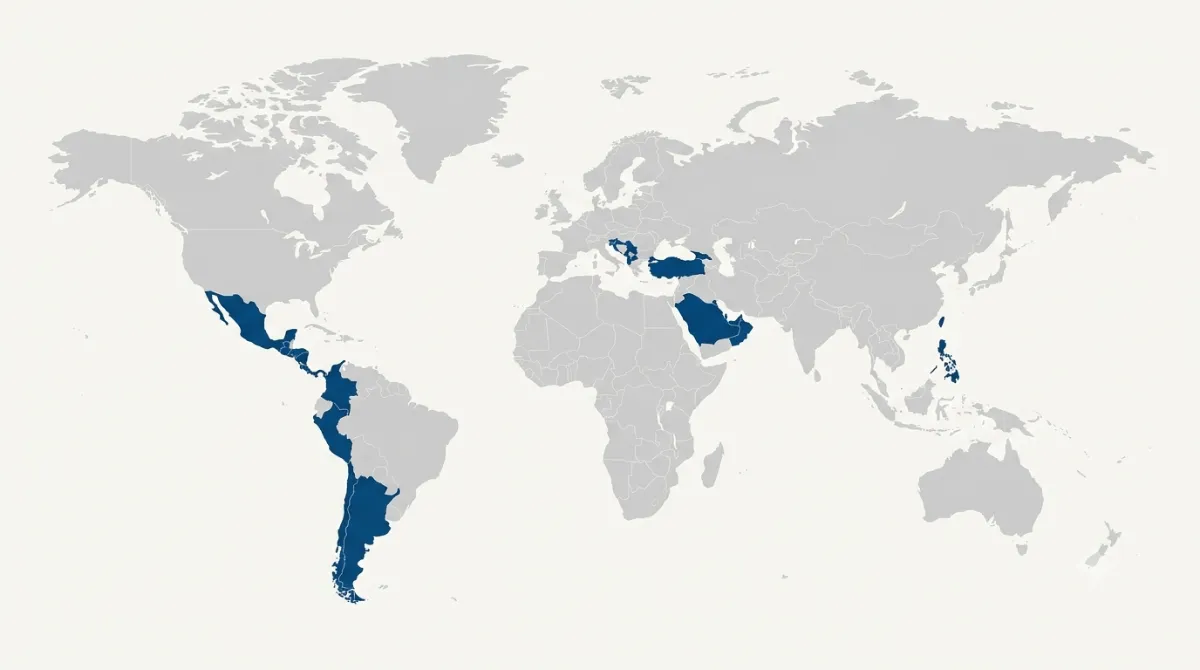
Key Takeaways
- There are around 30 countries you can visit with a US visa, through a full visa waiver, a visa on arrival, or a conditional e-visa you must apply for before you fly.
- Whether you can visit with a US visa depends on three things: your nationality, the class of US visa you hold, and in some countries whether the visa has already been used.
- A US green card is accepted at least as widely as a visitor visa, and several places you can visit with a US green card will not admit you on a visitor visa alone.
- Canada is the biggest myth. Its eTA-instead-of-visa programme covers 17 nationalities and India is not one of them.
- No Schengen country, and no European country at all, admits visitors on the strength of a US visa. The UK exemption covers airport transit only.
- North Macedonia’s arrangement expires on 31 December 2026 unless renewed.
- If you are not sure which class you hold, or which one you should be applying for, our guide to the types of US visa sets out every category and what each one allows.
Table of Contents
How a US visa gets you into another country
There is no single rule. The countries you can visit with a US visa do it in one of three ways, and the difference decides how much time and money you need before you fly.
Full visa waiver. You turn up with the US visa in your passport and are admitted as a visa-free visitor. Mexico, Georgia, Serbia and Colombia work this way. Nothing to apply for, nothing to pay.
Visa on arrival. You still get a visa, but it is issued at the airport rather than at a consulate, and the US visa is what makes you eligible. The Bahamas and the United Arab Emirates use this model.
Conditional e-visa or travel authorisation. You must apply online before you travel, and the US visa is the document that unlocks the application. Turkey, Oman, Saudi Arabia, Taiwan and Argentina all work this way. These are the destinations people get wrong most often, because being eligible to visit with a US visa is not the same as being allowed to board without doing anything first. Group the countries you can visit with a US visa this way and the planning problem becomes obvious: only the first group needs nothing from you in advance.
The three things that decide where you can visit with a US visa
Before reading any list, including this one, check your own situation against three filters. Nearly every failed trip comes down to one of them.
Your nationality
This is the filter most lists ignore completely. Many of these arrangements are not open to everyone — they are bilateral deals with named countries. Peru admits travellers who visit with a US visa only if they are Indian, mainland Chinese or Macanese. Chile’s rule covers India, mainland China and the Dominican Republic. The Bahamas visa on arrival is written for Indian nationals. Guatemala excludes about forty nationalities outright, including Bangladesh, China, Nepal, Sri Lanka and Vietnam.
So the honest answer to “how many countries can you visit with a US visa” depends on which passport it is stamped in. It also sits on top of whatever your passport already does on its own — Indian nationals should read this alongside the list of countries Indians can travel to without a visa, and Americans have a far longer list of countries US citizens can travel to without a visa. An Indian passport opens more of these doors than most, because India is party to more of these bilateral arrangements than almost any other country. Two travellers holding identical US visas can face completely different lists of countries they can visit with a US visa.
The class of US visa you hold
Some governments say “any valid US visa” and mean it. Others name specific categories. Argentina’s electronic authorisation for Indian nationals requires a B2 visitor visa specifically — an F-1 or H-1B will not do. Colombia, Costa Rica and Chile all exclude C-1 transit visas, and Costa Rica excludes C-1, C-2 and C-3 entirely. So the set of places you can visit with a US visa narrows or widens depending on which visa you were issued.
A US student visa or an H-1B is accepted by every country whose rule is written around “any valid US visa”. A US permanent resident card is the strongest document of the set. Several countries that will not accept a visitor visa will accept a green card, and Mexico, Belize, Chile and Argentina all name it explicitly.
One thing that is never a visa: an I-20, an I-797 approval notice, or an EAD work card. These are not entry visas and no border officer will treat them as one.
Whether the visa has been used
A few countries want evidence that you have actually travelled to the United States on the visa, not merely that you hold one. Panama requires the visitor visa to have been used at least once for entry. Albania says the same. Saudi Arabia’s e-visa pathway requires that the US, UK or Schengen visa has been used at least once to travel to the issuing country. An unused visa still gets you nowhere in these three.
Countries you can visit with a US visa on any passport
These are the destinations where the rule is written around the document rather than the traveller’s nationality. If you hold a qualifying US visa, and you are not from one of the small number of nationalities each country excludes, these should work.
Table 1: Countries you can visit with a US visa on any passport
| Destination | How it works | Maximum stay | Conditions |
|---|---|---|---|
| Mexico | Visa-free | 180 days | Visa physically stamped in the passport, or a US permanent resident card. Standalone documents such as an I-20 are not accepted. |
| Costa Rica | Visa-free | 180 days | Multiple-entry US visa or green card, valid more than 6 months on arrival (B and D visas exempt). C-1, C-2 and C-3 do not qualify. |
| Colombia | Visa-free | 90 days | US visa or green card valid at least 180 days from the date of arrival. C-1 transit visas excluded. |
| Panama | Visa-free | 30 days | US visitor visa must have been used at least once to enter the United States, or hold US residence. |
| Guatemala, El Salvador, Honduras, Nicaragua (CA-4) | Visa-free | 90 days per 180, shared across all four | Valid US visa or residence. About 40 nationalities are excluded, among them Bangladesh, China, Nepal, Sri Lanka and Vietnam. India is not. |
| Belize | Visa-free | 30 days | Multiple-entry US visa or US permanent resident card. |
| Dominican Republic | Visa-free | Standard tourist admission | Valid US visa or residence card. The published rule does not state a maximum; confirm with the airline before travel. |
| Georgia | Visa-free | 90 days per 180 | Any valid US visa or residence permit, valid on the date of entry. Set out in Government Ordinance No 280. |
| Serbia | Visa-free | 90 days per 180 | US visa or residence valid for the whole of the intended stay. |
| Albania | Visa-free | 90 days | Multiple-entry US visa that has been used at least once, or a US green card. |
| Montenegro | Visa-free | 30 days | Valid US visa or residence. The stay cannot run past the expiry of the visa itself. |
| Bosnia and Herzegovina | Visa-free | 30 days | Multiple-entry US visa or US residence. |
| North Macedonia | Visa-free | 15 days | Valid US visa, valid at least 5 days beyond the intended stay. Renewed annually; the current authorisation runs to 31 December 2026. |
| Turkey | Conditional e-Visa | 30 days, single entry | Requires a valid US, Schengen, UK or Ireland visa or residence permit. Must be applied for at evisa.gov.tr before travel. Free for Indian passport holders. |
| Saudi Arabia | e-Visa on arrival | e-Visa valid 90 days | US, UK or Schengen visa that has been used at least once. Available only on Saudi-based carriers (Saudia, flynas, flyadeal). |
| Oman | Unsponsored e-Visa | 10 or 30 days | Valid US, UK, Schengen, Canadian, Australian or Japanese visa or residence permit. 5 OMR for 10 days, 20 OMR for 30 days. |
| Morocco | Conditional e-Visa | 30 days | Valid US or Schengen visa or permanent residence. Some nationalities are excluded from the e-Visa entirely. |
| Compiled from each government’s published rules, August 2026. Entry is always at the discretion of the border officer. Confirm any country you can visit with a US visa against its own immigration authority before booking. | |||
Two rows deserve a note. North Macedonia’s arrangement is not permanent — it is renewed by government decision each year, and the current authorisation runs only to 31 December 2026, so confirm it before booking travel in 2027. Saudi Arabia’s e-visa on arrival is available only to passengers flying on Saudi-based carriers, in practice Saudia, flynas or flyadeal; arrive on any other airline and you cannot use it.
Countries you can visit with a US visa only on certain passports
These arrangements are nationality-specific. Holding the right US visa is necessary but not sufficient — your passport has to be on the list too, which is why so many of the places you can visit with a US visa differ from traveller to traveller.
Table 2: Countries you can visit with a US visa on selected passports only
| Destination | Who qualifies | How it works | Maximum stay | Conditions |
|---|---|---|---|---|
| United Arab Emirates | Indian passport holders | Visa on arrival | 14 days, one 14-day extension | Valid US visa, US green card, or an EU or UK visa or residence permit. Passport valid 6+ months. Since 13 February 2025, also Australian, Canadian, Japanese, New Zealand, South Korean and Singaporean residence permits. |
| Taiwan | India, Indonesia, Cambodia, Laos, Myanmar, the Philippines, Vietnam | Travel Authorization Certificate (free, online) | 30 days per entry; certificate valid 90 days, multiple entry | US visa or residence card, and it may be expired provided it expired less than 10 years before arrival. Australian, Canadian, Japanese, Korean, New Zealand, Schengen and UK documents also qualify. |
| Philippines | Indian and Chinese nationals | Visa-free | 30 days, no extension | Valid US, Australian, Canadian, Japanese, Schengen, Singaporean or UK tourist, business or resident visa. Indians without one still get 14 days visa-free, in force since 8 June 2025. |
| Peru | India, mainland China, Macau | Visa-free | 180 days | US, Canadian, UK, Australian or Schengen visa or residence permit, valid at least 6 months from arrival. |
| Chile | India, mainland China, Dominican Republic | Visa-free | 90 days | Valid US visa with at least 6 months of validity remaining. Transit visas excluded. |
| Argentina | India, mainland China, Dominican Republic | AVE electronic travel authorisation | 90 days | Indian nationals need a valid US B2 visa or a green card. The AVE costs in the region of US$400 — it is not a free shortcut. |
| Bahamas | Indian nationals | Visa on arrival | 90 days | A valid visa issued by the United States, Canada, the United Kingdom or a Schengen state. |
| Aruba | Selected nationalities | Visa-free | 90 days | US residence or return permit qualifies broadly; a US visitor visa alone qualifies only for certain nationalities. Confirm with the Aruban authorities before booking. |
| Compiled from each government’s published rules, August 2026. Nationality lists change without notice. Whether you can visit with a US visa here depends on your passport as much as your visa. | ||||
The Taiwan row is the most generous rule anywhere in this article and almost nobody knows about it: the Travel Authorization Certificate accepts a US visa or residence card that expired up to ten years before your arrival. A student visa from a decade ago still counts.
The Argentina row is the one to read twice. The electronic authorisation is real, but it costs in the region of US$400. It is a way to avoid a consulate appointment, not a cheap way to visit with a US visa.
Airports you can transit with a US visa
Transit is a separate question from entry, and this is where a US visa is unusually powerful. None of these is a country you can visit with a US visa in the ordinary sense — they are airports you can pass through on the way to somewhere else.
Table 3: Airports you can transit with a US visa
| Where | What the US visa does | Time limit | Conditions |
|---|---|---|---|
| United Kingdom (airside) | Exempts you from the Direct Airside Transit Visa | Airside transit only | Immigration (Passenger Transit Visa) Order 2014, article 4: a valid US entry visa, a US visa that expired less than 6 months after your last US entry, or an I-551 green card. Must be physical. No requirement to be flying to or from the US. Syrians holding B-1 or B-2 visas are excluded. |
| United Kingdom (landside) | Transit Without Visa scheme | Until 23:59 the day after arrival | Same qualifying documents, plus a confirmed onward flight and the correct documents for your final destination. |
| Singapore | Visa Free Transit Facility | 96 hours | Indian nationals and selected others. Valid visa or long-term pass for Australia, Canada, Germany, Japan, New Zealand, Switzerland, the UK or the US, with at least one month’s validity left. Enter by any mode, depart by air or sea. No extensions. |
| Transit is separate from entry: an airport you can transit with a US visa is not somewhere you can visit with a US visa. Airlines enforce these rules at check-in. Carry the physical passport. | |||
The United Kingdom is the significant one. Under article 4 of the Immigration (Passenger Transit Visa) Order 2014, a valid US entry visa exempts you from needing a Direct Airside Transit Visa — and unlike the widely repeated version of this rule, there is no requirement that you be flying to or from the United States. A US visa that expired less than six months after your last entry to the US also works, as does an I-551 green card. The document must be physical; an electronic visa does not satisfy the Order. One exception is written into the law: Syrian nationals holding US B-1 or B-2 visas are not exempt.
Where a US visa will not help you
This section matters more than the lists above, because the gap between where people believe they can visit with a US visa and where they actually can is what costs them money.
Canada. The most common and most expensive misunderstanding about where you can visit with a US visa. Canada does run a programme that lets travellers holding a valid US non-immigrant visa apply for an eTA instead of a visitor visa, but that programme is open to just seventeen nationalities: Antigua and Barbuda, Argentina, Brazil, Costa Rica, Indonesia, Malaysia, Mexico, Morocco, Panama, the Philippines, St Kitts and Nevis, St Lucia, St Vincent and the Grenadines, Seychelles, Thailand, Trinidad and Tobago, and Uruguay. India is not on that list. The programme also covers air travel only — arrive by car, bus, train or cruise ship and you need a visitor visa regardless.
The Schengen Area, Ireland and the UK for entry. No European country admits visitors on the strength of a US visa. The UK exemption described above covers transit only; to leave the airport as a visitor you need a UK visa.
South Korea. Korea’s transit exemption for holders of foreign visas does not list the United States among the qualifying countries. Older articles still repeat a thirty-day Korean transit waiver; do not plan around it without confirming with a Korean mission first.
Japan, Australia and New Zealand. None of them recognise a US visa for entry.
Which US visa classes count
As a working rule for judging whether you can visit with a US visa you already hold:
• B-1/B-2 is the most widely accepted visitor visa and the one nearly every rule is written around.
• A green card (Form I-551) is accepted at least as widely, and in several countries more widely.
• F-1, H-1B, L-1 and similar work wherever the rule says “any valid US visa” — Mexico, Georgia, Serbia, Costa Rica, Colombia — but not where a specific class is named.
• C-1 transit visas are excluded almost everywhere.
• Expired visas count in exactly two places covered here: Taiwan’s Travel Authorization Certificate, and the UK transit exemption within six months of your last US entry.
Five checks before you book
- Check your nationality against the rule, not just your visa. This is where most published lists of countries you can visit with a US visa mislead, and it is the single fastest way to work out whether you can visit with a US visa at all.
- Check the visa class. “Any US visa” and “a B2 visa” are different rules.
- Check remaining validity. Costa Rica, Chile and Peru want six months; Colombia wants 180 days from arrival. If yours is close to expiring, see whether you can renew it without an interview before planning anywhere you want to visit with a US visa.
- Check whether the visa must have been used. Panama, Albania and Saudi Arabia all require it.
- Carry the physical passport containing the visa. Printouts and electronic records are refused by Mexico and do not satisfy the UK transit exemption.
Airlines carry the liability if they board someone who is refused entry, so check-in staff apply these rules conservatively. If your case is unusual, carry a printout of the destination government’s own page — Georgia’s ordinance, Taiwan’s Travel Authorization Certificate rules, Singapore’s Visa Free Transit Facility page, Turkey’s e-Visa portal and Dubai’s GDRFA service page are all public.
Frequently asked questions
How many countries can you visit with a US visa?
About thirty, depending on your nationality. Lists claiming that fifty or more countries can be visited with a US visa are counting arrangements restricted to particular passports, or arrangements that have lapsed, as though they were open to everyone. The number you can personally visit with a US visa is the one that matters.
Does a US green card work as well as a US visa?
Usually better. Mexico, Belize, Chile, Argentina, Costa Rica and Albania all accept a permanent resident card, and several places you can visit with a US green card will not admit you on a visitor visa alone.
Can I visit with a US visa that has expired?
Only in two situations described here. Taiwan’s Travel Authorization Certificate accepts a US visa or residence card that expired less than ten years before arrival. The UK transit exemption accepts a US visa that expired less than six months after your last entry to the United States. Everywhere else the visa must be valid, and several countries want months of validity remaining.
Does an F-1 student visa or an H-1B count?
Wherever the rule says “any valid US visa” — including Mexico, Georgia, Serbia, Costa Rica and Colombia — yes. Where a rule names a class, such as Argentina’s B2 requirement, no.
Can I enter Canada with a US visa?
Not on an Indian passport. Canada’s eTA-in-place-of-a-visa programme covers seventeen specified nationalities and India is not among them, so Canada is not a country you can visit with a US visa. Everyone else on that list still needs to arrive by air.
Does it cost anything to visit with a US visa?
Sometimes a great deal. Argentina’s authorisation is around US$400. Oman’s unsponsored e-visa is 5 Omani rials for ten days or 20 rials for thirty. Turkey’s conditional e-visa is free for Indian passport holders but still has to be applied for in advance, with a return ticket, hotel booking, insurance and proof of funds of USD 50 per day. Each linked figure opens a live conversion on xe.com — these are set in local currency and move with the exchange rate.