
Applying for an Ireland student visa is the first formal step for any non-EEA national who plans to study in Ireland for more than 90 days. The process is managed by the Irish Naturalisation and Immigration Service (INIS) and requires careful preparation of financial documents, an acceptance letter from a recognised institution, and an online application. This guide explains every stage of the Ireland student visa process using current 2026 requirements — covering eligibility, visa types, documentation, fees, processing times, and what to do after you arrive.
Ireland Student Visa Types
The Irish government offers two types of student visas, determined by how long your course lasts:
| Visa Type | Course Duration | Work Permission | Notes |
|---|---|---|---|
| C Study Visa | Up to 90 days | Not permitted | Language courses, summer schools, short training programmes |
| D Study Visa | More than 90 days | Permitted (Stamp 2) | Undergraduate, postgraduate, doctoral, and diploma programmes over 3 months |
Most international students pursuing a degree or diploma will apply for the D Study Visa. This is the only visa type that allows holders to work part-time during their studies, under the conditions of Stamp 2 immigration permission. C Study Visa holders cannot work and cannot extend beyond the 90-day limit.

Ireland Student Visa Eligibility Requirements
To qualify for an Ireland student visa, applicants must meet the following criteria:
- Hold an offer letter from a recognised Irish educational institution whose programme is listed on the Interim List of Eligible Programmes (ILEP)
- Meet the academic entry requirements of their chosen course
- Demonstrate English language proficiency through IELTS (minimum 6.0–6.5 for most programmes), TOEFL, PTE, or Duolingo
- Provide evidence of sufficient funds to cover tuition fees and living expenses
- Hold valid private medical insurance for the duration of study
- Show clear intent to return home after completing studies (for visa-required nationalities)
EU, EEA, and Swiss citizens do not need a student visa to study in Ireland. Citizens of visa-exempt countries can enter Ireland and register with immigration authorities on arrival, provided their course is with an ILEP institution. If your nationality requires a visa, you must apply through the Irish Embassy or Consulate in your home country before travelling.
Ireland Student Visa Financial Requirements for 2026
Financial documentation is the area where most Ireland student visa applications face difficulty. From 2026, updated requirements apply:
- Courses longer than 8 months: proof of access to at least EUR 10,000 for the first academic year, plus tuition fees
- Courses of 8 months or less: proof of access to EUR 833 per month for the full duration (maximum EUR 6,665)
- For subsequent years: students must show they can access at least EUR 10,000 per year in addition to course fees
- A minimum tuition deposit of EUR 6,000 must have been paid to the institution before the visa application is submitted
Funds must be readily accessible — not tied up in fixed deposits or recently transferred in large, unexplained amounts. Bank statements should typically cover the three to six months preceding your application and clearly show the source of funds. Large last-minute deposits will be questioned by visa officers and may result in refusal.
For planning purposes, keep in mind that Ireland’s cost of living is relatively high compared to other EU study destinations. Dublin is more expensive than most regional cities. Students who plan to live outside the capital may find living costs lower. See our tourist visa guide for context on Ireland’s general cost structure for visitors.
Ireland Student Visa Required Documents
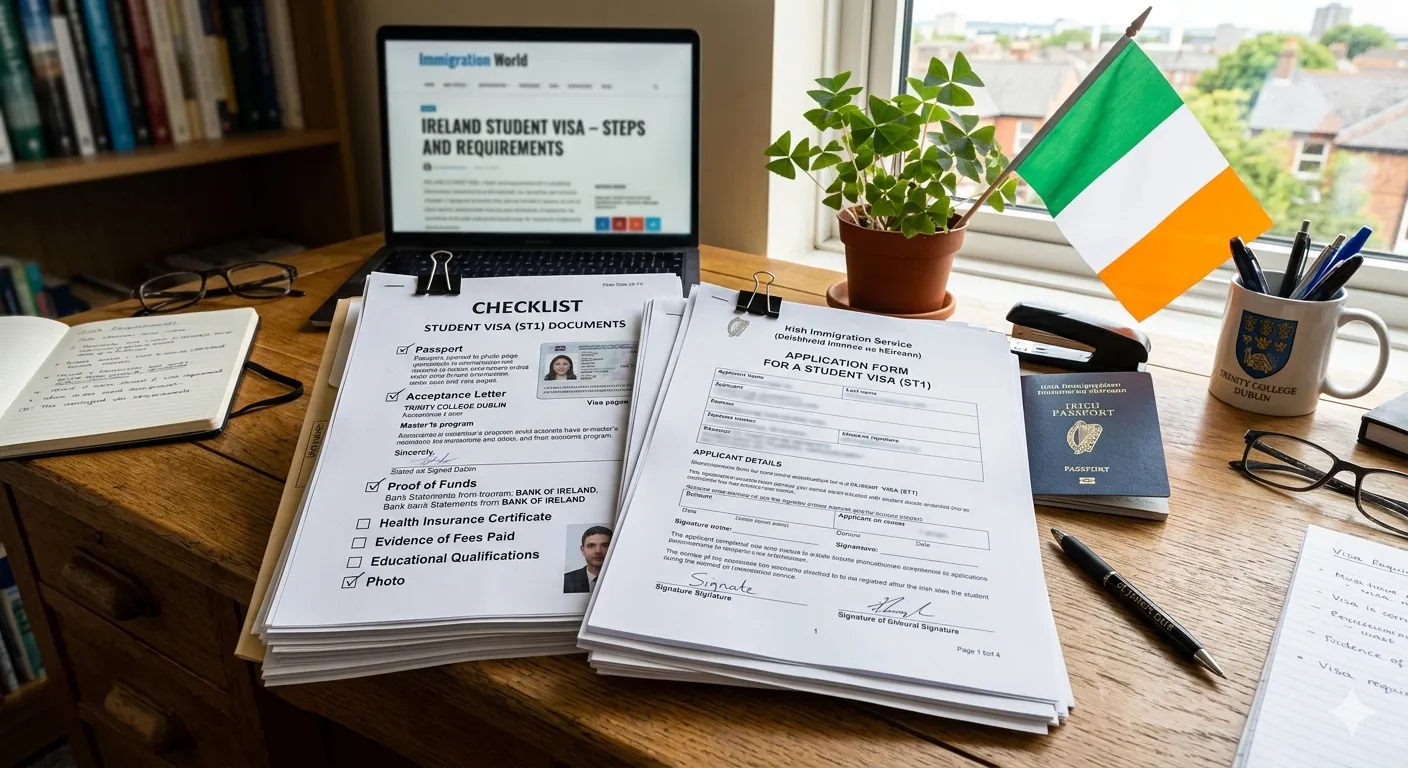
The following checklist covers the standard documents required for a D Study Visa application. Always check the INIS website for any updates specific to your nationality, as requirements can vary.
| Document | Details |
|---|---|
| Valid passport | Must have at least 12 months validity beyond your intended arrival date in Ireland |
| Two recent passport photographs | Taken within the last six months, white background |
| Completed online visa application summary | Signed by the applicant after submission on the AVATS portal |
| Letter of acceptance | From a recognised Irish institution on the ILEP list; must be on headed paper and include course name, duration, and fees |
| Proof of tuition fee payment | Minimum EUR 6,000 paid; official receipt or bank transfer confirmation acceptable |
| Statement of Purpose (SOP) | Letter explaining your reasons for studying in Ireland, how the course fits your career plans, and intent to return home after completion |
| Financial proof | Bank statements for 3-6 months, showing funds of at least EUR 10,000 for living expenses plus tuition balance |
| Private medical insurance | Valid for the full duration of study in Ireland; mandatory |
| Academic transcripts and certificates | Original or certified copies of prior qualifications |
| English language test results | IELTS, TOEFL, PTE, or equivalent – minimum scores vary by institution and programme level |
| Biometric data (where required) | Some nationalities must provide fingerprints; instructions are given after application submission |
| Certified translations | Any document not in English must be accompanied by a certified translation |
Documents should be organised in the order specified in the INIS application checklist. Originals and photocopies are both required for most documents. Poor organisation or missing items are common reasons for processing delays.
Ireland Student Visa Application Process: Step by Step
Step 1: Secure Your College Acceptance
Before applying for a visa, you must hold a confirmed offer of admission from an Irish institution. Confirm that your programme appears on the ILEP (Interim List of Eligible Programmes). This is a condition that applies specifically to non-EEA students. If the institution or programme is not on the ILEP, Stamp 2 permission — and therefore part-time work rights — cannot be issued. Check the current ILEP list on the Irish Immigration Service website.
Step 2: Pay the Tuition Deposit
A minimum tuition deposit of EUR 6,000 must be paid to your institution before you submit your visa application. Keep the official receipt or bank transfer confirmation as this is a mandatory document in the visa application. Some institutions may require payment in full upfront; check their admissions terms.
Step 3: Complete the Online Application
All applications must be submitted through the AVATS (Automated Visa Application and Tracking System) online portal at visas.inis.gov.ie. Fill in every section accurately. After submission, you will receive a transaction reference number and a signed summary form to print and include with your physical document package.
Step 4: Prepare and Submit Your Documents
Assemble all required documents in the order specified in the INIS checklist. Submit your application to the Irish Embassy or Consulate in your home country. Depending on your location, submission may be in person, by post, or through a Visa Application Centre (VAC). For Indian applicants, documents are submitted through the designated VAC. Biometric data may be required at this stage depending on your nationality.
Step 5: Track Your Application
Use your AVATS transaction number to track your application status on the INIS website. Visa decisions are published regularly on the Irish Immigration Service portal. Respond promptly to any requests for additional documents or an interview. If called for an interview, prepare to discuss your study plans, financial situation, and post-study intentions.
Step 6: Collect Your Visa
Once approved, your passport will be returned with the visa stamp. Do not book flights until the visa is confirmed. Keep your visa decision letter and all supporting documents, as you will need them at the Irish border and when registering with immigration authorities after arrival.
Ireland Student Visa Fees
| Fee | Amount | Notes |
|---|---|---|
| Single entry visa | EUR 60 | Non-refundable, even if the application is refused |
| Multiple entry visa | EUR 100 | Non-refundable, even if the application is refused |
| VFS service charge | Varies by country | Charged by the Visa Application Centre where applicable |
| IRP registration (after arrival) | EUR 300 | Paid at your immigration registration appointment in Ireland |
| Biometric fee | Varies | Only where required; instructions provided during application |
Note that visa application fees are entirely separate from tuition deposits, living costs, and insurance premiums. Budget for all of these when planning your move. The EUR 300 IRP registration fee is charged after arrival and is not part of the initial visa cost.
Ireland Student Visa Processing Time
Processing times for the Ireland student visa in 2026 typically range from 4 to 8 weeks under standard conditions. During peak intake periods — broadly May through September — processing can extend to 10 to 12 weeks due to higher application volumes.
Applicants are strongly advised to apply at least 8 to 10 weeks before their intended travel date, and ideally three months before the course start date. For the Irish Embassy in New Delhi specifically, initial decision times have been quoted at approximately 40 working days.
Do not make irreversible travel arrangements — flights, accommodation deposits — until your visa has been confirmed. This is standard guidance from the INIS, and booking in advance of a decision creates unnecessary financial risk. For context on how Ireland compares with other study destinations, see our passport rankings for 2026 to understand visa-free access by nationality.
After Arrival: IRP Registration and Stamp 2
Receiving an Ireland student visa is only the first step. After arriving in Ireland, all non-EEA students whose courses are longer than 90 days must register with Irish immigration authorities to obtain their Irish Residence Permit (IRP) card. This replaces the older GNIB card, which is now discontinued.
Registering for Your IRP Card
- Book an appointment with the Immigration Service Delivery (ISD) office or the Garda National Immigration Bureau (GNIB) depending on your location
- Bring your passport, visa, letter of acceptance, proof of accommodation, and proof of medical insurance
- Pay the EUR 300 registration fee at your appointment
- Your IRP card will arrive by post within 10 to 15 business days
- You will receive a temporary registration letter at the appointment as proof while you wait for the card
Understanding Stamp 2
Your IRP card will carry a Stamp 2 endorsement. This is the immigration permission that allows you to live and study in Ireland for the duration of your programme. Stamp 2 also grants the following work rights:
- Up to 20 hours per week during term time
- Up to 40 hours per week during official college vacation periods
A Stamp 2A is issued for shorter courses of under 6 months. This stamp does not include work rights. Ensure your programme qualifies for Stamp 2 before enrolling if part-time work is part of your financial plan.
Bringing Dependants to Ireland as a Student
From 2026, Ireland has clarified its rules on student dependants. Only postgraduate students enrolled at Level 9 or higher on the National Framework of Qualifications (NFQ) — which includes Masters and Doctoral programmes — are eligible to apply to bring a spouse or children to Ireland under a student visa arrangement. Undergraduate students cannot bring dependants under this route.
Students who plan to remain in Ireland after graduation may eventually be eligible under the Third Level Graduate Scheme or a work permit route. For more on Ireland’s longer-term immigration options, see our Portugal permanent residency guide as a comparative reference. For those planning a broader immigration strategy, our work visa guide covers the Irish employment permit system in detail.
Renewing an Ireland Student Visa
Students who need to extend their stay to complete further studies in Ireland must apply for a renewal before their current permission expires. Renewals are processed through the INIS online portal. The same financial requirements apply — students must demonstrate they continue to have access to at least EUR 10,000 for each additional year of study, on top of course fees.
Apply for renewal as early as possible, particularly during peak application periods from May to September. Remaining in Ireland with expired immigration permission is a serious issue that can affect future visa applications.
Frequently Asked Questions: Ireland Student Visa
Who needs an Ireland student visa?
Non-EEA nationals who plan to study in Ireland for more than 90 days require a student visa. EU, EEA, and Swiss citizens do not need a visa. Citizens of certain visa-exempt countries can enter without a visa but must still register with immigration authorities after arrival if their course exceeds 90 days.
What is the difference between a C Study Visa and a D Study Visa?
A C Study Visa is for short courses lasting 90 days or less, such as language programmes or summer schools. It does not allow work. A D Study Visa is for courses lasting more than 90 days, including most undergraduate and postgraduate degrees. D Visa holders receive Stamp 2 permission, which includes part-time work rights of up to 20 hours per week during term.
How much money do I need to show for an Ireland student visa in 2026?
For courses longer than 8 months, you must show access to at least EUR 10,000 for living expenses during the first academic year, in addition to having paid a tuition deposit of at least EUR 6,000. For shorter courses, the requirement is EUR 833 per month. Funds must be accessible and clearly evidenced through bank statements.
How long does the Ireland student visa take to process?
Processing typically takes 4 to 8 weeks. During peak periods (May to September), it can take up to 10 to 12 weeks. Applicants should apply at least 8 to 10 weeks before their planned departure date, and ideally three months in advance.
Can I work in Ireland on a student visa?
Yes, but only if you hold a D Study Visa and have received Stamp 2 immigration permission after registering for your IRP card. Under Stamp 2, you can work up to 20 hours per week during term time and up to 40 hours per week during official college holiday periods. Short-course students on Stamp 2A cannot work.
What happens after I arrive in Ireland on a student visa?
After arrival, you must register with the Immigration Service Delivery (ISD) or the Garda National Immigration Bureau (GNIB) to obtain your Irish Residence Permit (IRP) card. This registration must be completed within 90 days of arrival. The registration fee is EUR 300. Your IRP card will carry your Stamp 2 permission and will arrive by post within 10 to 15 working days.
What is the ILEP and why does it matter?
The Interim List of Eligible Programmes (ILEP) is an official register of Irish educational institutions and courses that are approved for non-EEA student visa purposes. Your chosen institution and programme must appear on the ILEP for your visa to be considered and for Stamp 2 work rights to apply. Before accepting an offer, confirm ILEP status through the Irish Immigration Service.