
Ireland permanent residency — formally known as Long-Term Residency — gives non-EEA nationals the right to live and work in Ireland on a Stamp 4 or Stamp 5 permission without the restrictions of an employment permit or study visa. After five years of legal residence in Ireland, most non-EEA nationals become eligible to apply. The Critical Skills Employment Permit route offers a faster pathway, with Stamp 4 available after just 21 months. This guide explains every aspect of Ireland permanent residency in 2026 — eligibility requirements, available pathways, documents, fees, processing times, and the route to Irish citizenship.
What Is Ireland Permanent Residency?
Ireland does not use the term ‘permanent residency’ in exactly the same way as some other countries. What is commonly called permanent residency in Ireland refers to two distinct statuses:
| Pathway | Time to Stamp 4 | Key Requirement | Notes |
|---|---|---|---|
| Critical Skills Employment Permit (CSEP) | 21 months | EUR 40,904+ (with degree); EUR 68,911+ (without degree) | Fastest route; no labour market test required |
| General Employment Permit (GEP) | 5 years | EUR 36,605+; employer labour market test required | Most common route for non-CSEP roles |
| Intra-Company Transfer (ICT) | 5 years | Transfer from overseas office; EUR 49,523+ | For multinationals moving employees to Irish offices |
| Dependent/Spouse of CSEP holder | Variable | Spouse holds CSEP; dependent receives Stamp 1G | Stamp 1G holders accrue time toward their own Stamp 4 |
| Scientific Researcher | 5 years | Hosting agreement with approved Irish research body | Separate pathway for academic researchers |
| Family Reunification | 5 years | Sponsored by Irish citizen or qualifying resident | Conditions vary based on sponsor’s status |
- Stamp 4 — Long-Term Residency: Granted after five years of reckonable residence (or 21 months for Critical Skills Employment Permit holders). Allows the holder to live and work freely without an employment permit, own a business, and access most public services. Must be renewed every five years.
- Stamp 5 — Without Condition as to Time: Granted to those who have lived legally in Ireland for eight or more years. Effectively permanent — no renewal required. Rare and granted on a case-by-case basis.
For most non-EEA nationals, the practical goal is to obtain Stamp 4 through the Long-Term Residency application. This is what is referred to throughout this guide when discussing Ireland permanent residency.
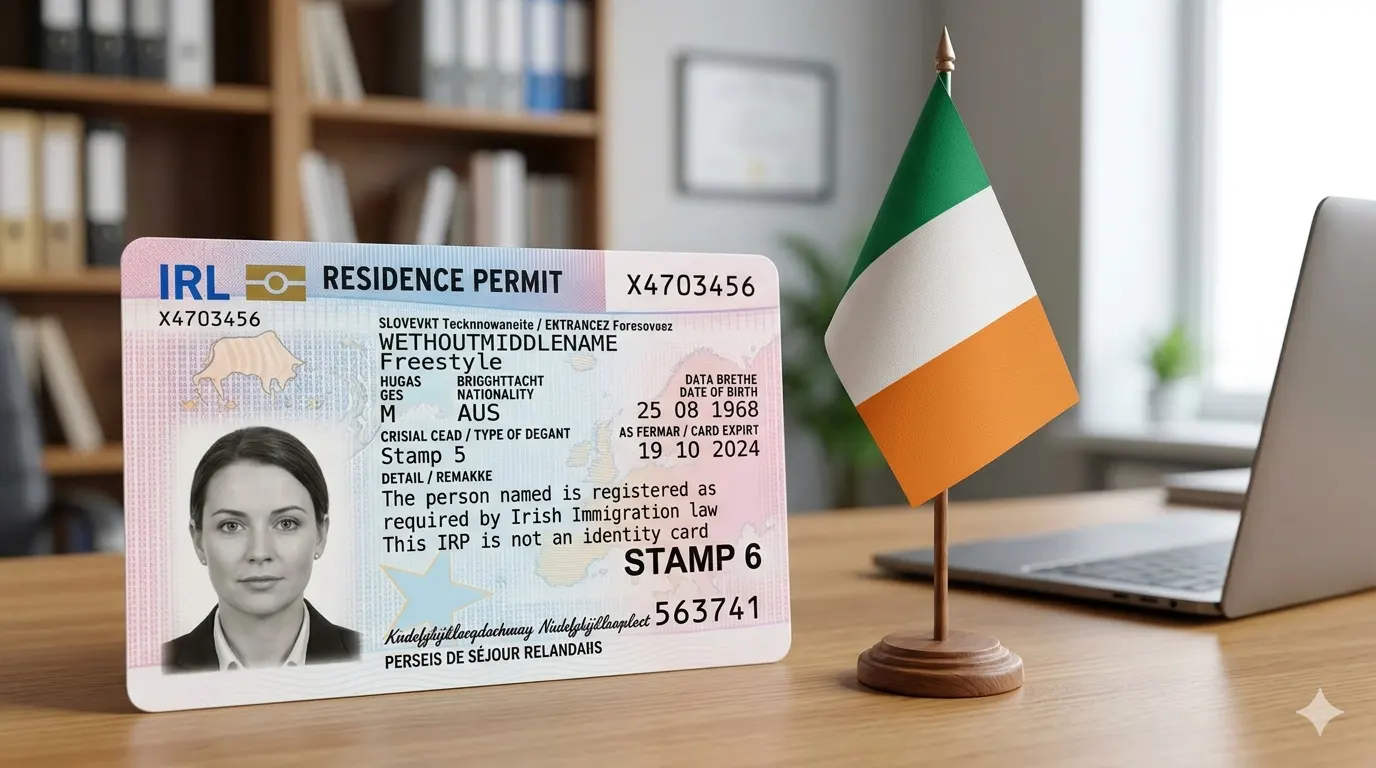
Ireland Permanent Residency Eligibility Requirements
To be eligible to apply for Ireland permanent residency (Long-Term Residency on Stamp 4), you must meet all of the following criteria:
- Be a non-EEA national aged 18 or over
- Have lived legally and continuously in Ireland for at least 5 years (60 months) immediately before the date of application — or 21 months for Critical Skills Employment Permit holders on the accelerated pathway
- Hold a good immigration record — no breaches of permission conditions, no periods of overstay, and no work outside permit conditions
- Have a clean criminal record (Garda clearance is checked as part of the application)
- Be able to demonstrate that you can support yourself and any dependants financially
The five years of reckonable residence must be calculated carefully. Certain time periods do not count toward the five years — specifically, time spent in Ireland on a study visa (Stamp 2) does not count in full. Up to 12 months of study time can be counted for Long-Term Residency purposes, but anything beyond that is excluded. This is an important distinction for international graduates who studied in Ireland before moving into employment.
Ireland Permanent Residency Pathways
There are several routes through which non-EEA nationals accumulate the qualifying residence for Ireland permanent residency. The most common are:
Of these routes, the Critical Skills Employment Permit is by far the most popular and strategically planned pathway to Ireland permanent residency. Demand for the CSEP has grown significantly, particularly in tech, engineering, and healthcare roles. For more on how work permits feed into permanent residency, see our Ireland work visa guide.
Documents Required for Ireland Permanent Residency
The Long-Term Residency application requires a comprehensive set of documents covering your entire immigration history in Ireland. Missing or incomplete documents are the most common cause of processing delays.
| Document | Details |
|---|---|
| Completed Long-Term Residency application form | Available on ISD website; must be completed in full and signed |
| Valid passport | All passports held during time in Ireland, not just current one |
| Current Irish Residence Permit (IRP) card | Copy of current IRP card; GNIB cards are no longer valid |
| All previous IRP cards | Copies of all IRP cards held throughout time in Ireland |
| Employment permits (all) | Copies of all employment permits issued during qualifying period |
| Proof of continuous residence | P60s, P21s, payslips for each year; lease agreements or utility bills |
| Employer reference letter | Confirming current employment, salary, and tenure |
| Garda criminal record clearance | Obtained through Garda vetting process or National Vetting Bureau |
| Evidence of financial self-sufficiency | Bank statements for previous 6 months |
| Proof of compliance with permit conditions | No record of working outside employment permit conditions |
| Two passport photographs | Recent, white background, to Irish photo standards |
| Certified translations | Any document not in English must be accompanied by a certified translation |
How to Apply for Ireland Permanent Residency
Step 1: Confirm Your Qualifying Period
Before applying, carefully calculate your reckonable residence. Use your IRP cards, passport stamps, and entry/exit records to confirm you meet the five-year threshold. If you have spent time outside Ireland, note that absences of more than six months in any 12-month period can break continuity of residence. Shorter absences for holidays, work travel, or emergencies are generally acceptable but should be documented.
Step 2: Gather Your Documents
Compile all documents listed above, covering your entire period of residence in Ireland. This is the stage that takes the most preparation. Track down old IRP cards, P60s, and employment permits from across your years in Ireland. Missing historical documents are a common cause of delays.
Step 3: Submit Your Application
Complete and submit the Long-Term Residency application form along with all supporting documents to the Long-Term Residency Division of the Immigration Service Delivery (ISD) in Dublin. Applications can be submitted by post or, where available, through the ISD online portal. Ensure your documents are well organised and accompanied by a clear cover letter.
Step 4: Pay the Application Fee
The application fee is EUR 500. This fee is not payable with your initial application — it is payable only after your application has been reviewed and you have received an approval letter from the ISD. You have 28 days from the date of the approval letter to pay the fee. Failure to pay within this window will result in your application being closed and you will need to reapply.
Step 5: Register Your New Status
Once the fee is paid and your Long-Term Residency is formally granted, you must register your new Stamp 4 status at your local immigration registration office or at the Burgh Quay Registration Office in Dublin. You will receive an updated IRP card reflecting your Stamp 4 permission.
Ireland Permanent Residency Fees
| Fee Item | Amount | Notes |
|---|---|---|
| Long-Term Residency application fee | EUR 500 | Payable only after approval letter received; must be paid within 28 days |
| IRP card renewal (Stamp 4) | EUR 300 | Payable at each IRP registration or renewal appointment |
| Stamp 5 (Without Condition as to Time) | EUR 300 | One-time registration; no renewal required after Stamp 5 |
The EUR 500 Long-Term Residency fee is among the lowest permanent residency application fees in Europe. Budget for the EUR 300 IRP registration fee separately, as this is payable at your immigration registration appointment after approval.
Ireland Permanent Residency Processing Time
Processing times for Long-Term Residency applications have historically ranged from 6 to 8 months. In 2025 and into 2026, ISD has been working to reduce backlogs, but applicants should still expect a wait of at least six months from the date of a complete application submission.
Submit your application in advance of your current IRP card expiry where possible. If your IRP expires while your Long-Term Residency application is pending, you can apply to renew your current permission while the LTR application is processed. Contact the ISD to confirm your options if you are approaching an expiry date.
Rights and Benefits of Ireland Permanent Residency
Stamp 4 Long-Term Residency grants significant rights compared to a standard work permit:
- Right to live in Ireland without the need for an employment permit
- Freedom to work for any employer, change jobs, or start a business without needing separate permission
- Access to most public services, including social welfare, public healthcare, and education
- Right to sponsor eligible family members to join you in Ireland
- Right to travel to the UK under the Common Travel Area without additional permission
- Pathway to Irish citizenship after meeting the naturalisation requirements (see below)
Stamp 4 does not confer EU citizenship or EU free movement rights. Ireland permanent residency is specific to Ireland. However, as a stepping stone toward Irish citizenship — which does carry EU passport rights — it is a strategically important status for long-term immigrants.
From Permanent Residency to Irish Citizenship
After holding Long-Term Residency and continuing to live in Ireland, many residents eventually apply for Irish naturalisation (citizenship). The general requirements for Irish citizenship by naturalisation are:
- 5 years of continuous reckonable residence in Ireland immediately before applying, including at least 1 year of continuous residence in the 12 months immediately before application
- Hold Stamp 4 or Stamp 5 immigration permission at the time of application
- Be of good character
- Intend to continue to reside in Ireland after naturalisation
Irish citizenship is one of the most valuable outcomes of the permanent residency process. The Irish passport currently ranks among the world’s most powerful, offering visa-free access to 185 countries. For passport strength comparisons by nationality, see our passport rankings for 2026.
Frequently Asked Questions: Ireland Permanent Residency
How long do I need to live in Ireland before applying for permanent residency?
The standard requirement is five years (60 months) of continuous, legal residence in Ireland. Critical Skills Employment Permit holders can apply for Stamp 4 after just 21 months of employment in Ireland under the accelerated pathway.
Does time spent studying in Ireland count toward permanent residency?
Only partially. Up to 12 months of study time (Stamp 2) can be counted toward the five-year qualifying period for Long-Term Residency. Any study time beyond 12 months is excluded from the calculation. Graduates who move directly into employment on a work permit can begin accruing qualifying time from the date their employment permission begins.
What is the difference between Stamp 4 and Stamp 5?
Stamp 4 is Long-Term Residency, granted after five years of qualifying residence. It must be renewed every five years and allows the holder to live and work freely. Stamp 5 (Without Condition as to Time) is effectively permanent with no renewal required, granted to those with eight or more years of legal residence. Most applicants target Stamp 4 as the practical goal.
What happens if I leave Ireland for an extended period?
Absences of more than six months in a single 12-month period can break the continuity of residence required for Long-Term Residency. Shorter absences for holidays, work travel, or family emergencies are generally acceptable. If you are approaching your five-year qualifying period and have had extended absences, seek advice from the ISD before applying.
Can my family join me in Ireland once I have permanent residency?
Yes. Stamp 4 holders can sponsor eligible family members to join them in Ireland through the family reunification process. Spouses, civil partners, and dependent children are the primary qualifying categories. Family members will need to apply separately and their applications are assessed on individual merit.
How much does it cost to apply for Ireland permanent residency?
The Long-Term Residency application fee is EUR 500, payable after receiving an approval letter. You also pay EUR 300 for IRP registration when you collect your Stamp 4 card. The total cost is therefore EUR 800, plus any ancillary costs for document preparation, translation, or legal advice.
Can I apply for Irish citizenship after getting permanent residency?
Yes. After holding Stamp 4 and meeting the residence requirements for naturalisation — five years of reckonable residence including one continuous year immediately before application — you can apply for Irish citizenship. Citizenship confers an Irish passport and EU citizenship rights, including freedom of movement across EU member states.
Also Read