
The United States has introduced a major change to its immigration system by cutting the validity of Employment Authorization Documents (EADs). From now on, your US work permit validity is reduced from five years to 18 months.
The policy, effective December 5, 2025, is expected to significantly impact thousands of Indian workers.
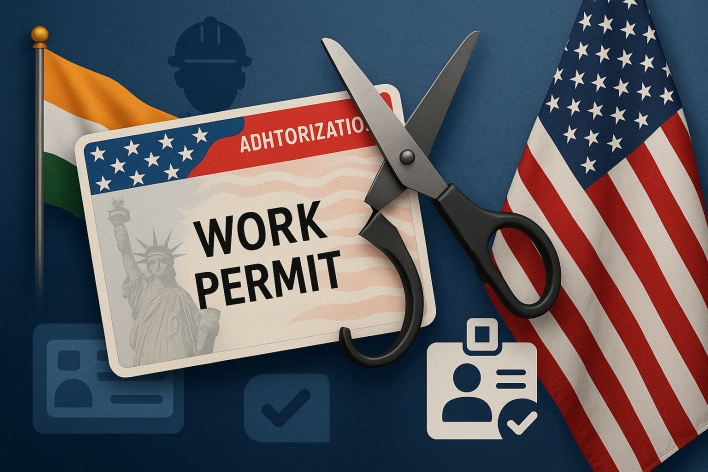
Table of contents
Work-Permit Validity Change – Who Is Affected the Most
The change in work permit validity primarily affects individuals who rely on EADs rather than employer-sponsored visas.
- Indian Green Card Applicants (Adjustment of Status): Many stuck in the EB-2 and EB-3 backlogs depend on EAD + Advance Parole. Shorter validity means more frequent renewals and a higher risk of lapses.
- Asylum Seekers & Refugees: Indians with pending asylum cases rely exclusively on EADs to work.
- Individuals Granted Withholding of Removal: Allowed to stay but not granted full asylum, making EADs essential for employment.
- TPS Holders & Parolees: Some categories now face validity periods as short as 1 year.
- Spouses of Certain Parole-Based Visa Holders: Entrepreneur parole spouses and similar categories now require more regular renewals.
Read: US Paused Immigration Applications From 19 Non-European Countries
US Work Permit Validity – What Exactly Changed
- EAD validity reduced from 5 years to 18 months.
- Applies to all new and pending applications from December 5, 2025.
- Additional rules further restrict validity for TPS and parole-based categories.
Why the US Slashed Work-Permit Validity
USCIS states that the policy aims to:
- Enable more frequent security vetting
- Improve fraud detection
- Allow closer monitoring of individuals with unresolved immigration status
These changes are aligned with broader national-security priorities.
Read: Every Immigration Statement Made by Donald Trump So Far
Impact on Indian Workers
- More frequent renewals every 12–18 months.
- Higher risk of job interruptions if renewals are delayed.
- Increased paperwork and fees.
- Greater uncertainty, especially for those navigating multi-year Green Card backlogs.
Who Is Not Affected
- H-1B visa holders
- L-1 and O-1 workers
- F-1 OPT/STEM OPT students (unless relying on other EAD categories)
- Workers with stable employer-sponsored non-immigrant visas
What Affected Workers Can Do
To reduce disruption:
- Apply early — renew as soon as the window opens (typically 180 days in advance).
- Use automatic extensions where applicable (up to 540 days).
- Avoid international travel if dependent on Advance Parole.
- Consider shifting to employer-sponsored visas like H-1B or L-1.
Explore interfiling or category changes for faster Green Card movement.
A Changing Landscape
The reduction in EAD validity marks a notable tightening in the U.S. immigration landscape. For thousands of Indian workers, especially those in long legal limbo, the rule change adds greater uncertainty to an already challenging process.
Also Read