
A France student visa lets non-EU nationals enter France to study, and the type you need depends on how long your course lasts. Courses of up to 90 days use a short-stay visa, while longer programs use a long-stay visa that also serves as a residence permit for the first year.
This guide covers each France student visa type, the documents and funds consulates expect, the fees and taxes in force since 1 May 2026, how to apply through France-Visas and Campus France, and what to do after arrival. For how study fits alongside the work, family, and visitor routes, see our guide to the types of France visas.
Citizens of the EU, the European Economic Area, and Switzerland can study in France without a visa. Everyone else should confirm the right category with the visa wizard on the official France-Visas student page before applying.
Key Takeaways
- A France student visa for a course longer than 90 days is usually the VLS-TS étudiant, valid for 4 to 12 months and validated online after arrival.
- Students applying from 1 August 2026 must show at least €877.50 a month, or €10,530 for a 12-month course.
- The long-stay visa fee is €50 in Études en France countries and €99 elsewhere, and validation costs €100 at the student rate.
- Residents of more than 70 Études en France countries and territories apply through Campus France before the visa stage.
- VLS-TS holders can work up to 964 hours a year, while VLS-T holders cannot work.
- Submit the long-stay application on France-Visas no earlier than three months before departure.
- Which France student visa do you need?
- France student visa requirements
- How to apply for a France student visa
- France student visa fees and costs
- After you arrive: validating your France student visa
- Working on a France student visa
- FAQ: France student visa
- How much money do I need for a France student visa?
- How much does a France student visa cost?
- Can I work in France on a student visa?
- Do I need to go through Campus France for a France student visa?
- How early can I apply for a France student visa?
- What is the difference between a VLS-TS and a VLS-T student visa?
Which France student visa do you need?
The length of your course decides which France student visa to request. Each type carries different rights, so check the label on the visa sticker when it arrives. The table below compares the four options.
Table 1: France student visa types compared
| Visa | Course length | Work allowed | Renewable in France | After arrival |
|---|---|---|---|---|
| Short-stay student visa (Schengen, type C) | Up to 90 days | No | No | Nothing to do |
| Student-competition visa (étudiant-concours) | Up to 90 days, for an entrance exam | No | Yes, through a student residence card if admitted | Apply to the prefecture if you pass |
| VLS-T étudiant (temporary long-stay) | 4 to 12 months | No | No | No formalities |
| VLS-TS étudiant (long-stay visa valid as a residence permit) | 4 to 12 months | Yes, up to 964 hours a year | Yes, through a student residence card | Validate online within 3 months |
| Sources: France-Visas, Campus France, and Service-Public, checked 27 November 2026. | ||||
Short-stay student visa for courses up to 90 days
For a language course, summer school, or other program of three months or less, consulates issue a Schengen short-stay visa. It covers up to 90 days in any 180-day period, cannot be extended, and does not allow work. Nationals of visa-exempt countries can take short courses without a visa, within the 90/180 rule.
The application follows the same process as a holiday, and our guide to the Schengen short-stay visa covers the documents, appointment, and decision times.
Student-competition visa for entrance exams
Candidates invited to sit an entrance exam or competitive interview at a French institution apply for the short-stay étudiant-concours visa. It lasts up to 90 days, and consulates issue it only when results usually arrive within that period.
Candidates who pass can apply for a student residence card at the prefecture without returning home. Those who fail must leave the Schengen area when the visa expires. Visa-exempt candidates still need this visa if they want to stay on after a successful exam, and France-Visas states that Algerian nationals cannot apply for it.
VLS-T temporary long-stay student visa
The VLS-T étudiant covers one stay of four to 12 months, such as a single semester or exchange term, according to Campus France. It needs no formalities after arrival, but it cannot be renewed. It also gives no right to work, to housing aid from the CAF, or to the Visale rental guarantee.
Choose the VLS-T only if you are certain you will not extend your studies. Once it expires, you must leave France.
VLS-TS long-stay student visa
The VLS-TS étudiant is the standard France student visa for degree programs. It is a long-stay visa valid as a residence permit for four months to one year, and it lets you travel in the Schengen area for up to 90 days in any 180.
Validate it online within three months of arrival and pay the validation tax. From the second year, apply for a student residence card. Students on a mobility program longer than 12 months receive a long-stay visa marked for a residence card instead, and they request that card within two months of arrival.
France student visa requirements
Consulates assess the same core documents for every long-stay France student visa. The France-Visas wizard produces the exact checklist for your nationality and country of residence, and it usually includes:
- a passport issued within the last 10 years, valid for at least three months after the visa ends, with two blank pages
- the signed France-Visas application form and its receipt
- recent passport photos that meet the published specifications
- a certificate of enrollment or final admission letter from a French higher education institution
- proof of funds of at least €877.50 a month for the length of the course
- proof of accommodation, or a temporary address for the first three months
- the Études en France confirmation, if your country uses that procedure
Programs taught in French may also ask for proof of language level, and some consulates add their own items. Bring originals and one set of copies to the appointment.
Proof of funds for a France student visa
Since 1 August 2026, students must show resources of at least €877.50 a month, according to Service-Public. A decree published in June 2026 set the floor at 47% of the gross monthly minimum wage (SMIC), replacing the earlier €615 figure. Over 12 months, the requirement comes to €10,530.
For a France student visa, bank statements, a scholarship award letter, a sponsor’s guarantee with the sponsor’s bank statements, or an education loan letter can all show the funds. Because the floor follows the minimum wage, it rises whenever the SMIC is revalued. Confirm the current figure on the day you apply.
Health insurance and social security
Non-EU students under 28 who enroll in a higher education program register free of charge with the French social security system after arrival. Short-stay students need travel medical insurance with at least €30,000 of cover, as for any Schengen visa. Older students and those on some private programs should arrange private health insurance before travel.
How to apply for a France student visa
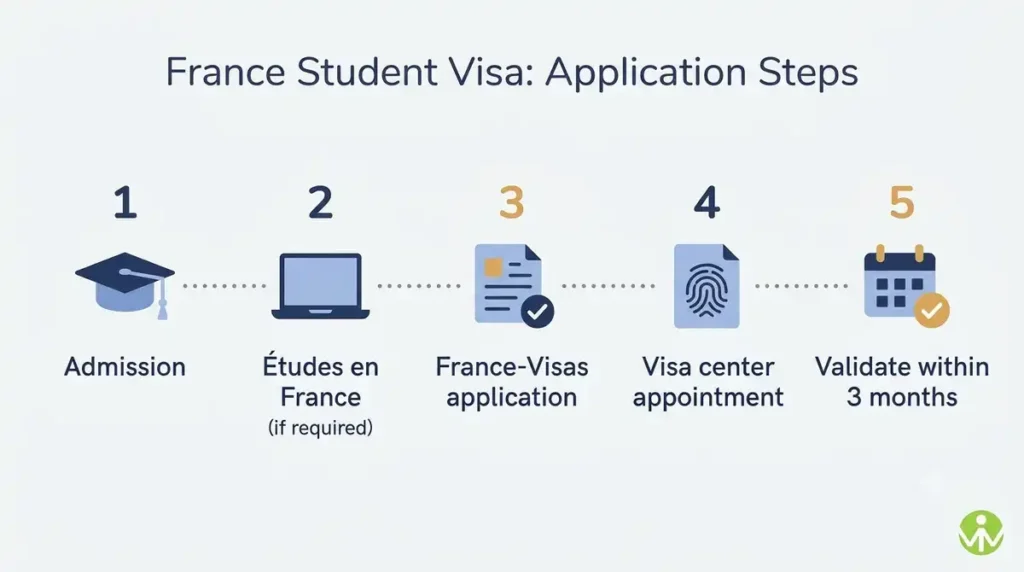
The France student visa process has up to three stages: admission, the Campus France procedure where it applies, and the visa application itself. Our general guide on how to apply for a visa explains the appointment and document steps that apply in most countries.
Step 1: Secure admission
Apply to your program first. First-year undergraduates follow Parcoursup or a preliminary admission request (DAP), depending on their situation, while master’s and doctoral candidates usually apply directly to the institution. Consulates need a final admission letter or enrollment certificate before they process the visa.
Step 2: Complete Études en France if your country uses it
Residents of more than 70 countries and territories, including Algeria, Brazil, China, India, Nigeria, Turkey, the UK, and the US, must use the Études en France platform, run by Campus France. The platform handles applications to institutions, a Campus France file review, and, in many countries, an interview. Campus France charges a processing fee that varies by country.
Once Campus France clears the file, apply for the visa on France-Visas. Applicants who complete Études en France pay the reduced €50 visa fee.
Step 3: Apply on France-Visas
Create an account on France-Visas, complete the long-stay application form, and upload digital copies of your documents where the service is available. Submit no earlier than three months before departure. Book the appointment as soon as your admission and funds are in place, since slots fill quickly before the September intake.
Step 4: Attend the appointment and wait for a decision
Go to the visa application center or consulate named on France-Visas, give your fingerprints and photo, and hand over the original documents. Processing times for a France student visa vary by consulate and season, so plan several weeks ahead. If the consulate gives no answer within two months, French law treats the silence as an implicit refusal, which you can challenge.
France student visa fees and costs
France-Visas sets the France student visa fee, and the rate depends on whether your country uses Études en France. Visa application centers add their own service charges, and long-stay students pay a validation tax after arrival. That tax rose on 1 May 2026, as Service-Public reports.
Convert the €50 student rate, the €99 standard fee, and the €100 validation tax into your currency before you budget.
Table 2: France student visa fees and taxes
| Item | Amount | Notes |
|---|---|---|
| Short-stay student visa (Schengen) | €90 | €45 for children aged 6 to 12 |
| Long-stay student visa, Études en France countries | €50 | Paid when you apply |
| Long-stay student visa, other countries | €99 | Paid when you apply |
| Visa application center service fee | Varies | Set by the provider, such as TLScontact or VFS Global |
| Études en France processing fee | Varies by country | Paid to Campus France |
| VLS-TS validation tax | €100 | Student reduced rate from 1 May 2026 (€50 before) |
| Multi-year student residence card | €150 | €100 tax plus €50 stamp duty |
| Student and campus life contribution (CVEC) | €105 | 2026–27 academic year, paid before enrollment |
| Amounts in force on 27 November 2026. Sources: France-Visas, Service-Public, and etudiant.gouv.fr. | ||
Tuition is separate and ranges from a few hundred euros to more than €10,000 a year, depending on the institution. Most students also pay the CVEC of €105 before enrolling, unless they hold a scholarship that exempts them.
After you arrive: validating your France student visa
A VLS-TS France student visa works as a residence permit only after you validate it. Validate it online on the ANEF portal, run by the Ministry of the Interior, within three months of arrival. Pay the €100 validation tax by electronic tax stamp, and keep the confirmation with your passport.
The VLS-T and short-stay student visas need no validation. Holders of the student-competition visa who pass their exam go straight to the prefecture for a student residence card.
Renewing after the first year
To stay beyond the VLS-TS, apply online for a student residence card in the two months before the visa expires. The prefecture issues a one-year card or a multi-year card valid for two to four years, matching the rest of your course. Renewal requires proof of enrollment, results that show real progress, and resources of at least €877.50 a month. The multi-year card costs €150.
Working on a France student visa
A VLS-TS étudiant lets you work up to 964 hours a year, about 60% of full-time working hours, without a separate work permit. Algerian nationals can work up to 50% of full-time hours. The VLS-T and short-stay visas do not allow work.
Treat part-time work as extra income rather than proof of funds. Consulates assess your resources before you arrive, and wages earned in France do not count toward that check.
Staying on after graduation
Graduates with a master’s-level degree from a French institution can apply for a one-year job-search or company-creation card. It allows work while they look for a job or set up a business, and it can lead to a work permit or a Talent residence permit. Our guide to the types of France visas describes those routes, and our guide on how to migrate to France covers longer-term settlement.
FAQ: France student visa
How much money do I need for a France student visa?
For applications filed from 1 August 2026, show at least €877.50 a month, or €10,530 for 12 months. The figure is 47% of the gross minimum wage, so it changes when the SMIC changes.
How much does a France student visa cost?
The long-stay visa costs €50 in Études en France countries and €99 elsewhere. After arrival, a VLS-TS holder also pays a €100 validation tax, and visa centers add a service fee.
Can I work in France on a student visa?
Yes, a VLS-TS étudiant allows up to 964 hours of work a year. The VLS-T and short-stay student visas do not allow work.
Do I need to go through Campus France for a France student visa?
Only if you live in a country or territory covered by the Études en France procedure. Other applicants apply to the institution directly and then submit the visa application on France-Visas.
How early can I apply for a France student visa?
Submit the long-stay application no earlier than three months before departure. Start the admission process and Campus France steps much earlier, since consulates are busiest before the September intake.
What is the difference between a VLS-TS and a VLS-T student visa?
A VLS-TS acts as a residence permit once validated, allows part-time work, and leads to a student residence card. A VLS-T covers a single stay of 4 to 12 months, requires no validation, and cannot be renewed or used to work.