
Foreign nationals can apply for German citizenship after five years of legal residence, provided they meet the language, income, and integration requirements in the Nationality Act (Staatsangehörigkeitsgesetz, StAG). Germany also passes citizenship to children of German parents and grants it at birth to some children of foreign residents.
Families who lost German citizenship through Nazi persecution can also reclaim it. Since 27 June 2024, most people who naturalise keep their previous nationality. This guide explains every route to German citizenship, what each requirement means in practice, what it costs, and what changed in 2024 and 2025.
Demand is at a record level. Germany naturalised 332,524 people in 2025, according to the Federal Statistical Office (Destatis). For the residence permits that come first, see our overview of the types of Germany visas.
Key Takeaways
- German citizenship by naturalisation normally needs five years of legal residence. The three-year fast track ended on 30 October 2025.
- Applicants need B1 German, a passed naturalisation test, a secure income, a clean record, and a qualifying residence permit.
- Spouses of German citizens can apply after three years of residence once the marriage has lasted two years.
- A child born in Germany is German at birth if one parent has lived there legally for five years and holds a permanent right of residence.
- Germany has accepted dual citizenship since 27 June 2024, so most applicants keep their current passport.
- The fee is €255 per adult and €51 for a child naturalised with a parent.
- German citizenship at a glance
- German citizenship requirements for naturalisation
- German citizenship for spouses and children
- German citizenship by birth in Germany
- German citizenship by descent and restoration
- Dual citizenship in Germany
- How to apply for German citizenship
- What changed, and what is under discussion
- German citizenship: frequently asked questions
- How long does it take to get German citizenship?
- Can I keep my current passport if I get German citizenship?
- What level of German do I need for German citizenship?
- Can I apply for German citizenship on a student or job-seeker permit?
- Is a child born in Germany automatically a German citizen?
- How much does German citizenship cost?
- Do I need permanent residency before applying for German citizenship?
German citizenship at a glance
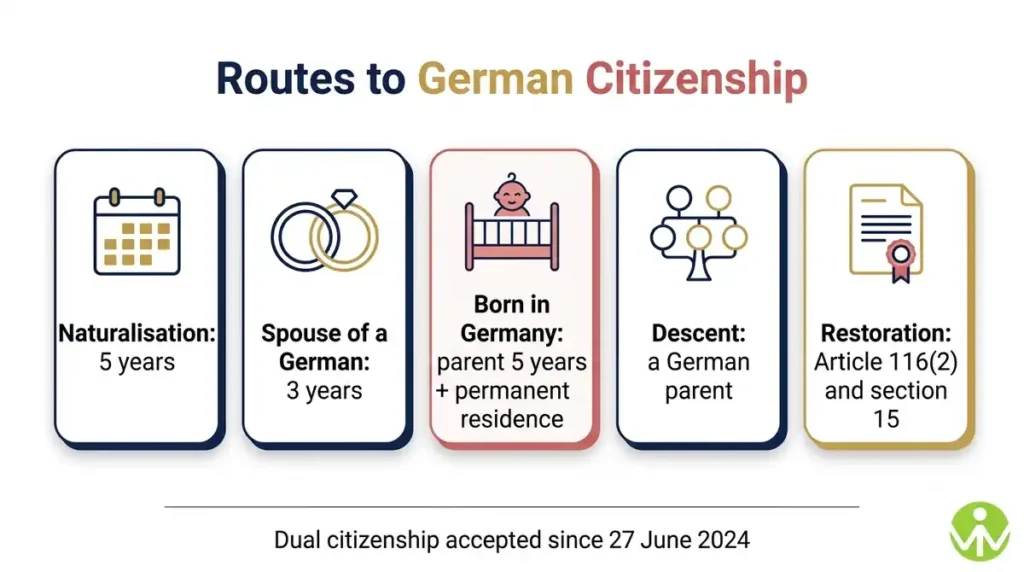
Germany grants citizenship through naturalisation, birth, descent, and restoration. The table compares the residence rule and main conditions for each German citizenship route.
Table 1: German citizenship routes compared
| Route | Who it suits | Residence needed | Main conditions | Legal basis |
|---|---|---|---|---|
| Standard naturalisation | Foreign residents with a qualifying permit | 5 years | B1 German, test, secure income, clean record, commitment to the Basic Law | Section 10 StAG |
| Spouse or registered partner of a German | People married to a German citizen for at least 2 years | 3 years | Same conditions as standard naturalisation | Section 9 StAG |
| Child naturalised with a parent | Minor children of an applicant | No fixed minimum | Applies with the parent; €51 fee | Sections 9 and 10 StAG |
| Birth in Germany | Children of foreign parents | Parent: 5 years plus a permanent right of residence | Automatic at birth | Section 4(3) StAG |
| Descent | Children of a German parent | None | Birth registration within 1 year if the German parent was born abroad after 1999 and lives abroad | Section 4(1) and (4) StAG |
| Restoration | Descendants of people persecuted from 1933 to 1945 | None | Loss of citizenship linked to Nazi persecution | Article 116(2) Basic Law; section 15 StAG |
| Source: Nationality Act (StAG) as last amended on 21 July 2026, and the Basic Law. Checked 27 November 2026. | ||||
German citizenship requirements for naturalisation
Most adults reach German citizenship through standard naturalisation under section 10 of the Nationality Act. Applicants who meet every condition have a legal right to naturalise. The Federal Government’s Make it in Germany naturalisation page lists the official requirements in English.
Five years of legal residence
The standard route requires five years of lawful, habitual residence in Germany. Habitual means Germany is the centre of your life, not a base for occasional visits.
Germany repealed the three-year fast track for exceptionally well-integrated applicants from 30 October 2025. Under section 10 of the Nationality Act, five years is now the minimum for anyone who is not married to a German.
A qualifying residence permit
When the authority decides, you need a permanent right of residence, an EU Blue Card, or a residence permit that can lead to settlement. A settlement permit qualifies, but you do not need one first. Our guides to permanent residency in Germany, the German work visa, and the EU Blue Card explain which permits lead there.
Permits for study, job seeking, and several humanitarian grounds do not qualify. Holders of a German student visa usually switch to a work or settlement permit before they apply.
German language at B1 level
Applicants must show German at level B1 of the Common European Framework of Reference (CEFR), usually with a recognised language certificate. A German school-leaving certificate, German vocational training, or a German degree generally counts as proof. Children under 16 need only age-appropriate German.
Former guest workers recruited before 1974, and former contract workers in East Germany, need only everyday spoken German. Illness, disability, or age can waive the language and knowledge requirements altogether.
The naturalisation test
Most adults must pass the naturalisation test (Einbürgerungstest): 33 multiple-choice questions, with 17 correct answers needed to pass. It costs €25 per attempt. A German school-leaving certificate exempts you, and a German degree in law, social sciences, political science, or public administration generally does too. Our German citizenship test guide covers the format, sample questions, and registration.
Supporting yourself and your family
You must support yourself and dependent family members without citizen’s allowance (Bürgergeld) or social assistance. The law makes three exceptions. Former guest workers and contract workers qualify if they are not responsible for needing benefits.
People who have worked full time for at least 20 of the last 24 months also qualify. So does their spouse or registered partner, if they live together with a minor child.
A clean criminal record
Minor convictions do not block German citizenship. The authority disregards fines of up to 90 daily rates and suspended prison sentences of up to three months that were later remitted. That rule does not apply when a court found an antisemitic, racist, or other inhumane motive.
Applicants must also list convictions and pending criminal cases abroad. The authority waits for any open investigation to conclude before deciding.
Commitment to the Basic Law
Applicants declare their commitment to the free democratic basic order of the Basic Law, in writing and orally. Since 2024, the declaration also covers Germany’s historical responsibility for Nazi injustice, including the protection of Jewish life. The authority also checks your identity and nationality, usually from a passport.
German citizenship for spouses and children
Spouses and registered partners of German citizens can apply after three years of lawful residence, once the marriage has lasted two years. All other requirements still apply, including B1 German and the test. The authority can shorten the residence period in the public interest once the marriage reaches three years.
Minor children can join a parent’s application even without three or five years in Germany. From age 16, children apply in their own name, and parents apply for younger children. A spouse who does not qualify alone may also join an eligible partner’s application, at the authority’s discretion.
Family members abroad first need a residence permit to join a resident in Germany. Our Germany dependent visa guide covers that step.
German citizenship by birth in Germany
A child born in Germany to foreign parents becomes German at birth if one parent has lived in Germany legally for five years. That parent must also hold a permanent right of residence on the date of birth. The registry office records the acquisition in the birth register.
Since 27 June 2024, these children no longer have to choose between German citizenship and their parents’ nationality as adults. A child who does not qualify at birth can naturalise later.
German citizenship by descent and restoration
A child with at least one German parent is German at birth, wherever the child is born. One limit applies abroad under section 4 of the Nationality Act. If the German parent was born abroad after 31 December 1999 and lives abroad, the child is German only if the birth is registered within one year.
Apply for registration through the German embassy or consulate. The time limit does not apply if the child would otherwise be stateless.
Germany also restores citizenship to people deprived of it on political, racial, or religious grounds between 30 January 1933 and 8 May 1945, and to their descendants. Article 116(2) of the Basic Law covers formal deprivation. Section 15 of the Nationality Act, in force since 20 August 2021, covers families who lost or never received citizenship because of persecution.
The Federal Office of Administration (BVA) handles applications from abroad, and both routes are free of charge. Applicants do not need to live in Germany first.
Dual citizenship in Germany
Germany has accepted multiple citizenship since 27 June 2024. People who naturalise keep their previous nationality, and Germans who acquire another citizenship keep their German one. The old retention permit (Beibehaltungsgenehmigung) no longer exists.
Whether you keep your original passport depends on your other country’s law, so check with its authorities first. Our list of countries that allow dual citizenship shows where conflicts can arise.
How to apply for German citizenship
Apply to the naturalisation authority (Einbürgerungsbehörde) where you live, usually part of the city or district administration. Book an advice session first if your authority offers one, because document lists vary by state and city.
A typical application includes a passport, residence permit, B1 certificate, test certificate, and proof of income. Applicants also sign the declaration of commitment and disclose any convictions or pending investigations, in Germany or abroad.
The authority runs security and criminal-record checks, then invites you to collect a naturalisation certificate (Einbürgerungsurkunde). German citizenship takes effect when you receive it. Processing times vary widely between authorities, and large cities report long backlogs.
The naturalisation fee is €255 per adult and €51 for a minor child naturalised with a parent. Authorities can reduce fees for low earners or large families, or agree instalments.
Table 2: German citizenship fees
| Item | Fee | Notes |
|---|---|---|
| Naturalisation, adult | €255 | Per person, including a spouse naturalised at the same time |
| Child naturalised with a parent | €51 | Minor with no income of their own |
| Child naturalised alone | €255 | Same fee as an adult |
| Naturalisation test | €25 | Per attempt |
| Certificate of citizenship (Staatsangehörigkeitsausweis) | €51 | Proof of citizenship for people who are already German |
| Restoration under Article 116(2) or section 15 | Free | Federal Office of Administration handles applications from abroad |
| Source: section 38 StAG and BAMF. Authorities can reduce or waive fees, or agree instalments, for hardship or public-interest reasons. Checked 27 November 2026. | ||
What changed, and what is under discussion
Germany reformed its citizenship law on 27 June 2024. The reform cut the standard residence period from eight years to five, accepted dual citizenship, and ended the option duty for children born in Germany. It also added a three-year fast track, which a 2025 amendment removed from 30 October 2025.
On 18 November 2026, media reports described a CDU/CSU parliamentary group proposal for eight years of residence, B2 German, and limits on dual citizenship. It is not a bill. The SPD, the coalition partner, has pointed to the coalition agreement, which kept the five-year rule.
Nothing has changed for applicants. Authorities decide German citizenship applications under the law in force, and we will update this guide if a bill advances.
German citizenship: frequently asked questions
How long does it take to get German citizenship?
Most applicants need five years of legal residence in Germany. Spouses of German citizens can apply after three years. Processing then takes several months or longer, depending on the authority.
Can I keep my current passport if I get German citizenship?
Germany has allowed dual citizenship since 27 June 2024, so you don’t have to give up your nationality. Your other country may still require you to renounce your citizenship, so check its rules first.
What level of German do I need for German citizenship?
You need B1 German, the CEFR intermediate level. Children under 16 need only age-appropriate German, and illness, disability, or age can lead to an exemption.
Can I apply for German citizenship on a student or job-seeker permit?
No. When the authority decides, you need a permanent right of residence, an EU Blue Card, or a permit that can lead to settlement. Study and job-seeker permits do not qualify.
Is a child born in Germany automatically a German citizen?
Only if one parent has lived in Germany legally for five years and holds a permanent right of residence on the date of birth. Otherwise, the child can naturalise later.
How much does German citizenship cost?
The naturalisation fee is €255 per adult and €51 per child naturalised with a parent. The naturalisation test costs €25, and restoration for descendants of persecuted Germans is free.
Do I need permanent residency before applying for German citizenship?
No. A settlement permit qualifies, but an EU Blue Card or another permit that can lead to settlement is also enough.