
A family-based green card lets a US citizen or a lawful permanent resident sponsor a close relative for permanent residence in the United States. It is the largest single source of new green cards. The route a relative takes depends on two things: the sponsor’s status and the family relationship.
Spouses, unmarried children under 21, and parents of adult US citizens face no annual cap. Other relatives join one of four preference queues, where waits range from months to more than two decades. This guide covers both routes, the forms, current government fees, the latest Visa Bulletin dates, and the rules that changed in 2026. For how the family route compares with work, investment, and lottery routes, see our US green card guide.
Key Takeaways
- A family-based green card starts with Form I-130, filed by a sponsor who is a US citizen or a permanent resident.
- Immediate relatives of US citizens (spouses, unmarried children under 21, and parents of citizens aged 21 or over) have no annual cap.
- Other relatives use the F1, F2A, F2B, F3, and F4 preference categories, which share at least 226,000 visas a year and queue by priority date.
- In the November 2026 Visa Bulletin, F2A has a final action date of 22 October 2026, while F4 for most countries sits at 22 October 2012.
- Core government fees are $675 for the I-130 on paper ($625 online), plus $1,440 for the I-485, or $680 in State Department and USCIS fees for consular processing.
- A stricter public charge rule applies to I-485 filings from 18 September 2026, and the travel ban no longer exempts immediate relatives.
- What a family-based green card is
- Family-based green card categories
- How long a family-based green card takes
- How to apply for a family-based green card
- Family-based green card fees
- Rules that changed for family-based green card applicants in 2026
- Conditional green cards for recent marriages
- Frequently asked questions about the family-based green card
- Who can sponsor a relative for a family-based green card?
- How long does a family-based green card take?
- Can a green card holder sponsor parents or siblings?
- How much does a family-based green card cost?
- Can my relative visit the United States while the family-based green card case is pending?
- Does the travel ban affect family-based green cards?
- What happens if my child turns 21 during the process?
What a family-based green card is
A family-based green card grants lawful permanent residence based on a family relationship rather than a job, an investment, or a lottery win. The sponsor, called the petitioner, must be a US citizen or a green card holder. The relative being sponsored is the beneficiary.
The petitioner’s status decides who can be sponsored. US citizens can sponsor a spouse and children of any age or marital status. Once they turn 21, they can also sponsor parents, brothers, and sisters. Permanent residents can sponsor only a spouse and unmarried children, never parents, married children, or siblings.
Grandparents, cousins, aunts, uncles, and in-laws have no family category of their own. A child born in the United States gives the parents no immediate status either, as our guide to US citizenship by birth explains. Our guide to who qualifies for a US green card covers eligibility across every route.
A family-based green card is an immigrant visa route, so it differs from temporary visits by relatives. For short stays, study, or work, see our overview of US visa types.
Family-based green card categories
The family-based green card route splits into two tracks with sharply different waits. Immediate relatives of US citizens are uncapped. Everyone else falls into a preference category with an annual limit and a queue.
Immediate relatives of US citizens
Three immigrant visa classes cover immediate relatives. IR-1 or CR-1 covers spouses, and IR-2 or CR-2 covers unmarried children under 21. IR-5 covers parents of citizens aged 21 or over. The CR prefix means conditional residence. It applies when a marriage is less than two years old on the day residence begins.
No annual cap applies, so immediate relatives never wait for a visa number. Their timeline depends only on processing at USCIS, the National Visa Center, and the consulate or USCIS field office.
Engaged couples follow a different path. The K-1 visa admits a fiancé(e) for 90 days to marry, after which the spouse applies to adjust status. Couples who can marry abroad often choose the CR-1 or IR-1 spouse visa instead, because the spouse arrives as a permanent resident.
Family preference categories
Four preference categories cover the remaining relationships. Together they receive at least 226,000 visas a year, and no country may receive more than 7% of the combined family and employment preference total. Family numbers that go unused fall across to the employment-based green card limit the following year.
Each case queues by its priority date, normally the date USCIS receives the I-130. Countries with heavy demand get their own columns in the Visa Bulletin, and applicants born there can wait much longer.
Table 1: Family-based green card categories at a glance
| Category | Who it covers | Sponsor | Annual limit |
|---|---|---|---|
| IR-1 / CR-1 | Spouse | US citizen | No limit |
| IR-2 / CR-2 | Unmarried child under 21 | US citizen | No limit |
| IR-5 | Parent | US citizen aged 21 or over | No limit |
| F1 | Unmarried son or daughter aged 21 or over | US citizen | 23,400, plus unused F4 numbers |
| F2A | Spouse or unmarried child under 21 | Permanent resident | About 77% of the F2 total |
| F2B | Unmarried son or daughter aged 21 or over | Permanent resident | Remainder of the F2 total |
| F3 | Married son or daughter | US citizen | 23,400, plus unused F1 and F2 numbers |
| F4 | Brother or sister | US citizen aged 21 or over | 65,000, plus unused numbers from F1 to F3 |
| F2 receives 114,200 visas a year plus unused F1 numbers. Family preference categories share a worldwide floor of 226,000 visas a year. Source: Immigration and Nationality Act sections 201 and 203. | |||
How long a family-based green card takes
For immediate relatives, the family-based green card wait is administrative. For preference relatives, it is mostly the queue, which the Department of State sets each month in the Visa Bulletin.
The bulletin publishes two charts. Final action dates show when a green card or immigrant visa can actually be approved. Dates for filing show when applicants can submit their paperwork early. USCIS announces each month which chart applies to adjustment of status, and for November 2026, it accepted the dates for filing chart for family cases.
A priority date earlier than the listed cutoff is current, and the case can move to final processing. The December 2026 bulletin had not been published when this guide was updated.
Table 2: Family final action dates in the November 2026 Visa Bulletin
| Category | All other areas | China | India | Mexico | Philippines |
|---|---|---|---|---|---|
| F1 | 22 Jan 2021 | 22 Jan 2021 | 22 Jan 2021 | 22 Sep 2008 | 1 Nov 2013 |
| F2A | 22 Oct 2026 | 22 Oct 2026 | 22 Oct 2026 | 22 Apr 2026 | 22 Oct 2026 |
| F2B | 22 Aug 2020 | 22 Aug 2020 | 22 Aug 2020 | 15 May 2010 | 1 Oct 2013 |
| F3 | 22 Oct 2015 | 22 Oct 2015 | 22 Oct 2015 | 15 Jul 2001 | 22 Jul 2006 |
| F4 | 22 Oct 2012 | 22 Oct 2012 | 15 Dec 2006 | 22 Apr 2001 | 15 May 2008 |
| Source: US Department of State Visa Bulletin for November 2026. Immediate relatives are not listed because no cutoff applies to them. Check the current bulletin before relying on these dates. | |||||
F2A covers spouses and minor children of permanent residents. It is now within weeks of real time and is current on the dates for filing chart. F4 is the slowest category. A sibling whose petition was filed in late 2012 is only now reaching the front of the worldwide queue. Siblings born in India face a December 2006 cutoff.
Final action dates can also move backwards when demand outpaces supply, a change known as retrogression. Check the current bulletin before planning travel, job moves, or school enrollment around an expected date.
How to apply for a family-based green card
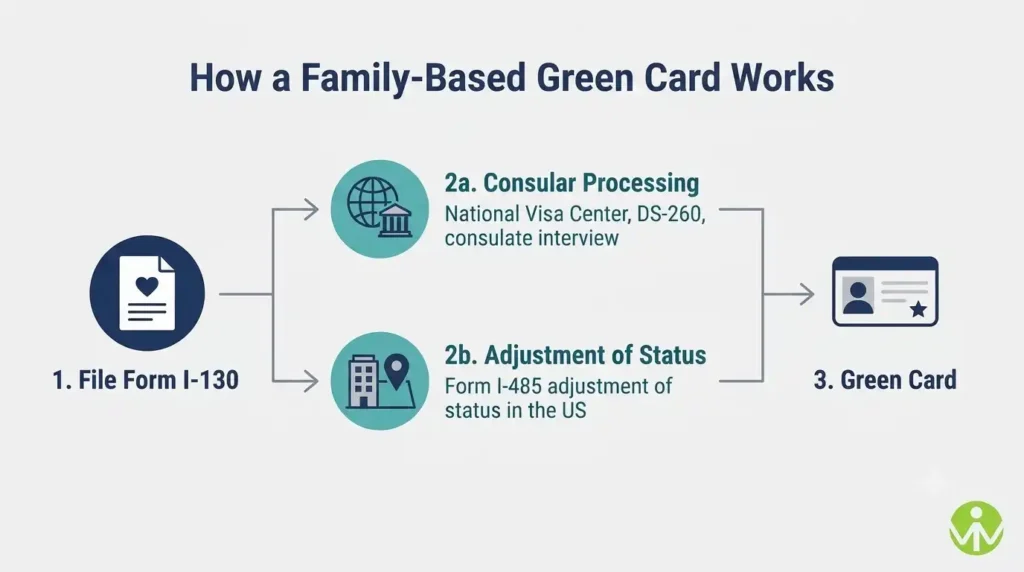
A family-based green card case moves through three stages: the petition, the visa or adjustment stage, and the final decision. The middle stage depends on where the relative lives.
Step 1: The sponsor files Form I-130
The petitioner files Form I-130, Petition for Alien Relative, with USCIS, together with proof of their own status and of the relationship. A spouse petition also needs Form I-130A for the beneficiary. Filing online through a USCIS account costs $50 less than filing on paper.
Typical evidence includes a birth or marriage certificate and proof of citizenship or a green card. Spouses also show the marriage is genuine, with joint leases, bank records, and photos. An approved I-130 establishes the relationship only. It gives the relative no status or right to live in the United States.
Step 2a: Consular processing through the National Visa Center
When the relative lives abroad, USCIS sends the approved petition to the National Visa Center (NVC). For preference cases, the NVC holds the file until the priority date is close to current.
The NVC then collects the fees, civil documents, and the Form I-864 affidavit of support. The beneficiary completes the DS-260 immigrant visa application, which also asks for social media identifiers, as our guide to US visa social media vetting explains.
Once the case is complete, the consulate schedules an interview, and the relative attends a medical exam with an approved panel physician beforehand. After approval, the relative pays the USCIS Immigrant Fee and becomes a permanent resident on entry. The family-based green card arrives by mail, and no Form I-485 is needed on this route.
Step 2b: Adjustment of status through Form I-485
Relatives already in the United States after a lawful entry may instead finish the family-based green card case by adjusting status on Form I-485. Immediate relatives can file the I-485 together with the I-130, which is known as concurrent filing.
Preference relatives can file only when their priority date is current on the chart USCIS designates for that month. Immediate relatives can usually adjust even if their status has lapsed, while preference relatives generally must have kept their status.
The I-485 package includes Form I-864, the medical exam record on Form I-693, and evidence of lawful entry. Applicants can also request a work permit and advance parole while the case is pending. USCIS may hold an interview before it approves the family-based green card.
The affidavit of support
Most family-based green card applicants need a sponsor who signs Form I-864, a contract with the US government. The petitioner must show household income of at least 125% of the federal poverty guidelines, or 100% for active-duty military sponsoring a spouse or child. A joint sponsor can cover a shortfall.
Officers then decide whether the relative is likely to become a public charge, weighing age, health, income, assets, education, and skills. The section on 2026 rule changes below explains how that test has tightened.
Family-based green card fees
Family-based green card fees depend on the processing route, and the linked amounts convert at current rates on xe.com. The petitioner pays the I-130 fee of $675 on paper or $625 online.
On the consular route, the NVC charges $325 per applicant for the immigrant visa application and $120 per case to review the affidavit of support. After the visa is issued, USCIS charges a $235 Immigrant Fee to produce the card.
On the adjustment route, the I-485 costs $1,440 for applicants aged 14 or over, and $950 for a child under 14 filing with a parent. An optional work permit adds $260, and advance parole adds $630.
Medical exams, translations, and police certificates cost extra and vary by country. The 16 October 2026 inflation adjustment raised some USCIS fees, but it left the I-130 and I-485 unchanged.
Table 3: Family-based green card government fees
| Fee | Paid to | Amount (USD) | When it applies |
|---|---|---|---|
| Form I-130 petition (paper) | USCIS | 675 | Every case, paid by the petitioner |
| Form I-130 petition (online) | USCIS | 625 | Every case, if filed online |
| Immigrant visa application (DS-260) | Department of State | 325 | Consular processing, per applicant |
| Affidavit of support review | Department of State | 120 | Consular processing, per case |
| USCIS Immigrant Fee | USCIS | 235 | Consular processing, after visa issue |
| Form I-485 (aged 14 or over) | USCIS | 1,440 | Adjustment of status |
| Form I-485 (under 14, filing with a parent) | USCIS | 950 | Adjustment of status |
| Form I-765 work permit | USCIS | 260 | Optional, with a pending I-485 |
| Form I-131 advance parole | USCIS | 630 | Optional, with a pending I-485 |
| Government fees as of November 2026. Form I-864 has no USCIS filing fee. Excludes medical exams, translations, police certificates, and legal fees. | |||
Rules that changed for family-based green card applicants in 2026
Three developments in 2026 changed who can complete a family-based green card case. Two tightened the rules, and one ended a pause. A 2025 policy on how USCIS counts a child’s age also still applies.
A stricter public charge rule and a bond pilot
A Department of Homeland Security final rule took effect on 18 September 2026. It rescinded the 2022 public charge regulations and gives officers broader discretion in adjustment of status cases. It applies to I-485 applications postmarked or submitted on or after that date, and USCIS rejects older editions of the form.
USCIS still judges benefits received before 18 September 2026 under the narrower 2022 standard. Refugees, asylees, and several other humanitarian categories remain exempt from the public charge ground.
Abroad, the Department of State began a public charge bond pilot on 5 August 2026. Consular officers may require certain applicants refused on public charge grounds to post a bond through USCIS to overcome the refusal. Applicants cannot ask for a bond themselves, and reported bond amounts reach $250,000.
The travel ban no longer exempts immediate relatives
Presidential Proclamation 10998 took effect on 1 January 2026. It suspends or limits visas for nationals of 39 countries and for holders of Palestinian Authority travel documents.
Unlike the June 2025 ban it replaced, it has no blanket exception for spouses, children, or parents of US citizens. It does not affect existing green card holders or visas issued before 1 January 2026. Our US travel ban guide lists the countries and the remaining exceptions.
The 75-country immigrant visa pause has ended
From 21 January 2026, the Department of State paused immigrant visa issuance for nationals of 75 countries, citing public charge concerns. Interviews continued, but consulates issued no visas to those nationals.
A federal court in New York vacated the pause. The Department of State confirmed that it is no longer in effect as of 21 August 2026. Relatives from those countries can again complete a family-based green card case at a consulate, unless the travel ban or another bar applies.
Children who turn 21 during the process
A child who turns 21 before the family-based green card is approved can age out of the category. The Child Status Protection Act (CSPA) can freeze or reduce a child’s age for this purpose.
For immediate relatives, the child’s age freezes on the I-130 filing date. For preference cases, the calculation depends on visa availability, and since 15 August 2025, USCIS has used only the final action dates chart. Our article on the stricter CSPA policy explains the change. A permanent resident’s child who ages out moves from F2A to F2B rather than losing eligibility.
Conditional green cards for recent marriages
When a marriage is less than two years old on the day a spouse receives a family-based green card, USCIS issues a two-year conditional card. A child who immigrates through the same marriage also receives one.
To remove the conditions, the couple files Form I-751 jointly in the 90 days before the card expires. A spouse who has divorced, or whose marriage involved abuse, can request a waiver of the joint filing requirement.
Spouses of US citizens can apply for naturalization after three years as permanent residents, rather than five, if they remain married and living together. Our guide to US dual citizenship covers what naturalization means for an existing nationality.
Frequently asked questions about the family-based green card
Who can sponsor a relative for a family-based green card?
US citizens can sponsor spouses, children, parents, and siblings, though they must be at least 21 to sponsor parents or siblings. Permanent residents can sponsor only spouses and unmarried children. The sponsor must also live in the United States, or show they will return, to sign the affidavit of support.
How long does a family-based green card take?
Immediate relatives wait only for processing, which varies by USCIS office, the NVC, and the consulate. Preference relatives also wait for their priority date to become current. That wait runs from a few months in F2A to more than 20 years for some F3 and F4 applicants.
Can a green card holder sponsor parents or siblings?
No. A permanent resident can sponsor only a spouse and unmarried children. To sponsor parents or siblings, the sponsor must first become a US citizen and be at least 21.
How much does a family-based green card cost?
Government fees for a consular case total $1,305 with an online I-130, or $1,355 on paper. An adjustment case costs $2,065 with an online I-130 and the $1,440 I-485, or $2,115 on paper. Medical exams, translations, and legal help cost extra.
Can my relative visit the United States while the family-based green card case is pending?
Possibly, but a pending petition makes a visitor visa harder to obtain. Consular officers can refuse a visitor visa when they believe the applicant intends to stay, and a family petition is evidence of that intent. Take advice before planning travel.
Does the travel ban affect family-based green cards?
Yes, for nationals of the 39 listed countries. Since 1 January 2026, Proclamation 10998 has had no exception for immediate relatives, so consulates cannot issue most immigrant visas to those nationals. A relative already in the United States may still apply to USCIS for adjustment of status.
What happens if my child turns 21 during the process?
The Child Status Protection Act may protect the child. For immediate relatives, the child’s age freezes when the I-130 is filed. In preference cases, a formula reduces the child’s age, and a permanent resident’s child who still ages out moves from F2A to F2B.