
The Startup Denmark visa is capped at a maximum of 75 permits a year, which is the first thing a founder comparing Denmark with Estonia, the Netherlands or Portugal ought to know, and the one figure most guides to the scheme leave out.
The Startup Denmark visa sets no minimum investment, no capital threshold, and no turnover target, which, on paper, makes it one of the most open founder routes in Europe. The gate sits somewhere else. An expert panel appointed by the Danish Business Authority must approve the business idea before the Danish Agency for International Recruitment and Integration (SIRI) will consider a residence application at all, and that panel is seeking something innovative and scalable rather than merely a viable small business.
This guide covers who qualifies, what the Startup Denmark visa costs in 2026, how the panel scores an application, what to do when it says no, and what the scheme asks of a founder two years later at extension. Every figure below was checked against nyidanmark.dk, the official Danish immigration portal on 2 September 2026.
Key Takeaways
- The Startup Denmark visa is capped at a maximum of 75 permits a year. SIRI does not publish how much of that quota is left at any point.
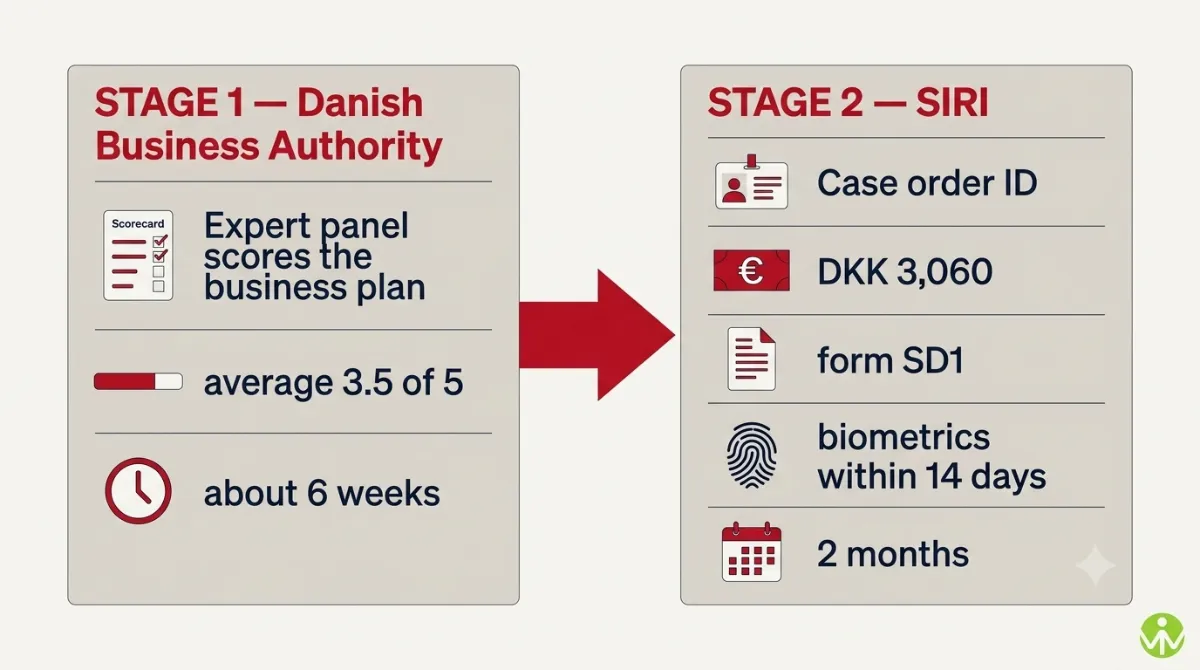
- There is no minimum investment. Approval rests on an expert panel’s assessment of the business idea, scored 1 to 5 on four criteria, with an average of at least 3.5 required.
- The Startup Denmark visa processing fee is DKK 3,060 in 2026 — and the same amount again at every extension.
- A single applicant must document DKK 153,240 in self-support funds, and more with a spouse or children.
- The permit runs for up to two years and extends in blocks of up to three years, but the expert panel re-evaluates the business each time.
- Restaurants, retail stores, smaller trade, and import and export businesses are excluded by design.
Table of Contents

What the Startup Denmark visa is
The Startup Denmark visa is not, strictly speaking, a visa. The scheme’s official name is Start-up Denmark, and what a successful applicant receives is a Danish residence and work permit issued on the strength of an approved business idea rather than a job offer.
Two authorities are involved, and they act in sequence. The Danish Business Authority appoints the panel that decides whether the business idea qualifies. SIRI then decides the immigration application. Neither substitutes for the other, and an application that skips the first stage goes nowhere.
Up to three people may apply as a team on a single shared business plan. Each team member is still assessed individually against the immigration conditions, and each one granted a permit counts against the annual quota.
The permit ties its holder to the approved business. It is not a general work permit, and it does not allow the holder to take a job elsewhere in the Danish labour market.
The Startup Denmark visa quota: only 75 permits a year
SIRI states plainly that a maximum of 75 foreign nationals can be granted a permit under the scheme per year. That number frames everything else on this page.
Seventy-five is a small number. A three-person founding team approved together uses three of the year’s places. Neither SIRI nor the Danish Business Authority publishes a running count, so an applicant has no way of telling from the outside how much of the quota remains when they submit. The practical consequence is that a strong application is a necessary condition and not a sufficient one, and a founder who has a realistic alternative should keep it open rather than treat Denmark as settled.
For comparison, Estonia’s startup visa and the Dutch scheme carry no annual cap at all, and Austria’s founder route is limited by a points threshold rather than a headcount. Denmark is unusual among European startup routes in this respect.
Who is eligible for the Startup Denmark visa
The eligibility conditions for the Startup Denmark visa are cumulative. All of them have to be met.
- You are a citizen of a country outside the EU, the EEA and Switzerland. Applications from EU citizens are screened out.
- Your business idea has been approved by the panel of experts appointed by the Danish Business Authority.
- The business is innovative and scalable. SIRI is explicit that a permit cannot be granted for a business, or a Danish branch of a business, without innovative potential, and names restaurants, retail stores, smaller trade, and import and export businesses as examples.
- You play an active part in running the business, and your presence is necessary for establishing or operating it. A passive shareholder does not qualify.
- You can support yourself, and any family accompanying you, for the duration of the stay.
- You apply on your own or as part of a team of no more than three people sharing one business plan.
Stage one of the Startup Denmark visa: getting the business idea approved
The business plan is submitted electronically through the expert panel’s own web portal, not through the immigration system. This is the stage that decides most applications, and it rewards being treated as a funding pitch rather than a form.
What the business plan must cover
The panel expects the submission to answer six things:
- The business pitch — what the product or service is, and how far it has been developed.
- Team competencies — evidence that the applicant, or the team, has the skills and resources to deliver the plan.
- Market analysis — the target customer, the existing competitors, the distribution model, price bands and the marketing approach.
- Why Denmark — a specific reason for building this business in Denmark rather than anywhere else.
- Initially planned activities — the first concrete steps after approval, and the budget set aside for them.
- Documentation — patents, funding, letters of intent and anything else that substantiates the claims above.
Format and the video pitch
The panel sets limits on file length. PowerPoint and image files may run to a maximum of 15 pages; Word files to a maximum of 10. Everything must be in English — an application in any other language is screened out before it reaches the panel.
A video pitch is required as well, and an application submitted without one is screened out. The video should address the innovation in the idea, where the company sits in its market, its scaling potential, and why this founder is the right person to build it. The panel does not publish a maximum length for the video, so the various durations quoted elsewhere online should be treated with caution and checked against the portal before recording.
How the expert panel scores a Startup Denmark visa application
The panel scores each application from 1 to 5 on four criteria. The threshold is an average of at least 3.5 across all four — not 3.5 on every one. The distinction matters, because it means a genuinely strong idea can carry a weaker team score.
Table 1 — Startup Denmark visa scoring criteria
| Criterion | What the panel is assessing | Score range |
|---|---|---|
| Innovation | How far the business model departs from what already exists | 1 to 5 |
| Market attractiveness | The commercial value of the idea and the size of the opportunity | 1 to 5 |
| Scalability | Whether the business can grow beyond its first market | 1 to 5 |
| Team competencies and resources | Whether the founder or team can actually deliver the plan | 1 to 5 |
| An average of at least 3.5 across all four criteria is required — not 3.5 on each criterion individually. Source: Start-up Denmark expert panel, verified 2 September 2026. | ||
If the panel screens out or rejects the application
Submissions are checked against the formal requirements before they reach the panel. An application screened out at this stage generates an email explaining why, and it can be corrected and resubmitted. The usual reasons are:
- the applicant is an EU citizen
- the application is not in English
- there is no video pitch
- the business model falls outside the scheme’s criteria
- the information given is not credible
An application that clears screening goes to the expert panel. If the panel rejects it, the applicant receives a written statement covering all four judging criteria. That statement is the most useful document in the whole process, because it says exactly where the idea fell short. From there the applicant can revise the plan and reapply, or appeal the evaluation to the Danish Business Authority.
The panel aims to evaluate a business plan within three weeks of submission, though applicants are told to expect around six weeks before being notified of the result.
Stage two of the Startup Denmark visa: the residence and work permit
Approval of the business idea is not a permit. The second stage is an immigration application to SIRI, and it runs like any other Danish work-permit application.
- Create a case order ID on nyidanmark.dk.
- Pay the processing fee of DKK 3,060.
- Complete and submit application form SD1 online.
- Have your biometric features recorded — photograph and fingerprints — no later than 14 days after submitting the application.
Biometrics are recorded at a Danish diplomatic mission abroad or, for applicants already in Denmark, at a SIRI branch office.
Documents required
Alongside the panel’s approval, a Startup Denmark visa application needs:
- scanned copies of every page of your current passport
- proof that the fee has been paid
- documentation of the funds you are relying on for self-support
- proof of your ownership of, and role in, the business
Startup Denmark visa fees and processing time
SIRI’s stated normal processing time for the residence application is two months, extending to four months where further information is needed. Taken together with the panel stage, a realistic end-to-end expectation is three to six months from first submission to decision.
Table 2 — Startup Denmark visa costs and timelines (2026)
| Item | Amount or period | Notes |
|---|---|---|
| Expert panel assessment of the business plan | No fee | Submitted through the panel’s web portal |
| Panel assessment time | About 6 weeks | The panel’s own target is 3 weeks |
| Residence and work permit processing fee | DKK 3,060 | Not refunded if the application is refused |
| Residence permit processing time | 2 months | Up to 4 months if further information is needed |
| Biometrics deadline | 14 days | Counted from submission of the application |
| First permit validity | Up to 2 years | Tied to the approved business |
| Extension fee | DKK 3,060 | Payable at every extension |
| Extension processing time | 4 months | Up to 5 months if further information is needed |
| Annual quota | 75 permits | Maximum granted under the scheme per year |
| Fees are 2026 rates from SIRI’s published fee schedule. Processing times are SIRI’s stated norms, not guarantees. Verified against nyidanmark.dk on 2 September 2026. | ||
Startup Denmark visa self-support amounts
An applicant has to document enough money to support themselves, and any accompanying family, without recourse to Danish public funds. The amounts are set by SIRI and adjusted periodically. The figures below are the ones SIRI currently publishes for this scheme.
Table 3 — Startup Denmark visa self-support amounts
| Who is coming to Denmark | Amount you must document |
|---|---|
| Applicant alone, no family | DKK 153,240 |
| Applicant and spouse | DKK 306,480 |
| Applicant, spouse and one or more children | DKK 356,904 |
| Applicant and one or more children, without a spouse | DKK 203,664 |
| Spouse joining after the permit has been granted | DKK 153,240 |
| Children joining after the permit has been granted | DKK 50,424 |
| Amounts as published by SIRI and labelled 2025 level; SIRI had not issued a 2026-level figure for this scheme as at 2 September 2026. Check nyidanmark.dk before relying on them. | |
Startup Denmark visa validity and extension
A first Startup Denmark visa permit is granted for up to two years. After that it can be extended for up to three years at a time, with no fixed limit on the number of extensions.
Extension is not a formality. To extend a Startup Denmark visa the holder must show that the business is still active, that they still play an active part in running it, and that they can still support themselves and their family. Critically, the panel of experts evaluates the company again before SIRI decides whether the conditions are still met, so a business that has drifted away from its approved plan, or has simply not moved beyond it, is exposed at this point.
Timing matters. An extension application has to be filed before the current permit expires, and can be filed no earlier than three months before it does. The fee is DKK 3,060 again, and SIRI’s normal processing time for an extension is four months, rising to five where more information is needed — which is why that three-month window is best used from its first day rather than its last.
Who the Startup Denmark visa is not for
Several kinds of applicant are better served elsewhere.
- EU, EEA and Swiss citizens, who can already live and work in Denmark without any of this.
- Anyone opening a restaurant, café, retail store, small trading business or import-export operation. These are named exclusions, not borderline cases.
- Passive investors. There is no investor route attached to this scheme, and a shareholder who takes no part in operations fails the active-participation condition.
- Founders who want the freedom to take a Danish job if the venture stalls. The permit is tied to the approved business; the employment-based schemes are what come with labour-market access.
- Anyone who needs certainty of timing. Between the panel stage, the immigration stage and the 75-permit cap, this is not a fast or predictable route.
How the Startup Denmark visa compares with other European routes
Among the endorsement-based European schemes, Denmark’s closest relative is Estonia. Both replace a capital test with an expert assessment, and both exclude consultancies and hospitality businesses. Austria goes the other way, asking founders for capital and a points score instead of a panel judgement. Outside Europe, Hong Kong’s entrepreneur route similarly turns on a business plan rather than a capital minimum, but sets no annual headcount cap. Our startup visa by country comparison sets out which schemes are open in 2026 and which have closed.
Within Denmark itself, the Startup Denmark visa sits alongside the employment-based routes covered in our guide to the types of visa to Denmark, and the study route covered in our Denmark student visa guide. Note that the EU Blue Card does not apply in Denmark, so a founder cannot fall back on it here.
Startup Denmark visa FAQ
How many Startup Denmark visas are granted each year?
A maximum of 75 foreign nationals can be granted a permit under the scheme in any year. The cap covers everyone approved under Start-up Denmark, so a founding team of three uses three of the places. SIRI does not publish how much of the quota remains at a given point in the year.
How much does the Startup Denmark visa cost?
The processing fee is DKK 3,060 in 2026, payable when the application is submitted and not refunded if it is refused. The same DKK 3,060 applies to each extension. The expert panel’s assessment of the business plan carries no separate fee.
Is there a minimum investment for the Startup Denmark visa?
No. Denmark sets no minimum capital, no investment threshold and no turnover requirement. What it asks instead is that an expert panel judges the business innovative and scalable, and that the applicant documents self-support funds — DKK 153,240 for a single applicant.
Can a team apply for the Startup Denmark visa together?
Yes. Up to three people can submit one shared business plan. Each of them still has to meet the immigration conditions individually, and each permit granted counts against the annual cap of 75.
What happens if the expert panel rejects the business idea?
The applicant receives a written statement addressing all four judging criteria. From there the options are to revise the plan and reapply, or to appeal the panel’s evaluation to the Danish Business Authority. A rejection at the earlier screening stage — for a missing video pitch, say, or an application not written in English — can simply be corrected and resubmitted.
How long does the Startup Denmark visa last, and can it be extended?
The first permit runs for up to two years and can then be extended for up to three years at a time. Extension requires the business to still be active, the holder to still be actively running it, and the expert panel to evaluate the company again. Apply before the current permit expires, and no earlier than three months beforehand.