
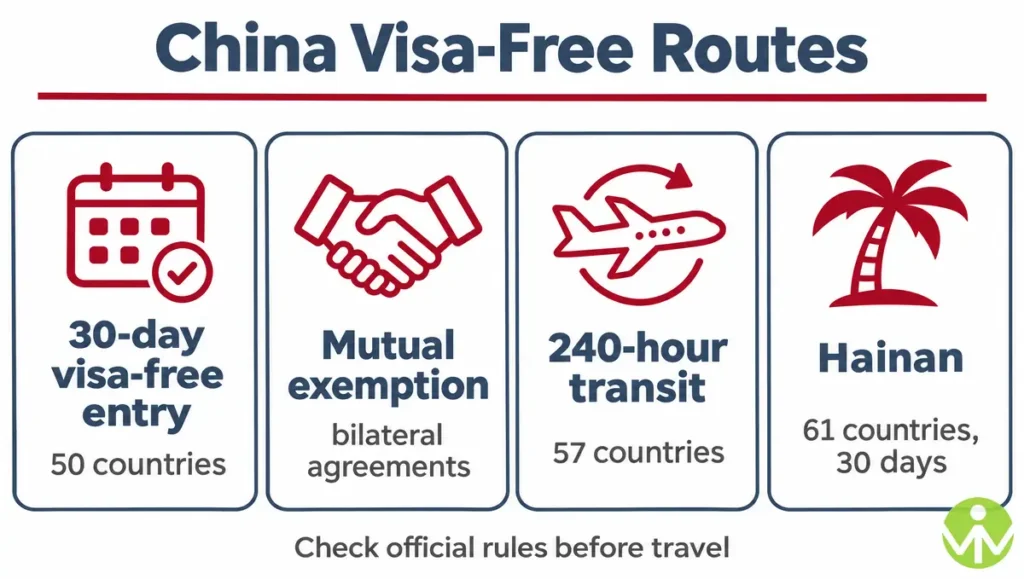
The types of China visas open to foreign nationals cover 13 ordinary categories, from the L tourist visa to the K visa for young science and technology talent, but many short trips now need no visa at all. China lets ordinary passport holders from 50 countries enter visa-free for up to 30 days, and citizens of 57 countries can use 240-hour visa-free transit.
This guide explains each visa-free route, the types of China visas by purpose, how to apply, and who can qualify for permanent residence. Most of China’s visa-free entry is temporary: the 30-day policy for 48 of those 50 countries runs until 31 December 2026, and China has not yet said whether it will continue.
Key Takeaways
- China lets ordinary passport holders from 50 countries, including the UK, Canada, Australia, France, Germany, Japan, and South Korea, enter visa-free for up to 30 days.
- For 48 of those countries, the policy ends at 24:00 Beijing time on 31 December 2026 unless China extends it; Russia’s arrangement runs to 31 December 2027.
- Citizens of 57 countries, including the United States, can stay up to 240 hours when transiting through China to a third country or region.
- The main types of China visa are L (tourism), M (business), F (exchanges), Z (work), R (high-level talent), K (young STEM talent), X (study), and Q and S (family).
- Long-stay types of China visa, such as Z, X1, Q1, and S1, require a residence permit within 30 days of arrival.
- Permanent residence is limited to seven categories, including investors, senior professionals, and spouses with five years of marriage and residence.
- Types of China Visa at a Glance
- Visa-Free Entry to China
- Short-Stay Types of China Visa
- Work Types of China Visa
- Study and Family Types of China Visa
- How to Apply for a China Visa
- China Permanent Residence
- Citizenship and Dual Nationality
- Hong Kong and Macao
- Choosing Between the Types of China Visa
- Frequently Asked Questions About Types of China Visa
- How many types of China visa are there?
- Which countries can enter China without a visa?
- Will China's visa-free policy continue after 31 December 2026?
- Which types of China visas allow work?
- What is the China K visa?
- How do I get permanent residence in China?
- Do I need a separate visa for Hong Kong and Macao?
Types of China Visa at a Glance
China’s Exit and Entry Administration Law divides visas into diplomatic, courtesy, official, and ordinary visas. Ordinary visas are the types of China visa most travellers need, and each carries a letter that matches the purpose of the trip. The table below lists the types of China visa by letter; the sections that follow explain each one.
Table 1: Types of China visa at a glance
| Visa | Purpose | Who it is for | Residence permit after arrival |
|---|---|---|---|
| C | Crew duties | Crew of international aircraft, trains, and ships, and accompanying family | No |
| D | Permanent residence | People approved for permanent residence | Permanent Residence ID Card |
| F | Exchanges and visits | Invited visitors on exchanges, study tours, and inspections | No |
| G | Transit | Travellers passing through China who cannot use visa-free transit | No |
| J1 and J2 | Journalism | J1 resident correspondents; J2 short reporting trips | J1 only |
| K | Young science and technology talent | Young STEM graduates, teachers, and researchers who meet official criteria | Varies |
| L | Tourism | Tourists and people visiting friends | No |
| M | Business and trade | Commercial visitors invited by a business in China | No |
| Q1 and Q2 | Family of Chinese citizens or permanent residents | Q1 stays over 180 days; Q2 visits of up to 180 days | Q1 only |
| R | High-level talent | Specialists whose skills China urgently needs | Varies |
| S1 and S2 | Private affairs | Relatives of foreigners working or studying in China; S1 over 180 days, S2 shorter | S1 only |
| X1 and X2 | Study | X1 study over 180 days; X2 study of up to 180 days | X1 only |
| Z | Work | People with an approved work permit | Yes |
| Source: Regulations on the Administration of the Entry and Exit of Foreigners (as amended from 1 October 2025) and National Immigration Administration. Checked 28 November 2026. | |||
Visa-Free Entry to China
Before applying for any of the types of China visa, check whether the trip qualifies for a visa-free route. There are five options, and each has its own conditions.
Table 2: China visa-free routes compared
| Route | Who qualifies | Maximum stay | Where | Valid until |
|---|---|---|---|---|
| Unilateral visa-free entry | Ordinary passport holders from 50 listed countries | 30 days | Whole mainland | 31 December 2026 for 48 countries; 31 December 2027 for Russia; Brunei on a separate arrangement |
| Mutual visa exemption | Passports covered by a bilateral agreement, such as Singapore, Thailand, and the UAE | Usually 30 days per entry; some agreements cap stays at 90 days in 180 | Whole mainland | No fixed end date |
| 240-hour visa-free transit | Citizens of 57 countries with a confirmed onward ticket to a third country or region | 240 hours (10 days) | Permitted areas of 24 provinces, entering through 65 ports | No end date announced |
| 24-hour visa-free transit | Nationals of any country with a confirmed onward ticket | 24 hours | Port restricted area, unless a temporary entry permit is issued | No end date announced |
| Hainan visa-free entry | Ordinary passport holders from 61 countries | 30 days | Hainan Province only | No end date announced |
| Sources: National Immigration Administration and Ministry of Foreign Affairs. Checked 28 November 2026. | ||||
China’s 30-Day Unilateral Visa-Free Policy
Under the unilateral policy, ordinary passport holders from 50 countries can enter China without a visa for business, tourism, visits to relatives and friends, exchanges, or transit, and stay for up to 30 days. The 30 days run from 00:00 on the day after entry. Work, study, and journalism are not covered; they need a visa from the types of China visa listed above.
The list has grown quickly. Sweden joined on 10 November 2025, and Canada and the United Kingdom joined on 17 February 2026 under a Ministry of Foreign Affairs announcement that runs until 31 December 2026. British travellers can compare China with other destinations in our list of visa-free countries for UK citizens.
Table 3: Countries on China’s unilateral visa-free list
| Region | Countries | Number | Valid until |
|---|---|---|---|
| Europe | Andorra, Austria, Belgium, Bulgaria, Croatia, Cyprus, Denmark, Estonia, Finland, France, Germany, Greece, Hungary, Iceland, Ireland, Italy, Latvia, Liechtenstein, Luxembourg, Malta, Monaco, Montenegro, the Netherlands, North Macedonia, Norway, Poland, Portugal, Romania, Slovakia, Slovenia, Spain, Sweden, Switzerland, and the United Kingdom | 34 | 31 December 2026 |
| Europe | Russia | 1 | 31 December 2027 |
| Oceania | Australia and New Zealand | 2 | 31 December 2026 |
| Asia | Bahrain, Japan, Kuwait, Oman, Saudi Arabia, and South Korea | 6 | 31 December 2026 |
| Asia | Brunei | 1 | Separate arrangement; not in the 2025 and 2026 extension notices |
| Americas | Argentina, Brazil, Canada, Chile, Peru, and Uruguay | 6 | 31 December 2026 |
| Sources: NIA list of countries covered by unilateral visa exemption policies (compiled 17 February 2026); MFA notices of 3 November 2025, 15 February 2026, and 20 May 2026. Checked 28 November 2026. | |||
What Happens After 31 December 2026?
For 48 countries, the unilateral policy expires at 24:00 Beijing time on 31 December 2026. On 17 November 2026, a Foreign Ministry spokesperson said China was assessing the policy, and Slovakia’s Foreign Ministry said on 10 November that China was ready to extend visa-free travel for Slovak citizens for another year. Until China publishes an official notice, travellers arriving on or after 1 January 2027 should not assume that visa-free entry continues.
Check with the nearest Chinese embassy or consulate before booking, and apply for an L or M visa, the usual short-stay types of China visa, if no extension has appeared. Russia’s arrangement already runs to 31 December 2027.
Mutual Visa Exemption Agreements
China also has standing mutual visa exemption agreements that cover ordinary passports. They include Singapore and Thailand (both since 2024), Kazakhstan, Georgia, Serbia, Qatar, and the United Arab Emirates. Most allow 30 days per entry, but some, including Thailand, Kazakhstan, and Georgia, cap total stays at 90 days in any 180-day period. The same agreement lets Chinese visitors enter Singapore visa-free, as our Singapore tourist visa guide notes. The National Immigration Administration publishes the full list of mutual visa exemption agreements.
240-Hour and 24-Hour Visa-Free Transit
Citizens of 57 countries, including the United States, the United Kingdom, and Russia, can stay up to 240 hours (10 days) without a visa when travelling through China to a third country or region. Travellers must enter through one of 65 designated ports, hold an onward ticket with a confirmed seat and date, and stay within the permitted areas of 24 provinces, autonomous regions, and municipalities. Kyrgyzstan and Vietnam joined on 20 August 2026.
Tourism, business, and family visits are allowed during transit, but work, study, and news reporting are not. The onward destination must differ from the origin: a Los Angeles to Shanghai to Seoul itinerary qualifies, while a return trip to Los Angeles does not. Every nationality can also use 24-hour visa-free transit at any open port, staying in the port’s restricted area unless border officers issue a temporary entry permit. The NIA transit page lists the eligible countries and ports. Travellers who need longer, or want to leave the permitted area, should apply for a visa instead; the types of China visa below cover most purposes.
US citizens are a common case. The United States is not on the 30-day list, so US visitors need a short-stay visa, usually the L visa, for a holiday but can use 240-hour transit, as our list of countries US citizens can visit without a visa explains.
Hainan Visa-Free Entry
Hainan Province runs its own scheme. Ordinary passport holders from 61 countries can enter Hainan without a visa and stay up to 30 days, but only within the province.
Short-Stay Types of China Visa
Travellers who do not qualify for visa-free entry, or who need more than 30 days, choose from the short-stay types of China visa below.
L Visa (Tourist Visa)
The L visa is the most widely used of the types of China visa. It covers tourism and visits to friends. Applicants usually provide a return or onward flight booking, hotel reservations or an itinerary, or an invitation letter from a host in China, along with a passport valid for at least six months with blank visa pages. Chinese missions issue single-entry, double-entry, and multiple-entry L visas; the stay per entry and the validity depend on the applicant’s nationality and the issuing mission.
Our step-by-step guide to the China tourist visa covers the application, and the general guide to applying for a tourist visa explains common document checks.
M Visa (Business Visa)
The M visa is for commercial and trade activities, such as meetings, negotiations, trade fairs, and site visits. Applicants need an invitation letter from a business in China that states the purpose, the dates, and who pays for the trip. Business travellers sometimes confuse the M visa with the Z visa, but the two types of China visa allow different activities: the M visa does not allow employment in China.
F Visa (Exchange Visa)
The F visa is the least known of the short-stay types of China visa. It covers non-commercial exchanges, visits, study tours, and inspections, such as academic conferences, cultural exchanges, or short lecture trips. Applicants need an invitation from the host organisation in China.
G and C Visas
Two other short-stay types of China visa are rarely needed. The G visa is for travellers passing through China who cannot use visa-free transit. The C visa is for crew members of international aircraft, trains, and ships on duty, and their accompanying family members.
Work Types of China Visa
Paid work in China needs a work permit and the matching visa. The work types of China visa range from the standard employer-sponsored Z visa to the newer K visa.
Z Visa and the Foreigner’s Work Permit
The Z visa is the standard work visa and the most common of the work types of China visa. The process starts with the employer, not the worker:
- The employer applies to the local foreign experts authority for a Notification Letter of Foreigner’s Work Permit.
- The worker uses the notification letter to apply for a Z visa at a Chinese embassy or consulate.
- After arriving, the worker completes the work permit and applies to the local exit-entry administration for a residence permit within 30 days.
The Ministry of Human Resources and Social Security oversees the system; it took over foreign experts management in 2023 and now carries the State Administration of Foreign Experts Affairs name. Since 1 December 2024, work permit details sit inside the holder’s social security card rather than on a separate physical permit.
China grades foreign workers into three categories: A (high-end talent, with no quota), B (professional talent, adjusted to market needs), and C (other foreign workers, limited by quota). Points for factors such as salary, education, work experience, Chinese language ability, and age decide the category. Our guide to applying for a work visa explains how employer sponsorship works in other countries.
R Visa (High-Level Talent)
Among the work types of China visa, the R visa is for high-level foreign talent and specialists whose skills China urgently needs. It usually requires confirmation of talent status from the relevant Chinese authorities, and holders typically qualify as Category A workers.
K Visa for Young Science and Technology Talent
The K visa is the newest of the types of China visa. It took effect on 1 October 2025, after the State Council amended China’s entry and exit regulations on 7 August 2025. It is for young foreign professionals in science, technology, engineering, and mathematics (STEM), such as graduates of well-known universities or research institutions and young teachers and researchers in these fields.
Unlike the Z visa, the K visa does not require an employer or an invitation from a Chinese organisation. Holders can take part in education, science, culture, entrepreneurship, and business exchanges, and the visa offers more flexible entry, validity, and stay terms than other ordinary visas. Embassies and consulates publish the detailed criteria and documents; our China K visa guide covers eligibility and the application steps.
Study and Family Types of China Visa
These types of China visa cover students, family members of Chinese citizens, and relatives of foreigners already living in China.
X1 and X2 Student Visas
Students use two types of China visa, chosen by course length. The X1 visa is for study programmes longer than 180 days, and the X2 visa is for programmes of 180 days or less. Applicants need an admission letter from the Chinese school and, for most programmes, a JW201 or JW202 form issued through the school. X1 holders must apply for a residence permit at the local exit-entry administration within 30 days of arrival; the residence permit, not the visa, then governs the stay. X2 holders stay within the period printed on the visa. See our China student visa guide for the documents list.
Q1 and Q2 Family Visas
Q visas are the family types of China visa for relatives of Chinese citizens and of foreigners with permanent residence in China. The Q1 visa covers family reunion, foster care, and stays longer than 180 days, and holders apply for a residence permit within 30 days of entry. The Q2 visa covers visits of up to 180 days.
S1 and S2 Private-Affairs Visas
S visas are the matching types of China visa for relatives of foreigners who work or study in China, such as spouses, parents, children under 18, and parents-in-law. The S1 visa covers stays longer than 180 days, with a residence permit needed within 30 days, while the S2 visa covers shorter visits and other private matters.
J1, J2, and D Visas
The J1 visa is for resident foreign journalists posted to China, and the J2 visa covers short reporting trips. The D visa is for people approved for permanent residence, who then collect a Foreigner’s Permanent Residence ID Card.
How to Apply for a China Visa
The process is broadly the same for all types of China visa:
- Check whether a visa-free route covers the trip, and confirm the right visa letter.
- Complete the online application form on the China Online Visa Application system, or the form the local mission specifies.
- Book an appointment and submit the passport, photo, and supporting documents at the Chinese embassy, consulate, or Chinese Visa Application Service Center that covers your place of residence.
- Give fingerprints if asked, pay the fee, and collect the passport once the visa is issued.
Standard processing typically takes about four working days, and most missions offer express and urgent services for an extra fee. Fees depend on nationality and the number of entries, and service centres add their own charge. Chinese missions have cut regular visa fees by about 25% from 2023 levels, and many have extended the reduction to 31 December 2026, as the Chinese missions in Australia confirm. Our guide on how to apply for a visa covers the documents most consulates expect.
Long-stay types of China visa, including Z, X1, Q1, S1, J1, and D, lead to a residence permit: holders must apply to the local exit-entry administration within 30 days of arrival. Every foreign visitor must also register their accommodation with local police within 24 hours of arrival. Hotels do this automatically, but people staying in a private home must register in person.
China Permanent Residence
The short-stay types of China visa do not lead to permanent residence. China’s Foreigner’s Permanent Residence ID Card, often called the China green card, is the most restrictive part of the system. The National Immigration Administration’s guidelines require applicants to obey Chinese law, be in good health, have no criminal record, and fit one of seven categories.
Table 4: China permanent residence eligibility
| Category | Main requirements |
|---|---|
| Investors | Direct, stable investment in China with good tax records for three consecutive years |
| Senior professionals and employees | Deputy general manager, deputy factory director, associate professor, or associate researcher level or above, or equivalent salary, for four consecutive years, with at least three years’ residence in China in that time and good tax records |
| Special contributors | Significant, outstanding contributions to China, or skills China especially needs |
| Dependants of the categories above | Spouse and unmarried children under 18 |
| Spouses | Married to a Chinese citizen or permanent resident for at least five years, with five consecutive years’ residence in China of at least nine months a year, and stable income and housing |
| Minor children | Unmarried, under 18, and dependent on a parent in China |
| Older relatives | Aged 60 or over, with no direct relatives abroad, living with a direct relative in China for five consecutive years of at least nine months a year, with stable income and housing |
| Source: National Immigration Administration, Guidelines for Approval of Foreign Nationals’ Eligibility for Permanent Residence in China. Checked 28 November 2026. | |
Applications go to the exit-entry office of the city public security bureau where the applicant invests or lives long-term, and the NIA gives final approval. A decision is due within six months of acceptance. The application fee is CNY 1,500, plus CNY 300 for the card.
The card is valid for 10 years, or five years for applicants under 18. Holders must normally spend at least three months a year in China and at least one year in any five-year period; otherwise, the NIA can cancel the status.
Citizenship and Dual Nationality
Naturalisation in China is rare, and China does not recognise dual nationality. Chinese nationals who settle abroad and take another nationality lose Chinese nationality automatically, and foreigners who naturalise in China cannot keep their previous nationality. Our list of countries that allow dual citizenship shows how other countries compare.
The Chinese passport itself opens fewer doors than China’s inbound policy might suggest, a gap our analysis of rich countries with weak passports explores. Our passport rankings show where it stands today.
Hong Kong and Macao
Hong Kong and Macao are Special Administrative Regions with their own immigration systems. The mainland types of China visa do not cover them, and their visa-free rules differ from the mainland’s. Travellers continuing to the mainland from either region need a mainland visa or a visa-free route. Founders looking at Hong Kong can read our Hong Kong startup visa guide.
Choosing Between the Types of China Visa
Start with purpose and length. A holiday or short business trip of up to 30 days may need no visa if the passport is on the unilateral or mutual list, and travellers passing through can often use 240-hour transit. Longer or repeated visits need an L, M, or F visa. Paid work needs a Z visa, or an R visa for recognised high-level talent, while young STEM professionals without an employer can consider the K visa.
Students choose X1 or X2 by course length, and family members choose Q or S visas, depending on whether their relative is a Chinese citizen or a foreign resident. Whichever of the types of China visa applies, check the latest rules with the National Immigration Administration or the nearest Chinese mission before travelling, especially for trips after 31 December 2026.
Frequently Asked Questions About Types of China Visa
How many types of China visa are there?
China issues diplomatic, courtesy, official, and ordinary visas. Ordinary visas, the types of China visa most travellers use, come in 13 lettered categories: C, D, F, G, J, K, L, M, Q, R, S, X, and Z. Several are split into two subtypes, such as X1 and X2.
Which countries can enter China without a visa?
Ordinary passport holders from 50 countries, including the UK, Canada, Australia, most EU states, Japan, and South Korea, can stay up to 30 days under the unilateral policy. Citizens of countries with mutual exemption agreements, such as Singapore and Thailand, can also enter visa-free. US citizens need a visa for a standard visit but can use the 240-hour transit policy.
Will China’s visa-free policy continue after 31 December 2026?
It is not confirmed. For 48 countries, the policy ends at 24:00 Beijing time on 31 December 2026, and as of 28 November 2026, China had said only that it was assessing the policy. Russia’s arrangement runs to 31 December 2027.
Which types of China visas allow work?
The Z visa is the standard work visa, and the R visa covers recognised high-level talent. Both require a work permit and, after arrival, a residence permit. Visa-free entry, L visas, and M visas do not allow paid work.
What is the China K visa?
The K visa is for young foreign STEM professionals and took effect on 1 October 2025. It does not require an employer or an invitation from a Chinese organisation, and it offers more flexible entry and stay terms than other ordinary visas.
How do I get permanent residence in China?
Only applicants in seven categories can apply, including investors with three years of stable investment, senior professionals with four years of work, and spouses married for five years who have lived in China for five consecutive years. A decision is due within six months, and the application fee is CNY 1,500.
Do I need a separate visa for Hong Kong and Macao?
Hong Kong and Macao set their own entry rules, and a mainland China visa does not cover them. Check each region’s immigration department before travelling.