
The Portugal D2 visa is the residence visa for people who want to work for themselves in Portugal, either as independent professionals or as entrepreneurs who set up or move a business there. Portugal’s Ministry of Foreign Affairs issues it through its consulates, and AIMA, the Agency for Integration, Migration and Asylum, turns it into a residence permit after you arrive.
The route sets no minimum investment. Instead, applicants must show a genuine activity, enough money to live on, and a place to stay. This guide covers who the Portugal D2 visa suits, how it relates to the StartUP Visa, the requirements and documents, the 2026 fees, and the path from a first permit to permanent residence and citizenship. Our guide to the types of Portugal visas sets the D2 visa apart from every other route.
Key Takeaways
- The Portugal D2 visa covers independent professionals, immigrant entrepreneurs, and founders admitted to the StartUP Visa program.
- No minimum investment applies. Consulates assess the activity and your means of subsistence, which are based on the 2026 minimum wage of €920 a month.
- The national visa fee is €110. AIMA then charges €133.00 to review the permit application and €114.30 to grant the permit.
- The visa is valid for four months and two entries. The first residence permit runs for two years and renews for three.
- Permanent residence is available after five years. Citizenship now takes ten years of legal residence, or seven for EU and CPLP nationals.
- What the Portugal D2 visa is
- The Portugal D2 visa and the StartUP Visa
- Portugal D2 visa requirements
- Documents for a Portugal D2 visa application
- How to apply for the Portugal D2 visa
- Portugal D2 visa fees in 2026
- The residence permit and renewals
- Bringing family on a Portugal D2 visa
- From a Portugal D2 visa to permanent residence and citizenship
- Frequently asked questions about the Portugal D2 visa
What the Portugal D2 visa is
The D2 label is a consular checklist code rather than a legal name. The Ministry of Foreign Affairs lists the Portugal D2 visa as the residence visa for independent professional activity or for immigrant entrepreneurs, and the same category covers the StartUP Visa program. Article 60 of the Foreigners Law (Law 23/2007) sets out the visa, and Article 89 governs the residence permit that follows.
Three groups use the Portugal D2 visa:
- Independent professionals, such as consultants, designers, and developers, who work under a service contract or through a company of their own
- Immigrant entrepreneurs who have made, or plan to make, an investment in a Portuguese business
- Founders accepted into the StartUP Visa program through a certified incubator
The D2 is not a route for passive income or for remote work for foreign employers. Pensioners and people living on rent or dividends use the D7 passive income visa, and people working remotely for employers or clients outside Portugal use the digital nomad visa. The D2 suits activity carried on in Portugal: a client base, a company, or an investment there.
The Portugal D2 visa and the StartUP Visa
Many guides treat the D2 and the StartUP Visa as one visa, but they are not the same thing. The StartUP Visa is a program that IAPMEI, Portugal’s Agency for Competitiveness and Innovation, runs under Normative Order 4/2018. Founders apply to IAPMEI first and sign an incubation contract with a certified incubator. They then apply for the Portugal D2 visa, using IAPMEI’s declaration as their specific document.
In other words, the StartUP Visa is a way into the D2 category, not a separate visa. Freelancers, established business owners, and investors who don’t want incubation apply for the Portugal D2 visa directly. The entrepreneur section of our Portugal visa guide explains the StartUP Visa program, and our startup visa by country comparison sets it beside schemes elsewhere. Founders weighing Spain can compare the Spain entrepreneur visa, which relies on an ENISA report on the business plan.
Table 1: Portugal D2 visa tracks compared
| Track | Who it suits | Specific document | How funds are assessed |
|---|---|---|---|
| Independent professional | Freelancers and liberal professions | Company contract or written service proposal; professional registration if the profession is regulated | Means can come from the service contract and should cover the permitted stay |
| Immigrant entrepreneur | People investing in or setting up a Portuguese business | Declaration of the investment (nature, value, and duration) and proof it was made, or proof of funds in Portugal and a described investment plan | At least 12 months of means of subsistence |
| StartUP Visa | Founders of innovative, scalable startups | IAPMEI declaration of an incubation contract with a certified incubator | Set by the consulate; check the program terms with IAPMEI |
| Source: Ministry of Foreign Affairs residence visa checklist and means of subsistence guidance, checked 28 November 2026. | |||
Portugal D2 visa requirements
Every applicant must meet the general conditions for a residence visa and then add the documents for their track. The consulate checks that the activity is real and that you can support yourself while it grows.
Means of subsistence for a Portugal D2 visa
Means of subsistence follow the Portuguese minimum wage, which is €920 a month in 2026. The main applicant needs 100 percent of that amount, a second adult needs 50 percent, and each child under 18 or dependent adult child needs 30 percent.
The period you must cover depends on the track. For investment purposes, the Ministry of Foreign Affairs asks for at least 12 months of means, or €11,040 for a single applicant. For independent work, the means should cover the permitted stay and can come from a service contract.
Consulates apply this rule differently. The London consulate’s checklist asks for three months of bank statements showing at least €920, while many posts expect the full 12-month amount, sometimes held in a Portuguese bank. Check the checklist of the consulate or visa center that serves your country of residence before you apply.
Accommodation
Proof of housing can be a property deed in your name, a lease registered with the Portuguese tax authority, or a signed term of responsibility from a host. The London consulate asks for a lease of at least 12 months, so check the minimum term your consulate accepts.
Criminal record, insurance, and passport
Applicants aged 16 and over need a criminal record certificate from their country of origin, or from any country where they have lived for more than a year, with an apostille where applicable. Travel insurance must cover medical expenses, urgent care, and repatriation. Your passport must remain valid for at least three months beyond the planned stay.
Nationals of CPLP countries, such as Brazil, Angola, and Cabo Verde, follow a separate CPLP checklist that drops some of these items.
Documents for a Portugal D2 visa application
Prepare the general documents first, then the specific documents for your track. Most consulates expect:
- A completed and signed national visa application form
- Two recent, identical passport photos
- A passport valid for three months beyond the planned stay, plus a copy of its biographical page
- Proof of legal status in the country where you apply, if you are not a national of it
- Travel insurance covering medical care and repatriation
- A criminal record certificate, apostilled or legalized
- Proof of means of subsistence and of accommodation in Portugal
Independent professionals then add their service contract or company documents, and entrepreneurs add the investment declaration and proof of funds. StartUP Visa founders add the IAPMEI declaration. The Ministry of Foreign Affairs residence visa checklist lists every item for the Portugal D2 visa.
Most applicants obtain a Portuguese tax number (NIF) before applying, because registering a lease and opening a Portuguese bank account both require one. After arrival, AIMA also asks for proof that you have registered the activity with the tax authority and Social Security.
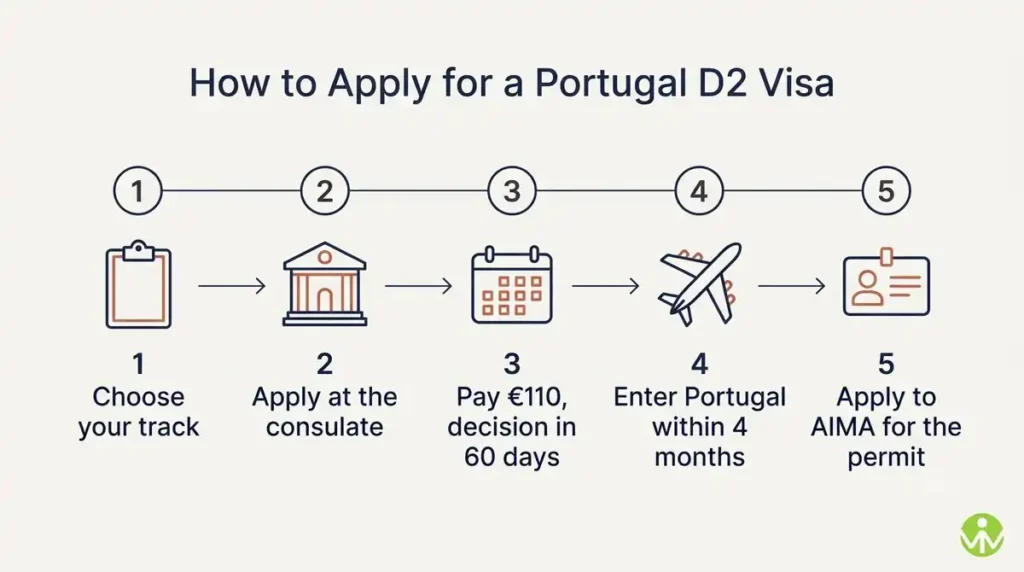
How to apply for the Portugal D2 visa
The Portugal D2 visa works in two stages: a consular visa abroad, then a residence permit from AIMA in Portugal.
- Choose your track and prepare the business plan, service contract, or IAPMEI declaration.
- Book an appointment at the Portuguese consulate or visa center that serves your country of residence, and lodge the application in person.
- Pay the €110 visa fee. The consulate has 60 days to decide on a residence visa.
- Collect the visa, which is valid for four months and two entries, and travel to Portugal.
- Attend an AIMA appointment within those four months to apply for the residence permit and give your biometrics.
If the consulate refuses the visa, you can file an administrative appeal for a €75 fee, and the consulate does not refund the original visa fee. AIMA has faced long appointment backlogs since it replaced SEF in October 2023, so book the residence permit appointment early and keep proof of every submission.
Portugal D2 visa fees in 2026
The consular fee is €110 per applicant for every national visa, after Portaria 91/2025 raised it from €90. Children under 6 pay nothing. AIMA’s fees come on top, and AIMA updates its table every March.
Table 2: Portugal D2 visa and residence permit fees
| Fee | Amount | Paid to |
|---|---|---|
| National residence visa (D2) | €110 | Portuguese consulate |
| Administrative appeal against a visa refusal | €75 | Ministry of Foreign Affairs |
| Review of the residence permit application | €133.00 | AIMA |
| Grant or renewal of the temporary residence permit | €114.30 | AIMA |
| AIMA amounts are in-person rates from the table in force since 1 March 2026; AIMA applies a 25% reduction where a procedure is available online. Visa centers add their own service charges. | ||
A single applicant therefore pays about €357.30 in government fees in the first year: €110 to the consulate, plus €133.00 and €114.30 to AIMA. Visa center charges, translations, and apostilles come on top. Our guide to Portugal permanent residency covers the AIMA fees that apply later.
The residence permit and renewals
AIMA issues a temporary residence permit for professional activity, which is valid for two years from issue and renewable for successive three-year periods. At renewal, you need to show that the activity continues and that you still meet the original conditions. A holder can also take salaried work by asking AIMA to replace the permit.
The permit lets you live in Portugal and visit other Schengen countries for up to 90 days in any 180-day period. Our Schengen visa guide explains how that rule works.
Bringing family on a Portugal D2 visa
The Portugal D2 visa covers only the main applicant. A spouse or partner, minor or dependent children, and dependent parents join through family reunification, which the resident starts with AIMA.
Since 23 October 2025, Law 61/2025 generally requires the sponsor to have held legal residence for two years before applying. The wait does not apply to spouses or partners with minor or dependent children in their care, and every sponsor must still show housing and stable means. Our family reunification section explains the rules in full.
From a Portugal D2 visa to permanent residence and citizenship
Time on a D2 permit counts toward permanent residence, which AIMA grants after five years of temporary residence if you meet its conditions, including A2-level Portuguese. Our Portugal permanent residency guide covers the requirements and absence limits.
Citizenship takes longer since 2026. Under Organic Law 1/2026, in force since 19 May 2026, naturalization requires ten years of legal residence, or seven for EU and CPLP nationals, counted from the issue of the first residence permit. Applications filed before that date continue under the old five-year rule. Check whether your current country allows dual citizenship before you plan for a Portuguese passport.
Table 3: Portugal D2 visa timeline to citizenship
| Stage | Typical point | What happens |
|---|---|---|
| D2 visa | Month 0 | Consulate issues a four-month, two-entry visa |
| First residence permit | Within four months of entry | AIMA issues a two-year permit |
| First renewal | Year 2 | Permit renewed for three years |
| Permanent residence | Year 5 | Apply to AIMA if you meet the conditions |
| Citizenship | Year 10 (year 7 for EU and CPLP nationals) | Counted from the issue of the first residence permit |
| AIMA processing times can push each stage later. Rules checked 28 November 2026. | ||
Frequently asked questions about the Portugal D2 visa
Is there a minimum investment for the Portugal D2 visa?
No. The law sets no minimum investment. Consulates assess whether the activity is genuine and whether you have enough means of subsistence, based on the €920 monthly minimum wage in 2026.
How much money do I need for a Portugal D2 visa?
For investment-based applications, the Ministry of Foreign Affairs asks for at least 12 months of means: €11,040 for a single applicant in 2026, plus 50 percent for a second adult and 30 percent for each child. Some consulates ask freelancers for less when a service contract covers their income, so check your consulate’s checklist.
Is the Portugal D2 visa the same as the StartUP Visa?
No. The StartUP Visa is an IAPMEI program for founders accepted by a certified incubator. Its participants apply for the D2 category with an IAPMEI declaration, while freelancers and other entrepreneurs apply for the D2 without one.
How long does a Portugal D2 visa take?
The consulate has 60 days to decide on a residence visa. The visa then gives you four months to enter Portugal and apply to AIMA for the residence permit, which can take longer to issue.
Can my family come with me on a Portugal D2 visa?
Not on the same visa. Family members join through family reunification, and since October 2025, most sponsors must hold residence for two years first unless an exemption applies.
Does the Portugal D2 visa lead to citizenship?
Yes, but not directly. A D2 permit leads to permanent residence after five years, and naturalization is available after ten years of legal residence, or seven for EU and CPLP nationals.